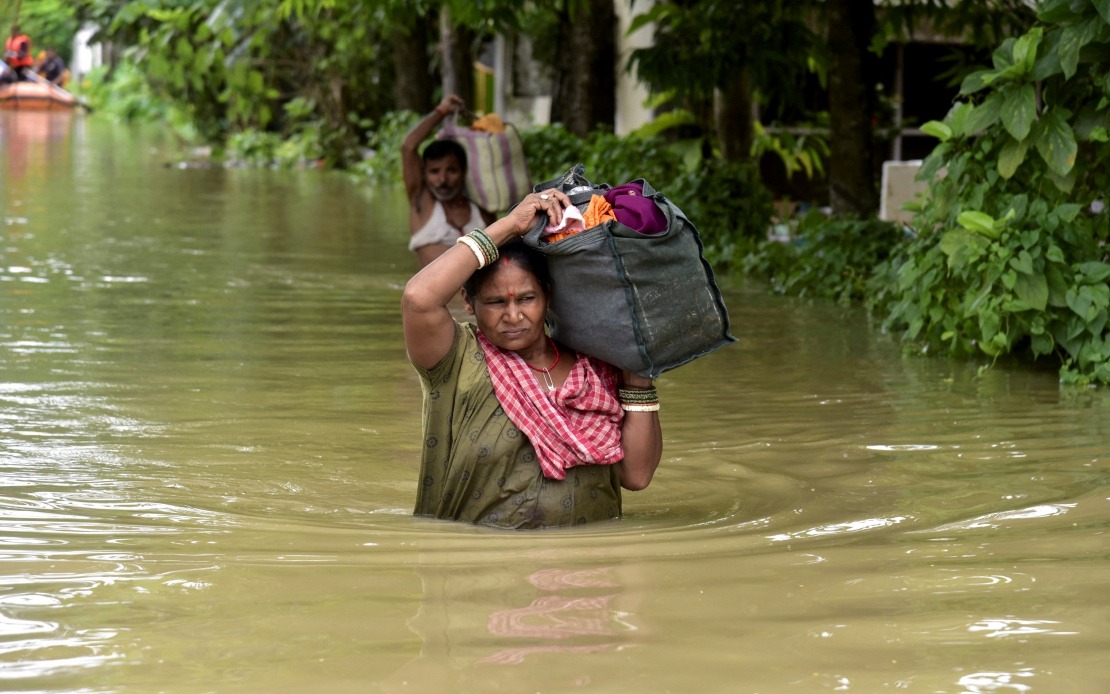
A catastrophic monsoon flooding event in India's northeastern state of Assam has turned into one of the season's most severe humanitarian emergencies, with the official death toll reaching 62 people as of late July, while eight others remain missing and unaccounted for. Chief Minister Himanta Biswa Sarma confirmed that the deluge has impacted a staggering population exceeding 1.1 million residents, creating a large-scale displacement crisis that has overwhelmed local administrative capacity across the region.
The geographical scope of the disaster underscores its severity. Flooding has inundated communities across 25 of Assam's administrative districts, affecting a vast portion of the state's territory. According to reports from state authorities, approximately 2,101 villages have been submerged under floodwaters, effectively cutting off entire communities from essential services and normal economic activity. This widespread submersion represents not merely an immediate threat to life but also a profound disruption to agricultural systems, infrastructure, and social cohesion in one of India's most flood-prone regions.
The agricultural impact has been particularly damaging to a state whose economy depends significantly on farming and cultivation. The Assam State Disaster Management Authority documented that 56,606 hectares of cropland—an enormous expanse of productive agricultural land—remains underwater. For a state already grappling with economic challenges, this destruction threatens food security and rural livelihoods, potentially creating secondary waves of hardship as farmers confront crop losses and reduced income for months or years ahead.
Water management authorities have sounded increasingly dire warnings about river levels. The Central Water Commission reported that multiple tributaries feeding into the Brahmaputra River, Assam's lifeline, are flowing significantly above danger thresholds. This persistently elevated water situation suggests that relief may not come swiftly, and communities in downstream areas face continuing risks of further inundation as water volumes remain dangerously high.
Government response mechanisms have been mobilized extensively, though the scale of the crisis tests their capacity. State authorities have established 170 dedicated relief camps and opened 1,304 relief distribution centres strategically positioned across the affected districts. These installations have thus far provided emergency food and shelter to approximately 45,004 individuals, though this figure represents only a fraction of those displaced and in need. The disparity between those assisted and total affected populations highlights the magnitude of logistical challenges facing administrators attempting to deliver aid across sprawling rural and semi-urban areas.
Rescue and relief operations have been significantly ramped up by local administration, with personnel deployed to conduct search and recovery missions while simultaneously attempting to restore basic services to stranded populations. These coordinated efforts span all 25 affected districts, requiring sustained resource allocation and personnel deployment across challenging terrain where flooding has damaged road networks and communication infrastructure. The operational complexity increases given the geographic spread and the rural character of many affected areas, where reaching isolated pockets of survivors demands substantial logistical effort.
For Malaysian readers and Southeast Asian observers, this Assam crisis offers sobering reminders about the region's shared vulnerability to monsoon-driven weather extremes. India's northeastern states, like many areas across Malaysia, Bangladesh, Thailand, and Indonesia, face recurring seasonal flooding that increasingly threatens expanding urban settlements and agricultural zones. The Brahmaputra's behavior—with tributaries overflowing danger levels—mirrors patterns seen in major Southeast Asian river systems where population growth upstream and land-use changes have amplified flood risks beyond historical baselines.
The recurring nature of Assam's flooding underscores a persistent regional challenge. Authorities acknowledge that devastating monsoon inundations constitute a virtually annual phenomenon in Assam during the wet season, yet each year communities face inadequate preparation and insufficient long-term mitigation investments. This cyclical pattern of disaster, response, recovery, and renewal suggests that existing approaches to flood management—whether structural measures like dams and embankments or institutional frameworks—remain insufficient to adequately protect vulnerable populations from water-related catastrophes.
The humanitarian implications extend beyond immediate mortality and displacement. Large-scale flooding disrupts education, healthcare delivery, and economic activity for extended periods. Water-borne disease outbreaks historically follow major flood events in South Asia, creating secondary public health emergencies. Psychological trauma among affected populations, particularly children exposed to disaster, compounds the visible material losses. For a region where poverty rates remain relatively high, flood-related disruptions can erase years of development gains and push marginal households deeper into economic vulnerability.
Longer-term recovery will demand substantial reconstruction investments. Beyond restoring damaged homes and infrastructure, authorities must address agricultural rehabilitation, livestock losses, and livelihood restoration for millions dependent on farming and rural employment. Water quality degradation following extensive inundation requires attention to ensure drinking water safety in coming weeks. These recovery phases will extend well beyond the immediate emergency response period and demand sustained commitment of resources from state and national governments.
The Assam situation also highlights climate adaptation challenges across South Asia. Changing precipitation patterns, glacier melt dynamics in Himalayan regions, and intensifying monsoon variability suggest that future flood seasons may bring even more severe impacts. Proactive investments in early warning systems, climate-resilient agriculture, improved drainage infrastructure, and comprehensive disaster risk reduction frameworks become increasingly imperative for protecting vulnerable populations from escalating water-related hazards that characterize the region's climatic future.

