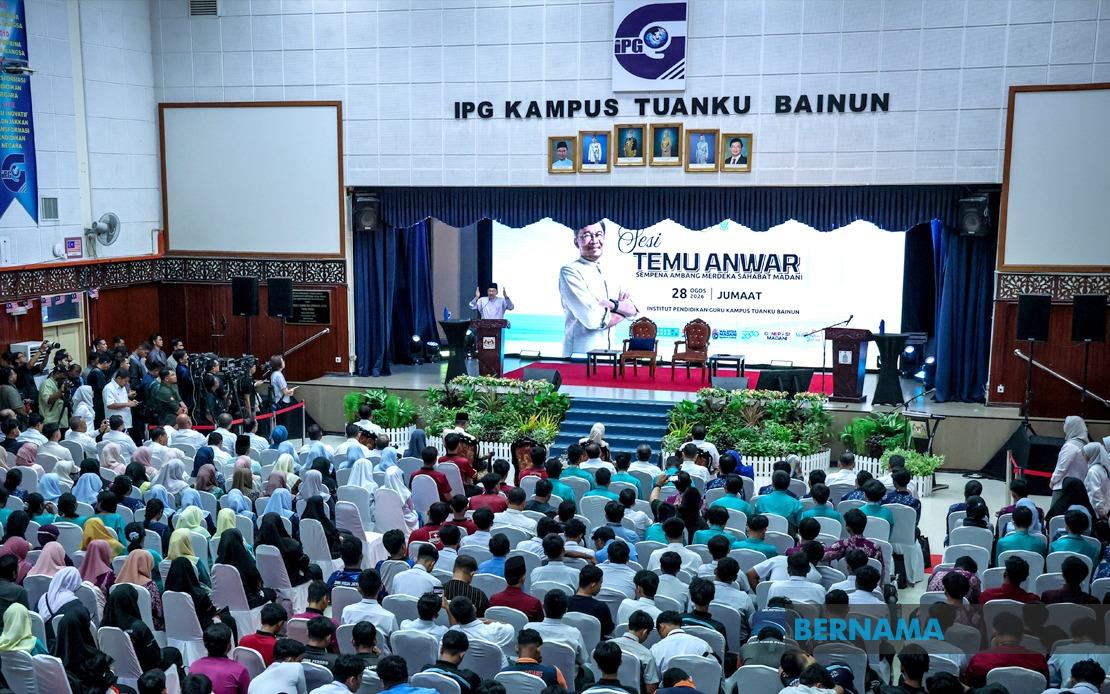
Prime Minister Datuk Seri Anwar Ibrahim has articulated a bold vision for Malaysia's higher education landscape, framing the complete repeal of the Universities and University Colleges Act 1971 as a transformative step toward intellectual liberation on campus. Speaking during a Temu Anwar session in Bukit Mertajam on August 28, Anwar positioned the AUKU abolition as central to his administration's commitment to fostering an environment where young people can exercise their fundamental right to free expression without institutional restraint.
At the heart of Anwar's argument lies a demographic logic that challenges half a century of restrictive educational governance. The Prime Minister underscored that students, once they reach 18 years of age, possess the legal capacity to participate in the electoral process through voting—a recognition of their citizenship rights and political maturity. He questioned the philosophical inconsistency of granting youths the ballot while simultaneously suppressing their right to articulate political opinions and engage in campus discourse. This framing recontextualises the debate around student freedoms from a matter of institutional discipline to one of democratic principle and consistency in how the state treats its citizens.
The AUKU, enacted in 1971 during a markedly different political era, had long restricted Malaysian university students' political participation and public commentary. These constraints reflected Cold War anxieties and the priorities of an earlier government determined to maintain tight social control. Anwar's pronouncement signals a decisive departure from that paradigm, acknowledging that five decades of technological, social, and political change have rendered those restrictions anachronistic. His rhetorical strategy—invoking the voting age as a turning point—suggests that the government views student maturity as a settled question, making further restrictions indefensible on rational grounds.
Beyond the mechanics of free speech, Anwar has articulated a pedagogical rationale for the reform that speaks to Malaysia's aspirations as a knowledge-based economy. He emphasised that unrestricted student expression serves as a crucible for developing creativity, sound judgement, and rigorous critical thinking. These competencies are increasingly recognised as essential not merely for academic success but for navigating complex professional environments and contributing meaningfully to national problem-solving. By linking the AUKU repeal to cognitive development, Anwar has reframed the reform as an investment in human capital rather than merely a concession to political pressure from student movements and civil society advocates.
The Prime Minister's comments also acknowledge an important pedagogical reality: that learning involves wrestling with competing ideas, testing assumptions, and occasionally arriving at conclusions that prove incorrect upon further examination. By stating that students should be encouraged to voice their perspectives even when those views may ultimately prove misguided, Anwar has endorsed a conception of education rooted in experiential learning and intellectual trial-and-error. This stance implicitly rejects the paternalistic model embedded in the AUKU, which assumed that state restrictions would guide students toward approved conclusions rather than allowing them to discover knowledge through debate and reflection.
The presence of Education Minister Datuk Seri Fadhlina Sidek at the session underscored government unity on this initiative. Her attendance signalled that the Ministry of Education has aligned itself with the Prime Minister's vision, suggesting that implementation mechanisms and policy details would follow in coordination with the ministry's strategic priorities. This institutional coherence is significant because the actual realisation of student freedoms depends not only on legal change but on consistent messaging and supportive policy frameworks within the education bureaucracy itself.
For Malaysian universities, the AUKU repeal represents a considerable shift in the operating environment. Institutions will need to recalibrate administrative policies, student conduct codes, and campus management approaches to accommodate greater student political activity and expression. This transition raises practical questions about how universities will balance student freedoms with institutional security, academic integrity, and the protection of the learning environment for all students. The sector will need guidance and professional development to navigate these complexities thoughtfully rather than either reverting to restrictive practices or adopting an overly permissive stance that might create new problems.
Regionally, Malaysia's decision to dismantle restrictions on student expression positions the country within a broader Southeast Asian conversation about democratic governance and institutional accountability in higher education. Thailand, Vietnam, and Indonesia have each grappled with questions about student activism and state oversight of campuses. Malaysia's move signals a commitment to a more open model, potentially influencing discourse in neighbouring countries about whether restrictions on student speech reflect genuine security imperatives or reflect outdated governance assumptions.
The reform also carries implications for Malaysia's international standing in global higher education rankings and partnerships. Universities in Western jurisdictions have increasingly linked institutional partnerships and research collaborations with commitments to academic freedom and open scholarly discourse. A reputation for suppressing student expression has historically complicated Malaysian universities' efforts to attract international faculty, forge research collaborations, and recruit talented students from abroad. The AUKU repeal removes a significant reputational liability and positions Malaysian higher education as more aligned with global norms around intellectual freedom.
However, the transition from legal prohibition to practical freedom will require sustained commitment and cultural change within universities and government. Entrenched bureaucratic practices, deeply ingrained cautionary instincts among administrators, and potential political resistance from conservative constituencies could all complicate implementation. Anwar's public endorsement at a prominent venue signals that the Prime Minister views this as a priority, but translating rhetorical commitment into institutional transformation demands continued attention and resources.
The broader context for this reform encompasses growing recognition that Malaysia's prosperity and competitiveness depend increasingly on developing a population capable of innovation, adaptive reasoning, and sophisticated problem-solving. An educated citizenry confined within intellectual boundaries cannot contribute optimally to addressing national challenges or advancing economic transformation. By connecting student freedoms to national development imperatives, Anwar has framed the AUKU repeal not as a sentimental gesture toward youth but as a strategic necessity for Malaysia's future.

