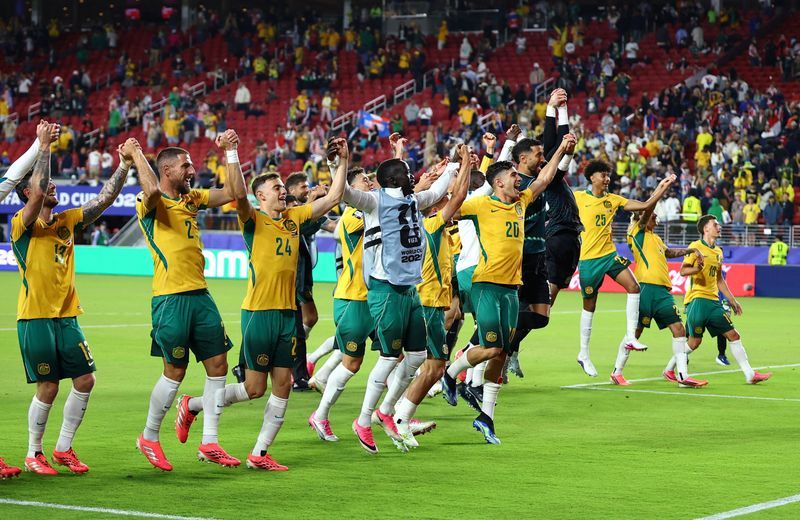
Australia has secured a place in the knockout phase of the World Cup following a tightly contested stalemate with Paraguay in Santa Clara on Thursday, marking the nation's return to the last 16 for the second consecutive tournament. The goalless draw at San Francisco Bay Area Stadium proved decisive for the Socceroos, who finished runners-up in Group D behind co-hosts the United States and will now prepare to face the second-placed team emerging from Group G, a cluster still wide open as Egypt prepare to meet Iran and Belgium take on New Zealand in upcoming fixtures.
The match itself unfolded as a physical, tense affair that reflected the stakes involved for both teams, with Paraguay left to anxiously monitor other results across the group stage to determine whether their four points would prove sufficient for advancement as one of the tournament's eight best third-placed finishers. For the South Americans, who reached the quarter-finals in 2010, the outcome represents a precarious position—a draw that keeps their hopes alive but guarantees nothing as they await clarity from parallel competitions scheduled in the coming days.
Manager Tony Popovic demonstrated tactical boldness by reshuffling six players in his starting lineup, signalling an aggressive approach against the Paraguayans. The inclusion of livewire midfielder Nestory Irankunda and forward Cristian Volpato in the attacking formation sent a clear message about Australian intentions to seize the initiative, particularly following the injury to Jacob Italiano, which forced Jordan Bos into an unfamiliar position on the right flank rather than his natural left-back role.
Australia's early dominance translated into several promising attacking movements, particularly down the right flank where Bos and Volpato coordinated to probe Paraguay's defensive shape. In one telling moment during the opening exchanges, Volpato's pass released Jackson Irvine into the penalty area, but the midfielder's angled effort flew straight into the grateful arms of Paraguay goalkeeper Orlando Gill. Late in the first period, both Bos and Volpato created additional opportunities that again found Gill extending his reach, though neither effort genuinely stretched the custodian's capabilities.
Paraguay's first-half performance reflected a team lacking attacking rhythm, managing only a single shot through a subdued opening 45 minutes. Coach Gustavo Alfaro responded to this lethargy by introducing Brazilian-born attacker Mauricio at the interval, a substitution that immediately altered the tactical balance. Within five minutes of the restart, Mauricio tested Australian goalkeeper James Deacon with a distant effort, signalling Paraguay's increased willingness to engage in open play as they shed their early passivity.
The transformative introduction of energetic Julio Enciso provided Paraguay with genuine attacking thrust through the second half, as the midfielder repeatedly pierced Australia's defensive lines with his penetrating runs and intelligent positioning. Enciso fashioned Paraguay's clearest opportunity with roughly eight minutes remaining, when he received the ball in threatening space and unleashed a low drive that whistled across the face of goal and beyond the left post, a moment that represented Paraguay's most dangerous attacking foray of the evening.
Australia maintained their composure and intensity despite Paraguay's growing threat, with the match evolving into an end-to-end spectacle that delivered genuine tension without genuine quality finishing. In the 89th minute, Bos almost sparked scenes of jubilation when he burst past two defenders from the right wing, charged into the penalty box, and sent his shot fizzing just past the far post—a fraction of an inch separating Australia from a dramatic victor's reward that ultimately never materialised.
The closing stages saw Mauricio briefly probe Australia's defensive vulnerabilities when he found a sliver of space at the edge of the penalty area, but his resulting effort proved tepid and low, offering Australian goalkeeper Deacon no genuine difficulty. As the final whistle sounded, Australia could reflect with quiet satisfaction on a progression earned through discipline and defensive solidity rather than sparkling attacking football, a characteristically pragmatic approach befitting tournament football where advancement matters far more than entertaining neutrals.
For regional football followers, Australia's qualification represents another significant tournament appearance for an Asian confederation member, reinforcing the growing strength of Southeast Asian and Oceanian representation on the global stage. The Socceroos' advancement also underscores their evolution as a competitive force in continental football, having now qualified for consecutive World Cup knockout phases and demonstrating the capacity to navigate challenging group configurations against physically demanding South American opposition.
The road ahead for Australia promises tougher examinations against opponents drawn from either second place in Group G, where Belgium, New Zealand, Egypt, and Iran remain in contention. Popovic will undoubtedly use the upcoming days to assess squad fitness, review the Paraguay encounter, and prepare tactical blueprints for knockout-stage football where margins between progression and elimination narrow dramatically. The manager's willingness to rotate and experiment against Paraguay, combined with his team's resilience in defending a narrow margin, suggests an Australian camp that understands the demands of tournament progression and possesses the mentality to compete in the knockout phase.

