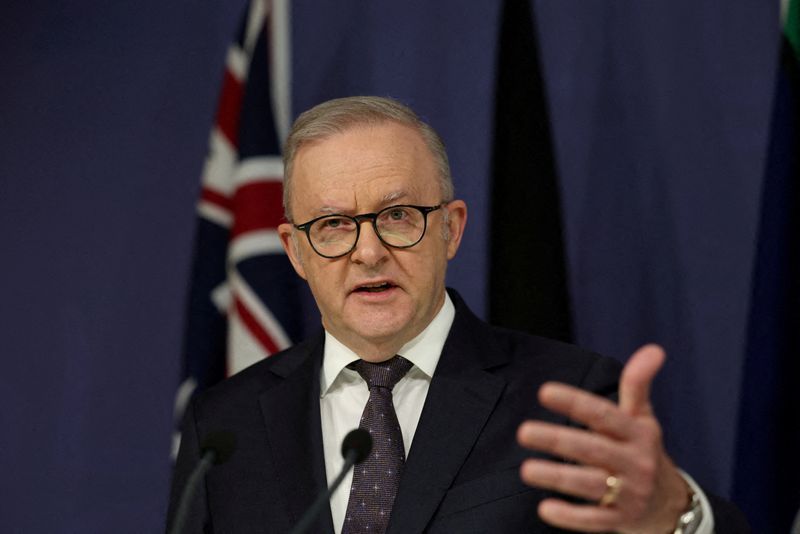
Australia is moving to centralise its approach to artificial intelligence by establishing a dedicated government office tasked with coordinating regulatory standards across the nation. The Office of AI, to be housed within the Department of the Prime Minister and Cabinet, represents a significant shift in how Canberra addresses the rapid proliferation of AI technologies throughout the economy. Prime Minister Anthony Albanese announced the initiative during a major policy address in Sydney, signalling the government's intent to develop a cohesive national strategy rather than managing AI challenges through piecemeal, sector-specific responses.
The creation of this office reflects recognition that artificial intelligence demands a whole-of-government approach similar to how Australia managed previous technological revolutions. Albanese drew parallels to historical precedent, noting that just as the nation developed coordinated frameworks for civil aviation during the 1920s and genetics in the 1990s, AI requires similarly comprehensive governance architecture. This framing positions the Office of AI not as a regulatory barrier but as an essential institutional response to a transformative technology that touches virtually every aspect of contemporary economic and social life.
The Australian government has identified the Office of AI as a competitive advantage in attracting international investment and establishing the country as a regional hub for data centre operations. By providing clearer approval pathways and streamlining compliance procedures, policymakers believe Australia can appeal to technology companies weighing where to establish operations and infrastructure. The uncertainty that currently characterises Australia's AI regulatory environment—where companies must navigate multiple fragmented frameworks rather than a single coordinated system—has potentially deterred investment. The new office is designed to eliminate this ambiguity.
However, this investment-focused approach occurs against mounting community concerns about AI's unintended consequences. Labour displacement represents the most immediate anxiety, with workers and unions warning that AI adoption could eliminate jobs across sectors ranging from administrative roles to professional services. Beyond employment, environmental considerations have gained prominence as data centres required to run sophisticated AI systems demand enormous quantities of water for cooling—a particularly acute concern in Australia, where water scarcity periodically constrains economic activity and agriculture.
Safety and security vulnerabilities associated with widespread AI deployment have also moved onto the political agenda. Advocates argue that as AI systems increasingly influence decisions in healthcare, criminal justice, finance, and infrastructure, the risks of algorithmic bias, system failures, and security breaches demand robust safeguards. Intellectual property concerns persist as well, with creative industries and researchers worried that AI systems trained on copyrighted material without permission or compensation could undermine existing protections and economic models.
Currently, Australia operates without comprehensive AI-specific legislation, instead relying on a patchwork of privacy laws, consumer protection regulations, and a voluntary industry ethics framework. This light-touch approach has allowed rapid experimentation and adoption but leaves significant gaps in accountability and oversight. The voluntary framework, while encouraging responsible development, lacks enforcement mechanisms and has proven insufficient to address the scale and speed of AI's integration into critical systems. Different government departments and regulatory bodies have begun developing their own AI policies independently, creating inconsistency and potential conflicts.
The Office of AI initiative positions Australia as an early adopter of centralised AI governance, though other nations and regions are pursuing their own regulatory strategies. The European Union has advanced comprehensive AI legislation establishing risk-based compliance requirements, while Singapore has positioned itself as a testing ground for AI innovation with lighter regulation. Canada, Britain, and the United States have established various inter-agency task forces and principles-based approaches. Australia's model differs by embedding AI governance at the highest institutional level—within the Prime Minister's Department—signalling that AI is deemed as strategically important as foreign policy or national security.
For Southeast Asian nations and regional partners, Australia's approach offers both a template and a cautionary example. The region comprises economies ranging from advanced technology hubs like Singapore to emerging digital markets, yet most have given limited formal consideration to comprehensive AI governance. Australia's choice to centre investment attraction alongside regulation may influence how neighbour nations approach similar decisions. The outcome will demonstrate whether centralised, whole-of-government coordination can successfully balance economic opportunity with social protection—a question that resonates across the region.
The Office of AI's success will ultimately depend on how effectively it navigates inherent tensions between promoting innovation and protecting communities. Businesses fear that stringent regulations will drive operations elsewhere or slow beneficial applications of AI technology. Conversely, workers, environmental advocates, and civil society groups worry that prioritising investment will subordinate safeguards to commercial interests. The office must earn credibility by demonstrating genuine independence from industry lobbying while maintaining pragmatic engagement with the technology sector.
Albanese's government has signalled that the Office of AI will develop explicit regulatory standards rather than rely indefinitely on voluntary frameworks. The timeframe and specific content of these standards remain unclear, but the commitment to move beyond Australia's current approach suggests tangible regulation will follow the office's establishment. This represents a deliberate choice to shape AI development according to national values and priorities rather than accepting whatever frameworks emerge from commercial incentives alone.
The announcement also reflects political consensus that AI governance cannot remain solely within sectoral regulators or market mechanisms. Parliamentary concern about AI's implications has grown across political parties, indicating that Australians—like citizens across developed democracies—expect government to establish clear rules for transformative technologies. The Office of AI represents a response to this democratic demand, though sceptics remain unconvinced that any regulatory framework, however well-intentioned, can adequately manage technology evolving as rapidly and unpredictably as artificial intelligence.

