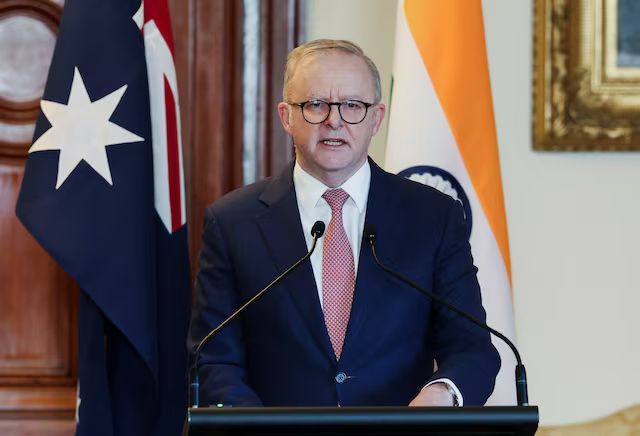
Australia's government is preparing to escalate its challenge to newly imposed American tariffs, with Prime Minister Anthony Albanese declaring he will pursue the matter directly with US President Donald Trump at all diplomatic levels. The tariff dispute has emerged as a significant point of tension following Washington's implementation of trade measures on Friday targeting 60 nations, a decision the Albanese administration has publicly denounced as unjustified and pledged to overturn.
The United States justified the action by claiming affected countries had failed to adequately restrict imports of goods manufactured through forced labour. The timing coincided precisely with the expiration of a temporary 10 percent blanket tariff that had previously been applied globally. The new framework creates a differentiated structure, with nations facing varying duty rates depending on Washington's assessment of their compliance with labour standards.
Australia finds itself in the highest-penalty category under the revised American tariff schedule. Canberra faces a 12.5 percent levy on affected imports, placing it alongside 37 other nations deemed to have insufficient forced-labour protections. A second tier of 17 countries confronts a 10 percent rate, while five nations have been assigned mixed tariff rates reflecting what the Trump administration views as sector-specific compliance failures.
Albanese's commitment to raising the issue represents more than diplomatic posturing. The Labor government has framed the dispute as a fundamental challenge to free and fair trade principles that underpin the Australia-US relationship. In televised remarks on Sunday, the Prime Minister emphasised the administration's determination to pursue the matter comprehensively, noting that discussions would occur at every level of bilateral engagement. This signals an approach spanning ministerial contacts, parliamentary channels, and diplomatic representations.
The Australian government's position rests on its assertion that the nation already maintains exceptionally robust safeguards against modern slavery and forced labour in supply chains. Rather than representing a weakness in Australian regulatory frameworks, officials argue the tariffs reflect misapplied American criteria. To strengthen this argument, Canberra has indicated it is actively enhancing existing protections through detailed supply chain scrutiny and escalating potential financial penalties for violations, demonstrating tangible commitment to strengthening labour standards.
For the Southeast Asian region, the tariff development carries broader implications. Australia's experience suggests that Trump administration trade policy may prove highly assertive in using labour compliance as a basis for protectionist measures. Other nations in the region with significant trade exposure to the United States—including Vietnam, Thailand, and Indonesia—may face similar scrutiny and potential tariff actions. The precedent being set in the Australia case will likely influence how other trading partners prepare their responses and craft their negotiating strategies.
The timing of the tariff announcement holds particular significance given the political context. Albanese campaigned on maintaining strong US relations while pursuing genuinely reciprocal trade arrangements that benefit Australian interests. The tariff action tests this commitment almost immediately, forcing the government to demonstrate it can stand firm on Australian interests while preserving the alliance relationship. His emphasis on raising the issue at every diplomatic level suggests recognition that this requires sustained, multi-faceted engagement rather than a single negotiation.
Economically, the 12.5 percent tariff will affect various Australian export sectors, though the specific products targeted remain subject to the precise details of the US implementation. Given Australia's reliance on free trade arrangements and historical dependence on open market access, the tariff represents a tangible cost that extends beyond the immediate value of affected shipments. It signals a return to more protectionist American trade postures that contrast sharply with the rules-based international trading system Australia has long championed.
The Trump administration's framing of the tariffs around forced labour provides what it views as moral justification for protectionist action. This rhetorical strategy complicates Australia's response, as it cannot simply dismiss the underlying concern. Instead, the government must demonstrate that Australian standards are sufficient, creating a debate about regulatory adequacy rather than the legitimacy of pursuing trade objectives through labour standards. This distinction matters because it allows the Trump administration to claim it pursues legitimate non-protectionist goals.
Looking ahead, Australia's engagement with Trump on this issue will test whether the Prime Minister can achieve concrete results through diplomatic channels. The outcome will carry implications for how other nations approach similar American tariff actions, and whether developed economies can successfully challenge labour-based tariffs through negotiation. For Malaysia and other Southeast Asian nations, watching Australia's approach and results may provide valuable lessons for their own potential encounters with American protectionist measures justified through labour compliance concerns.
The broader context involves Trump's demonstrated willingness to use trade tools aggressively to advance political objectives at home and abroad. For Australia, a nation deeply invested in its US alliance and dependent on trade relationships, the challenge involves asserting legitimate concerns without allowing tariff disputes to damage the fundamental strategic relationship. Albanese's commitment to raise the matter at all levels indicates the government recognises both the economic significance and the diplomatic complexities involved.

