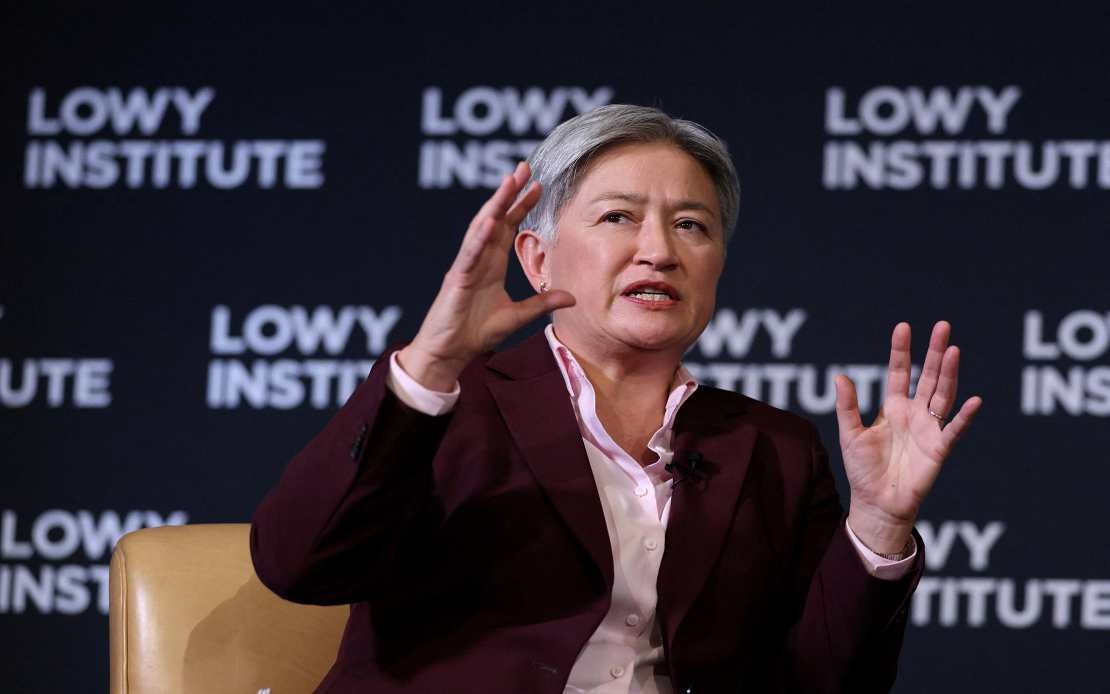
Australia's Foreign Affairs Minister Penny Wong has issued a pointed warning about the political dangers of monocultural ideology, arguing that such a trajectory would fundamentally weaken the nation's competitive position and international standing. Speaking at the Lowy Institute in Sydney on Friday, Wong positioned her remarks as a direct counter to rising populist sentiment that has gained traction across the country, particularly through Senator Pauline Hanson's One Nation party.
Wong framed Australia's historical identity as inherently multicultural, rejecting what she described as a "melancholic fantasy of monoculture" that romanticizes an imagined past. Her language was notably deliberate, treating monoculturalism not as a pragmatic policy choice but as a nostalgic retreat from reality. She argued that pursuing such policies would compel Australia to abandon its strategic advantages in an increasingly interconnected Indo-Pacific region, effectively handicapping the nation at a moment when regional partnerships and economic networks are more valuable than ever.
The Foreign Minister's critique struck at the heart of One Nation's platform, which has gained considerable momentum in recent months. Hanson's party has pledged to dramatically restrict immigration levels, slash foreign aid commitments, and fundamentally realign Australia's relationship with multilateral institutions should it secure power at the 2028 general election. These positions represent a sharp departure from the bipartisan consensus that has shaped Australian foreign policy for decades.
Wong's specific argument deserves examination for Malaysian and Southeast Asian audiences: she contended that monocultural advocacy represents "a call for Australia to curtail our choices and to cut off our connections." This framing highlights how immigration and cultural diversity are intertwined with trade relationships, diplomatic influence, and strategic partnerships. For a region like Southeast Asia, where Australia has historically positioned itself as a bridge between Asian and Western interests, such isolationist moves would carry significant implications for regional stability and economic cooperation.
The political context underlying Wong's speech is particularly striking. Recent polling data reveals a dramatic realignment of Australian electoral preferences that should concern policymakers across the region. According to YouGov Australia's July survey, One Nation's support has surged to 26 per cent of voters intending to vote for the party at the next election—a remarkable four-fold increase from the 6.4 per cent the party achieved at the 2025 general election. This trajectory suggests that populist anti-immigration sentiment has penetrated beyond fringe constituencies into mainstream Australian politics.
Simultaneously, support for both major governing parties has deteriorated. The ruling Labour Party, which garnered 34.5 per cent at the 2025 election, has seen backing decline to 28 per cent, while the conservative Coalition has collapsed from 31.8 per cent to 20 per cent. This fragmentation indicates voter dissatisfaction extends across ideological lines and may reflect broader anxieties about migration, economic security, and national identity that One Nation has successfully channeled into electoral support.
The underlying public sentiment regarding immigration adds another dimension to Wong's warning. The annual Lowy Institute poll released in June found that 55 per cent of Australians believe migrant intake levels are excessive, up from 53 per cent in 2025 and 48 per cent in 2024. This upward trajectory across three consecutive years suggests immigration concerns have become increasingly salient in public consciousness, providing One Nation with fertile political ground. However, Wong's argument implicitly suggests that public anxiety about immigration levels need not translate into support for wholesale cultural reorientation.
For Southeast Asian governments and businesses, the trajectory of Australian politics carries practical ramifications. A One Nation victory could reshape Australia's engagement with regional trade frameworks, reduce development assistance programs that benefit partner nations, and potentially withdraw Australian participation from multilateral security arrangements. Given Australia's significant economic footprint in Southeast Asia and its role as a security anchor in the Indo-Pacific, such shifts would reverberate across the region's strategic calculations.
Wong's framing of monoculturalism as a source of national weakness rather than strength represents a distinctly internationalist counterargument to rising nationalist sentiment. She positioned diversity and openness not merely as moral virtues but as strategic assets that enhance rather than diminish national capacity. This emphasis on capability and competitiveness rather than cultural preservation grounds her critique in pragmatism rather than ideology, potentially appealing to voters concerned about Australia's economic performance.
The timing of Wong's intervention is notable, delivered before One Nation's polling surge had become fully entrenched. By staking out clear ground against monocultural advocacy, the government signals that immigration and cultural diversity remain central to its identity and policy direction. However, the gap between government position and electoral sentiment—with One Nation's support at over 26 per cent while the government party backs only 28 per cent—suggests Wong faces a significant challenge in convincing voters that openness serves their interests.
For regional observers, Wong's speech underscores how domestic identity debates in major powers can reshape international relationships. Australia's movement toward or away from internationalism will influence regional institutions, trade relationships, and security arrangements across Southeast Asia for the coming decade. The Foreign Minister's vigorous defence of multiculturalism thus carries implications extending well beyond Australia's borders, touching fundamental questions about how the Indo-Pacific region organizes itself economically and strategically.

