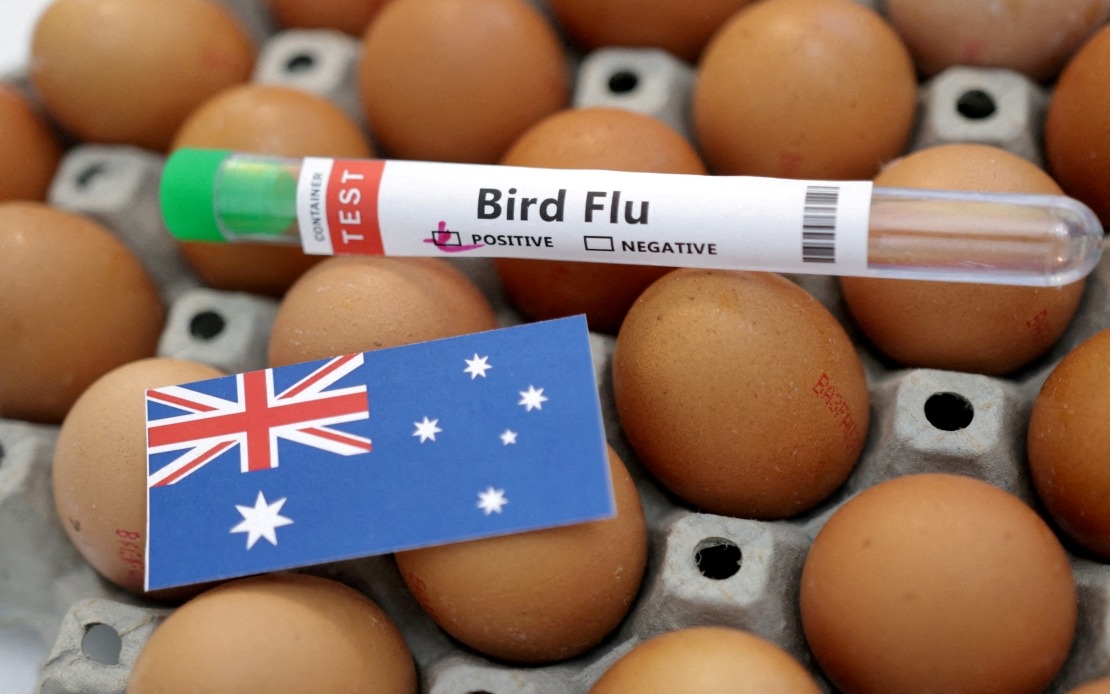
Australia faces an escalating bird flu emergency as H5N1 cases soared past the 200 mark in early August, prompting urgent biosecurity interventions across multiple states. The Australian federal Department of Agriculture, Fisheries and Forestry confirmed 203 confirmed or presumed positive cases of the deadly H5N1 strain, marking a dramatic acceleration of what had been a manageable situation just weeks earlier. The trajectory is particularly alarming when viewed through the lens of August's progression—confirmed cases jumped 290 per cent during the month alone, rising from 52 at July's end to well over 200 by early August, indicating exponential spread rather than steady accumulation.
The geographic distribution reveals a concerning concentration in Australia's agricultural heartland. South Australia has emerged as the epicentre, accounting for 147 of the national total, with 28 fresh detections confirmed on the Saturday the outbreak crossed 200 cases. These South Australian cases predominantly involve wild seabirds, suggesting the virus maintains active circulation in natural populations near coastal and inland water bodies. Victoria, Australia's second-most affected state, reported 43 cases including a cluster of 36 birds discovered in the state's western regions near the South Australian border during late July. This clustering pattern along state boundaries raises questions about wildlife movement corridors and the virus's natural transmission pathways through migratory bird populations.
The Victorian government's response reflects escalating concern about commercial poultry operations' vulnerability. Agriculture Minister Michaela Settle announced mandatory indoor confinement requirements for all poultry producers maintaining flocks of at least 50 birds along the state's south coast, encompassing the greater Melbourne region. The 14-day initial confinement period represents a precautionary approach designed to interrupt potential transmission pathways between wild bird populations and commercial farms. Such measures, while economically disruptive for producers, acknowledge the genuine threat posed by H5N1's jumping from wild to domestic bird populations, a scenario that remains relatively rare but catastrophically consequential for agricultural industries.
For Malaysian readers, Australia's outbreak carries particular significance given regional interconnections. Southeast Asian nations including Malaysia have previously experienced H5N1 outbreaks, with Malaysia recording multiple fatalities and significant poultry industry disruptions during earlier waves. The virus's demonstrated capacity to spread across vast distances through migratory bird populations suggests that Australia's current situation, whilst geographically distant, provides valuable epidemiological lessons. Australian poultry industry challenges may presage similar pressures facing Malaysian farms should the virus establish stronger foothold in regional wild bird populations or gain enhanced transmissibility.
The speed of Australia's August surge underscores H5N1's unpredictable nature. A 290 per cent monthly increase transforms public health assessments fundamentally—what appeared controlled becomes emergent, requiring rapid policy adjustments and resource reallocation. Victoria's decision to mandate indoor housing reflects this recalibration, shifting from reactive investigation of detected cases toward proactive habitat modification reducing wildlife-poultry contact. The 50-bird threshold establishing which operations face confinement suggests deliberate targeting of commercial rather than backyard producers, recognising that larger operations present greater amplification potential should infection breach their biosecurity perimeters.
The wild seabird predominance in detected cases carries ambiguous implications. While it demonstrates active viral circulation in natural reservoirs, it also suggests that Australian wildlife surveillance systems are functioning effectively, detecting infections that might otherwise spread unnoticed. South Australia's detection capacity, generating 28 cases in a single day, implies either systematic sampling of deceased or sick wild birds or environmental surveillance identifying virus shedding in concentrated waterbird populations. This surveillance strength, ironically, creates awareness of a problem that might silently worsen without detection infrastructure.
Victoria's south coast focus reflects epidemiological assessment of highest-risk zones where wild bird populations concentrate and intersect with intensive poultry operations. Melbourne's inclusion indicates recognition that suburban and periurban farming, often overlooked in outbreak planning, requires equivalent protective measures. The 14-day timeframe appears calibrated to disruption minimisation rather than purely epidemiological necessity, suggesting policy makers attempted balancing infection control imperatives against agricultural industry burden.
The outbreak timeline's acceleration raises fundamental questions about containment feasibility. When confirmed cases grow 290 per cent monthly, linear mitigation responses risk perpetual lag. Australia's federal and state authorities must now determine whether the 200-case threshold represents outbreak stabilisation point or merely exponential growth's visible inflection. Subsequent weeks' case numbers will clarify whether Victoria's confinement measures and heightened surveillance bend the growth curve or merely document inexorable spread.
Beyond immediate containment, Australia's situation illustrates broader avian influenza complexities facing developed nations. Unlike Southeast Asian contexts where virus persistence in live bird markets and inadequate biosecurity infrastructure perpetuate circulation, Australia's outbreak occurs within sophisticated agricultural systems with advanced veterinary oversight. Yet sophistication proves insufficient; the virus nonetheless spreads, suggesting that controlling H5N1 in wild bird populations remains fundamentally constrained by ecological factors transcending regulatory intervention. For Malaysia and other Southeast Asian countries, Australia's experience suggests that even well-resourced nations struggle decisively against naturally circulating H5N1, implying that regional cooperation on surveillance and early warning systems may prove more valuable than individual nation containment strategies.

