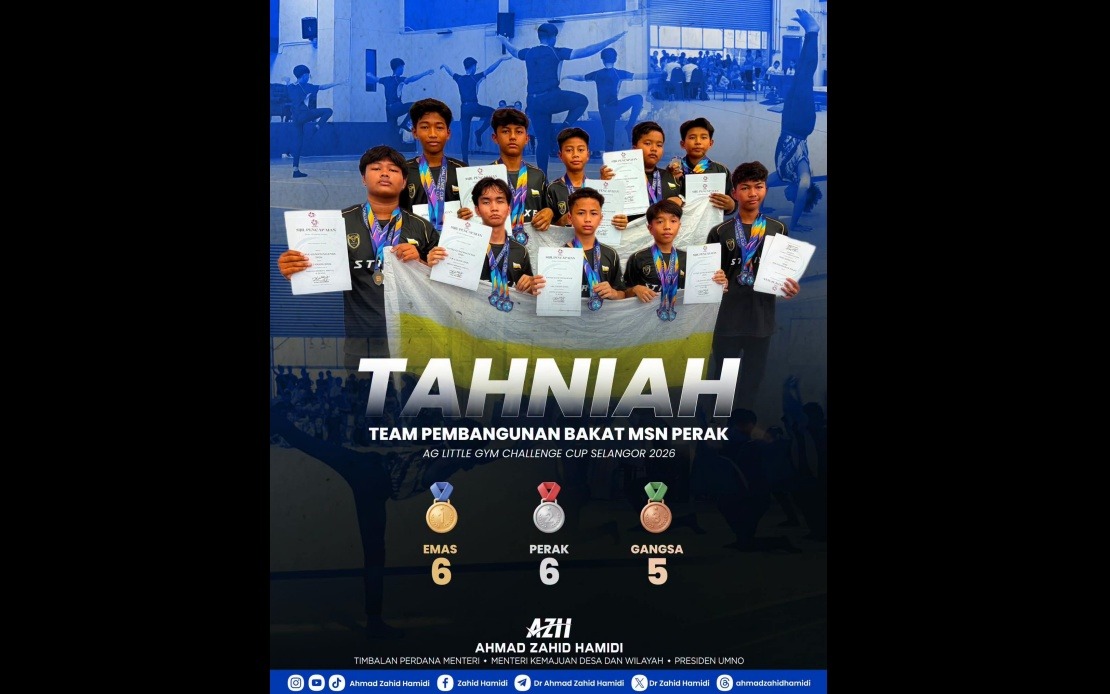
Bagan Datuk's young gymnasts have scripted a significant milestone in the district's sporting history by capturing six gold medals at the AG Little Gym Challenge Cup Selangor 2026, held in Kajang on August 1. The contingent's impressive haul also included six silver and five bronze medals, cementing a dominant performance across multiple events and age categories at the competition. The success marks another chapter in Bagan Datuk's emerging reputation as a source of talented young athletes who can compete at regional levels.
Deputy Prime Minister Datuk Seri Dr Ahmad Zahid Hamidi, who represents Bagan Datuk as Member of Parliament, publicly celebrated the gymnasts' achievements through social media, signalling the political and community importance attached to youth sporting accomplishments in the constituency. His endorsement underscores a growing recognition among Malaysian leaders that success in competitive sports provides young people with discipline, confidence, and pathways to personal development that complement academic pursuits.
In his statement, Ahmad Zahid emphasized that the medals represent more than individual athletic triumphs. He framed the victory as validation of Bagan Datuk's broader potential, arguing that the district's youth possess not only intellectual capability but also the physical prowess and mental fortitude required to excel in demanding sporting disciplines. This dual narrative—academic excellence coupled with athletic achievement—reflects a contemporary Malaysian emphasis on developing well-rounded individuals equipped for an increasingly competitive global environment.
The Deputy Prime Minister's comments also highlighted the enabling factors behind such successes. He attributed the gymnasts' breakthrough to a combination of proper opportunities, quality coaching, and parental support—elements that many Malaysian constituencies struggle to provide uniformly across their communities. By publicly acknowledging these structural supports, Ahmad Zahid implicitly raised questions about resource allocation and infrastructure disparities that persist across different regions and districts in Malaysia.
The Bagan Datuk Generasi Muda Gymnastics Club, the organization that led the team's preparation, celebrated the medalists with language emphasizing perseverance and future ambition rather than complacency. Their social media post framed the medal tally as a milestone rather than a destination, signalling to young gymnasts that their current achievement should fuel motivation for further improvement and higher competitive targets. This philosophy of continuous progression aligns with international best practices in youth sports development, where early success often catalyzes deeper commitment to training regimes and skill advancement.
The club's messaging also stressed the psychological dimensions of athletic success—discipline, determination, and commitment to sustained training effort. For Malaysian parents and young athletes observing these outcomes, the narrative carries weight as evidence that structured, long-term investment in sports development can yield tangible results. This contrasts with more casual recreational approaches and demonstrates the efficacy of dedicated coaching and systematic training schedules.
Gymnastics, as a sport demanding technical precision, strength, flexibility, and mental resilience, presents particular value as a development vehicle for young people. Unlike team sports where individual performance can be obscured or shared, gymnastics makes individual achievement transparently visible, creating powerful motivation for competitors. The fact that Bagan Datuk's programme has generated six gold medalists suggests the existence of a pipeline of developing talent, indicating sustainability beyond isolated victories.
The AG Little Gym Challenge Cup Selangor 2026 provided a significant testing ground for these young athletes, bringing together competitors from across Selangor state and likely drawing participants from other regions. Success in such inter-district or inter-regional competitions carries more weight than local victories, establishing credentials that can open doors to state-level trials, national championships, and potentially Southeast Asian age-group competitions. For Malaysian parents and educators, such accomplishments demonstrate the realistic possibility of developing world-class young athletes within the national system.
The consistency of Bagan Datuk's recent sporting successes suggests that a combination of local initiative, community support, and individual coaching commitment is creating cumulative advantages for young athletes in the district. This model—developing competitive programmes at the grassroots level rather than waiting for top-down national initiatives—has proven effective in other Malaysian states and provides a template that other constituencies might examine and adapt to their own contexts.
Looking forward, the challenge for Bagan Datuk's sporting community involves maintaining momentum and supporting these young champions through their continued development. Early success in gymnastics can sometimes plateau if training intensity, coaching quality, or facility access decline over time. Sustaining the trajectory evident in this medal haul will require sustained investment and ongoing community commitment to these young athletes' progression toward potentially representing Malaysia at junior national and eventually senior international levels.

