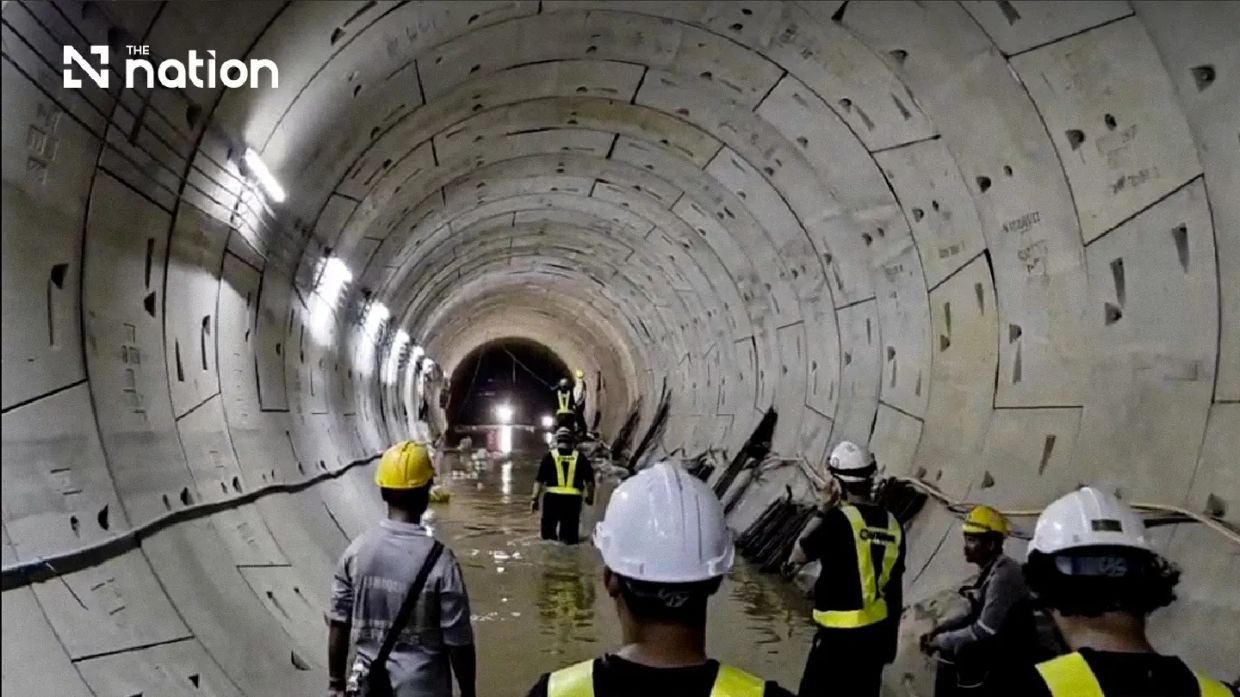
A water breach in Bangkok's Purple Line mass transit project has prompted an urgent safety inspection after heavy rainfall on July 8 flooded an underground construction shaft. Prime Minister Anutin Charnvirakul visited the affected site near Wongwian Yai late Wednesday evening, alongside several senior government ministers and engineers, as officials moved quickly to assess structural integrity and contain the incursion.
The leak occurred within a construction shaft beneath the tunnel section of the Tao Poon–Rat Burana segment, which forms part of the Kanchanaphisek Ring Road extension. The incident highlights the operational challenges facing Bangkok's ongoing rail infrastructure expansion during the city's monsoon season. As rainfall intensified throughout July 8, water levels within the worksite climbed steadily, eventually breaching containment barriers and triggering immediate alerts to transport authorities and project management.
The governmental response escalated rapidly, with Deputy Prime Minister Phiphat Ratchakitprakarn and multiple transport ministry officials reaching the location before the prime minister's arrival after midnight. This high-level deployment reflected underlying anxieties about tunnel safety on Bangkok's rail networks, particularly following the catastrophic ground collapse near Vajira Hospital in late September 2025, which had devastated roads and surrounding structures. The Wongwian Yai incident therefore carried considerable political weight, demanding demonstrable competence in crisis management and structural oversight.
The affected section belongs to Contract 4 of the southern extension, spanning from Saphan Phut to Dao Khanong, with Unique Engineering and Construction Public Company Limited (UNIQ) holding the 14.982 billion baht (US$447.3 million) contract. Current operations involve tunnel excavation and retaining wall construction—particularly vulnerable phases when groundwater intrusion can undermine geotechnical stability. Deputy Transport Minister Phattharaphong Phatraprasit stated that preliminary assessments found the situation manageable, though he immediately ordered comprehensive technical investigations to identify root causes and determine whether structural damage had occurred.
Facing pressure to prevent a recurrence of the Vajira disaster, officials issued directives requiring continuous monitoring, accelerated root cause analysis, and rapid deployment of corrective interventions. The Mass Rapid Transit Authority of Thailand and UNIQ received explicit instructions to maintain regular updates with the Transport Ministry and ensure all remediation measures adhered to engineering standards and safety protocols. This formal governance framework reflected determination to avoid the operational breakdowns that had allowed the Vajira incident to develop unchecked.
Anutin's characterisation of the situation as controllable carried significant reassurance value for both public confidence and markets. He emphasised that the water volume had not reached levels necessitating nearby road closures, and that maintaining the water level had proven achievable since morning operations began. The distinction he drew between passive structural failure at Vajira and the proactive detection and management at Wongwian Yai attempted to position this incident as a system working as intended—identifying problems early rather than discovering them catastrophically.
Nevertheless, the depth of concern was evident in the prime minister's decision to personally inspect the site at midnight, an unusually dramatic gesture for a sitting premier. This reflected sensitivity to public perception following the Vajira collapse and the political vulnerability inherent in infrastructure projects where engineering mishaps directly affect urban populations. The coordination of multiple ministerial agencies signalled governmental determination to prevent escalation while avoiding the appearance of bureaucratic indifference that had characterised earlier phases of the Vajira crisis.
Enhanced monitoring systems were deployed to detect any movement in surrounding buildings and underground structures, with no abnormal signs reported during initial surveys. However, officials acknowledged that sustained observation remained necessary, particularly given heavy rainfall patterns typical of Bangkok's southwest monsoon season. The expectation that the inspection process would conclude relatively quickly suggested confidence that the situation, while serious, remained within manageable parameters.
For Malaysian observers, the Bangkok Purple Line incident offers instructive lessons relevant to domestic rail expansion projects, particularly the MRT, LRT, and planned extensions now under construction in Klang Valley and other metropolitan regions. Extreme rainfall events and groundwater management pose comparable geotechnical challenges in Southeast Asia's tropical climate. The Thai government's response—combining transparent communication, senior-level oversight, and contractual accountability—represents a model potentially applicable to Malaysian transport authority operations, especially where dense urban development amplifies consequences of construction-phase incidents.
The incident also underscores systemic vulnerabilities in large-scale infrastructure procurement when climatic extremes interact with complex underground construction. As climate change intensifies rainfall variability across Southeast Asia, transport authorities must recalibrate design specifications, contractor risk management protocols, and contingency planning. The Vajira Hospital collapse had already prompted Bangkok to review standards; the Wongwian Yai leak suggests that lessons remain incompletely absorbed, with operational protocols still vulnerable to precipitation events within historical ranges.
Anutin's statement that the response was fundamentally engineering-driven attempted to reframe the incident from a political crisis into a technical management exercise. Yet the presence of the prime minister, multiple deputy ministers, and the mass media apparatus surrounding the midnight inspection revealed the political dimensions underlying infrastructure safety. In contexts where public faith in transport infrastructure has been damaged by recent collapses, demonstrating competent crisis response becomes as important as the technical response itself, shaping public confidence in the authorities' capacity to deliver safe, reliable metropolitan rail systems.
The immediate priority now centres on preventing water reingress, confirming structural integrity, and maintaining construction schedules despite the delay imposed by emergency remediation. For stakeholders across Southeast Asia's transport sectors, the unfolding Wongwian Yai response will signal whether Bangkok's infrastructure governance has genuinely reformed following the Vajira disaster, or whether similar vulnerabilities persist beneath new protocols.

