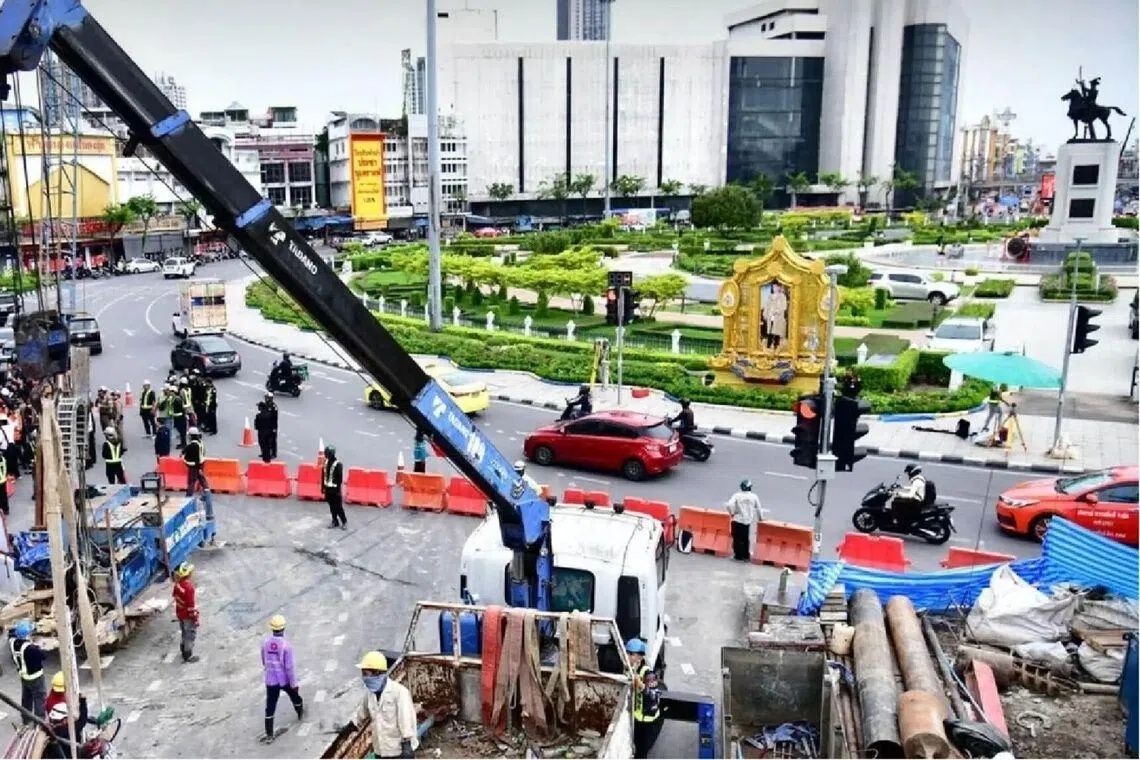
Bangkok's Purple Line subway construction project has triggered a major incident forcing the immediate evacuation of about 60 people from nearby commercial buildings after water seeped into a drainage sump, triggering ground subsidence that threatens neighbouring structures. The evacuation underscores the complex engineering challenges facing Thailand's capital as it pursues an ambitious expansion of its mass transit infrastructure, while simultaneously highlighting risks that major construction projects pose to urban communities and traffic flows in densely populated areas.
The problem emerged at the lowest point of the southern Purple Line construction tunnel near Wongwian Yai, where water infiltrated a drainage sump designed to manage groundwater. Once inside the underground structure, the seeping water destabilised the surrounding soil by allowing earth to flow into the tunnel, creating a void beneath the surface. This process caused the ground and road surface directly above to sink, prompting concerns about structural integrity in the vicinity and triggering a swift administrative response. Bangkok governor Chadchart Sittipunt visited the affected site on July 9 alongside deputy governor Wisanu Subsompon and deputy permanent secretary Kanokwan Iamlim to assess the situation firsthand.
In response to the subsidence, authorities closed approximately 200 metres of Prajadhipok Road between Ban Khaek intersection and Wongwian Yai as a precautionary measure to prevent further destabilisation from traffic vibration. All outbound lanes in this section have been sealed, with two inbound lanes temporarily repurposed to accommodate outbound traffic. The closure affects a critical corridor near major educational institutions including Suankularb Wittayalai School and Suksanari School, creating immediate complications for morning and afternoon school runs and general vehicular movement through central Bangkok. Drivers approaching from Memorial Bridge or Phra Pok Klao Bridge have been redirected to use alternative routes via Ban Khaek intersection and roads including Itsaraphap, Lat Ya and Somdet Chao Phraya.
The 60 evacuated residents from three commercial buildings located within 30 metres of the damaged road surface have been relocated to temporary accommodation, primarily hotel facilities, with expectations they will remain displaced for approximately one week. The Mass Rapid Transit Authority of Thailand's project contractor has assumed financial responsibility for accommodation costs, resident compensation and related expenses during the displacement period. Officials have made clear that residents will not be permitted to return until engineers complete comprehensive structural assessments of the affected buildings and surrounding infrastructure to confirm safety standards have been met.
To monitor the situation around the clock, the Department of Disaster Prevention and Mitigation installed two Rescue Guardian monitoring units on buildings proximate to the affected area, positioned within roughly 30 metres of visible road cracks. These real-time sensor systems continuously measure structural tilting and movement, automatically triggering alerts if abnormal shifts are detected. The equipment transmits all data to a central monitoring system enabling instant notification of concerning developments. Engineers from Thailand's national Urban Search and Rescue team have additionally joined the inspection effort to evaluate neighbouring structures and verify that all response measures conform to engineering standards and public safety protocols.
Authorities indicated that water levels and the rate of ground subsidence had begun stabilising by the time of inspection, yet round-the-clock monitoring would persist until engineers confirmed the situation had fully stabilised. The immediate technical priority centres on sealing the water leak and preventing additional soil migration into the tunnel. Continuous instrumentation monitors the road surface, soil movement rates, water leakage volumes and the condition of buildings in the vicinity. A forward command centre has been established near the subsidence point to coordinate activities among the Bangkok Metropolitan Administration, the Mass Rapid Transit Authority of Thailand, the contractor, district authorities, police and emergency response teams.
This incident marks the second major subsidence event affecting the same southern Purple Line alignment, following an earlier road collapse near Vajira Hospital, though that section involved a different contractor. The recurrence within the same project corridor raises questions about overall project management, geological survey adequacy and consistency of construction protocols across different contractor teams. The comparison to the Vajira Hospital incident suggests systemic vulnerabilities in how subsurface work is managed along this ambitious transit expansion, and whether lessons from the earlier mishap were adequately incorporated into subsequent tunnel construction phases.
The Department of Disaster Prevention and Mitigation has positioned generators, lighting equipment and specialised machinery to support continuous overnight operations at the site. Rescue foundations and volunteer teams remain on standby to provide emergency medical assistance or patient transfers should circumstances deteriorate. This extensive mobilisation of disaster management resources underscores the seriousness with which authorities are treating the potential for further ground movement that could endanger residents in the evacuation zone and construction workers engaged in remedial efforts.
Governor Chadchart suggested that Bangkok authorities may implement strategies previously deployed following the Vajira Hospital subsidence, potentially including supplementary school shuttle services to reduce vehicular traffic in the affected area during the closure period. Such measures acknowledge that the Wongwian Yai location represents a major traffic bottleneck where school transportation significantly compounds congestion problems. Final decisions regarding additional traffic management arrangements will be announced once engineers determine the timeline for maintaining road closures, a determination that depends on progress in stabilising the ground and repairing the tunnel's drainage infrastructure.
For Malaysian readers, this incident illustrates challenges facing Southeast Asian cities as they rapidly develop underground transit networks in areas with existing dense urban development and complex subsurface conditions. Bangkok's experience demonstrates the cascading effects of construction problems—displacing residents, disrupting traffic patterns and imposing substantial costs on project contractors. The deployment of real-time sensor technology and coordinated emergency management reflects international best practices in responding to such crises, yet also highlights that even advanced monitoring cannot always prevent initial failures. As Malaysia develops its own mass transit expansion plans, particularly in the Klang Valley region, careful attention to geological surveys, contractor accountability and community communication during such incidents remains essential for maintaining public confidence in major infrastructure projects.

