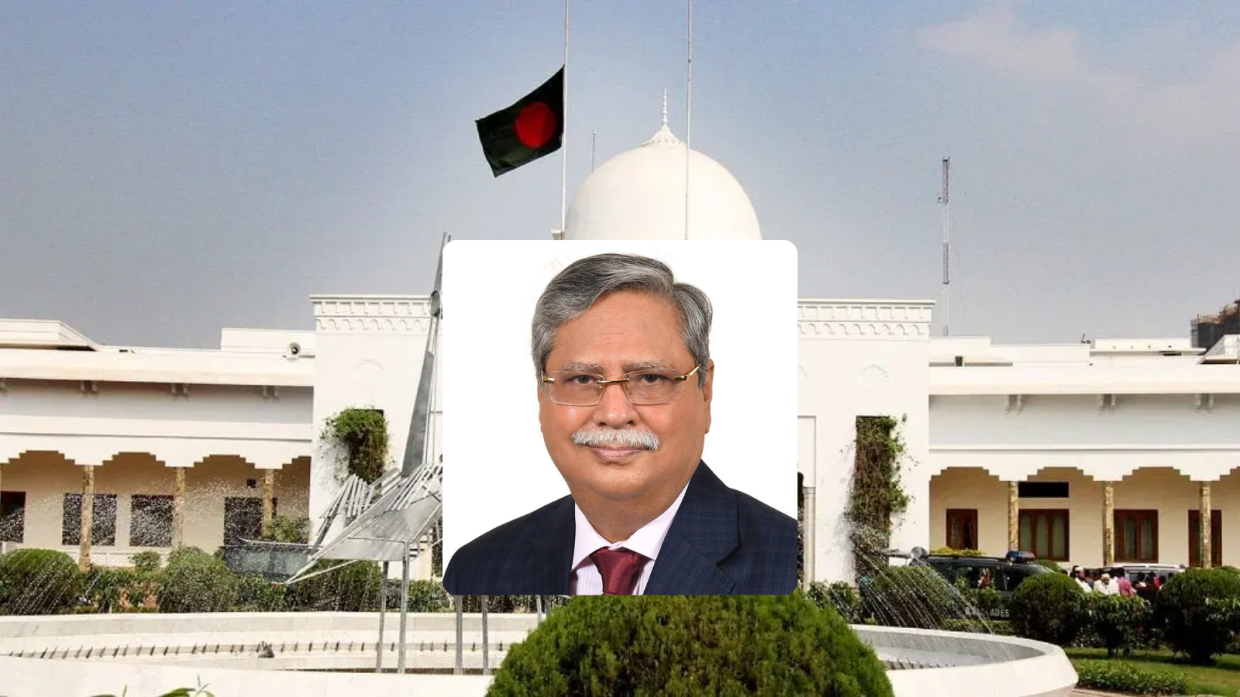
President Mohammed Shahabuddin of Bangladesh is expected to resign imminently, according to informed sources tracking the country's shifting political landscape. His departure would mark a significant turning point in the nation's governance structure, removing the last remaining top constitutional figure from the period before July's watershed mass uprising that fundamentally reshaped the country's power dynamics.
Shahabuddin assumed the presidency in April 2023, predating the tumultuous events of July 2024 that triggered widespread upheaval and forced major institutional changes. His continued tenure has increasingly become viewed as anachronistic by current power holders, particularly as Bangladesh's leadership seeks to establish fresh political legitimacy under the BNP-led government that took office in February this year. Multiple high-level government sources have signalled that his departure is now treated as merely a matter of timing rather than a substantive question.
The impetus for his expected resignation intensified following a phone conversation he held with exiled former Prime Minister Sheikh Hasina during a medical visit to London in May. Intelligence agencies subsequently learned of the contact, prompting officials to informally suggest to Shahabuddin that he consider stepping down. Hasina, who has remained in India since the July uprising and faces a death sentence in absentia within Bangladesh, has announced that she and senior Awami League figures intend to return to the country around December and surrender themselves to authorities. This development has seemingly galvanised government determination to consolidate control and eliminate potential institutional vulnerabilities.
BNP insiders have described the situation as considerably more intricate than a single phone call, pointing to broader strategic considerations driving the expected transition. The government's unease extends beyond the Hasina conversation to concerns that Shahabuddin may be attempting to reestablish connections with various political actors, a development that officials view with considerable suspicion. Retaining a figure associated with the pre-uprising political order at such a sensitive moment when the government is working to consolidate authority and prevent Awami League reorganisation is increasingly judged as imprudent.
The government's vigilance regarding Awami League activities has markedly intensified. Prime Minister Tarique Rahman recently directed cabinet authorities to strengthen enforcement actions against the Awami League alongside affiliated youth and student organisations. Intelligence reports indicate that some Awami League operatives within Bangladesh are attempting to rebuild organisational structures while their principal leaders remain outside the country. In this context, removing Shahabuddin—who served under the previous Awami League administration and might be perceived as sympathetic to that faction—serves to communicate resolute governmental commitment to preventing any destabilisation.
Shababuddin himself has previously indicated willingness to depart from office. During the interim government period in December 2025, he publicly stated his intention to resign midway through his term following parliamentary elections scheduled for February, citing feelings of humiliation from how he was treated. Following the BNP government's assumption of power, he reiterated in a February interview that he would voluntarily step down if the government preferred his departure, whilst remaining if asked to stay. These statements have positioned his resignation less as a forced removal and more as an expected transition aligned with his own earlier signals.
Constitutional procedures are already established for managing his departure. Should Shahabuddin resign, the Speaker of Parliament will assume the role of acting president until a new presidential election takes place. This mechanism ensures administrative continuity whilst the government determines who should occupy the position permanently. Unlike the uncertainty characterising his initial appointment, any successor would presumably enjoy clearer alignment with the current administration's political objectives and temporal origins.
Government insiders characterise Shahabuddin's exit as a natural evolution rather than a dramatic removal. One high-level source told The Daily Star that it was inevitable he would eventually depart, framing the resignation not as punishment but as a logical consequence of his pre-uprising background. Officials have concluded that maintaining a former-era figure in Bangladesh's highest constitutional position is incompatible with the fresh political order emerging from last year's mass uprising. The emphasis on his attempts to reactivate old political networks suggests government anxiety about potential internal contradictions within state institutions.
Timing considerations remain fluid, though sources indicate a decision could materialise within days. Shababuddin has a scheduled meeting on July 29 with non-resident ambassadors from four countries, an engagement that may or may not precede any formal announcement. The absence of predetermined resignation timing reflects the government's apparent preference for managing the transition smoothly rather than precipitously, though the consensus among informed observers is that the outcome is now largely predetermined.
For regional observers, Bangladesh's institutional recalibration carries broader implications. The removal of pre-uprising constitutional figures represents the consolidation phase following revolutionary political change, a pattern familiar throughout South Asian history. The government's evident determination to prevent Awami League reconstitution during the critical months before Hasina's announced December return suggests that current authorities view this period as strategically crucial. Southeast Asian governments monitoring Bangladesh's trajectory will likely view these moves as typical state reconstruction efforts following major political ruptures, though they underscore the continuing instability characterising the country's democratic institutions and the personalised nature of its political power structures.

