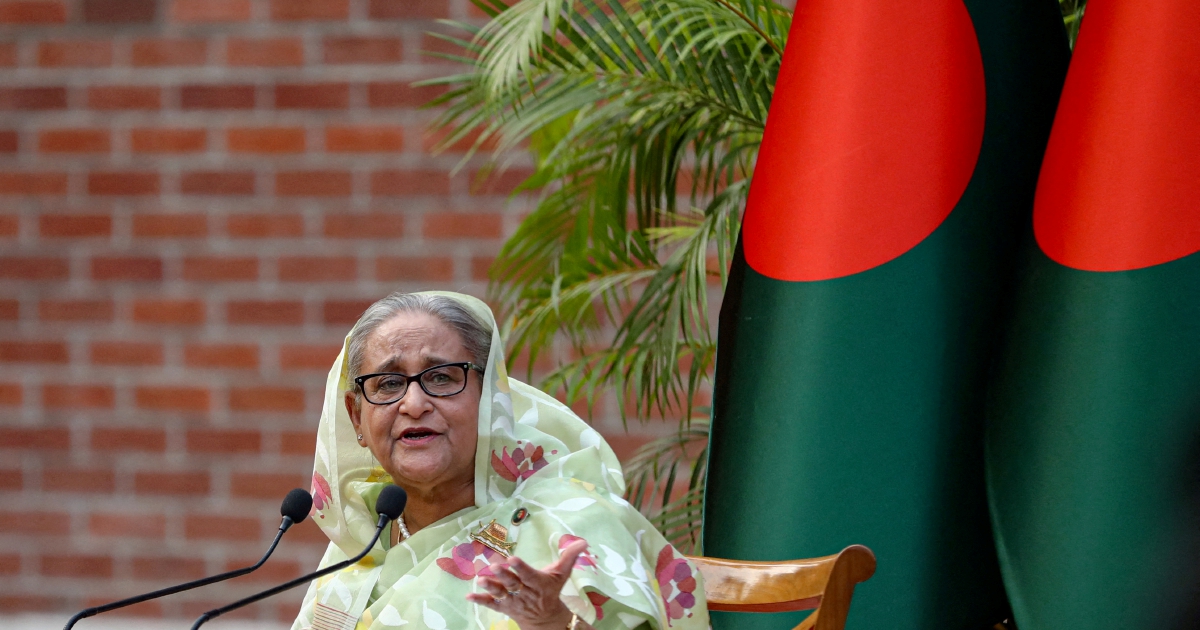
Bangladesh has moved to seize assets valued at 760 billion taka, equivalent to roughly US$6.2 billion, that authorities contend are linked to former Prime Minister Sheikh Hasina, members of her immediate family, and a network of ten major business groups. The confiscation, announced by officials on Wednesday, represents one of the most substantial asset seizures in the country's recent political history and signals the incoming administration's commitment to investigating alleged financial misconduct during Hasina's tenure.
The scale of the asset freeze underscores the complex web of commercial interests that have become intertwined with Bangladesh's political apparatus over decades. The targeted entities span multiple economic sectors, suggesting investigations extend beyond a single company or industry. Authorities have indicated that preliminary inquiries identified financial flows and property holdings that warrant freezing pending formal legal proceedings. The 760 billion taka figure encompasses cash holdings, real estate, business shares, and other valuable assets distributed across both domestic and international accounts.
For Malaysian readers and broader Southeast Asian observers, Bangladesh's action reflects a pattern increasingly visible across the region: newly installed governments conducting high-profile asset freezes and corruption investigations targeting their predecessors. This mirrors similar developments in Malaysia following the 2018 change of government, when authorities pursued investigations into 1Malaysia Development Berhad and related figures. Such transitions highlight the institutional vulnerability that occurs when political power changes hands, particularly when the transition involves significant popular or military pressure rather than electoral processes.
The Hasina family's prominence in Bangladesh's commercial landscape developed over decades of political influence. Sheikh Hasina served as Prime Minister across multiple periods, most recently from 2009 until her departure, during which her government shaped regulatory environments, awarded contracts, and granted licenses that enriched connected business interests. The extended family network, including her son Sajeeb Wazed and daughter Wazed Sarmila, had acquired substantial holdings in telecommunications, real estate, and other sectors. These accumulations, often justified by supporters as legitimate business success, are now being scrutinised as potentially stemming from preferential access and insider advantages.
The ten business groups identified in the asset seizure order require careful examination to understand the full scope of what authorities are investigating. While specific company names have not been exhaustively detailed in initial reports, the breadth suggests coordination across multiple holding structures and subsidiaries. Such networks typically operate through layers of proxy ownership, requiring forensic financial analysis to unravel actual beneficial interest. Bangladesh's financial investigation authorities will face substantial technical challenges in tracing asset flows, particularly for holdings that may have been transferred to third parties or moved across international borders.
The timing of the confiscation follows Hasina's exit from Bangladesh amid significant political upheaval. Her departure came amid widespread protests that escalated into a generational conflict between youth-led movements and the established political structure. The confiscation announcement serves multiple political functions simultaneously: it addresses popular demands for accountability, establishes the legitimacy of the transitional administration through decisive anti-corruption action, and potentially raises government revenue that could be redirected toward stabilising the economy or addressing fiscal pressures.
From a regional perspective, Bangladesh's asset seizure operations raise important questions about the rule of law and predictability of investment environments in South Asia. While investigations into genuine corruption merit scrutiny, the scale and speed of these confiscations may concern legitimate business operators who fear retroactive application of political standards to commercial activity. Malaysian investors and companies with operations in Bangladesh will likely monitor how these investigations develop, particularly regarding due process protections and the transparency of asset recovery proceedings.
The freezing of assets differs from final confiscation and requires subsequent legal proceedings to determine whether seized holdings should be permanently transferred to the state, returned to respondents, or partially retained pending settlement of financial claims. Bangladesh's courts will need to examine evidence supporting the designation of assets as ill-gotten gains versus legitimately acquired property that merely benefited from proximity to political power. This distinction matters considerably for establishing durable legal precedents and maintaining confidence in institutional processes.
International dimensions complicate the enforcement picture significantly. If substantial portions of seized assets reside in foreign jurisdictions, Bangladesh will require cooperation from other governments and financial regulators to enforce freezes and execute asset recovery. Previous regional experiences demonstrate that cross-border asset tracing can consume years of diplomatic effort with uncertain outcomes. Countries including Malaysia, Singapore, and others where wealthy Bangladeshis maintain overseas holdings may receive formal requests for cooperation, establishing focal points for international legal collaboration.
The investigation targeting the Hasina network reflects broader accountability pressures emerging across South Asia. Public demands for transparency regarding political enrichment have intensified as social media enables rapid dissemination of allegations and scrutiny of unexplained wealth accumulation. Bangladesh's incoming administration confronts expectations to demonstrate concrete results in anti-corruption efforts, making visible asset seizures politically significant regardless of ultimate legal outcomes.
Longer-term implications extend to Bangladesh's economic governance architecture. If investigations reveal systematic corruption embedded within regulatory institutions and privatisation processes, authorities may face pressure to reform procurement procedures, strengthen asset disclosure requirements, and enhance financial transparency mechanisms. Such institutional reforms typically require sustained political will and technical investment that extends beyond initial post-transition enthusiasm.
For Malaysian readers following regional political developments, Bangladesh's unfolding situation provides instructive parallels regarding post-transition governance challenges. Both nations have experienced leadership changes involving investigation of predecessor administrations, raising common questions about balancing accountability with institutional stability, ensuring due process while addressing public demands for justice, and rebuilding confidence in democratic institutions following political crises.

