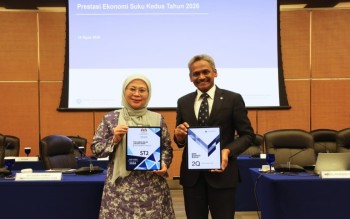
Bank Negara Malaysia has signalled confidence in its economic outlook by maintaining the 2026 gross domestic product growth forecast at 5 per cent, even as global headwinds and geopolitical tensions threaten to destabilise emerging markets across Asia. The central bank's decision to hold its projection reflects an assessment that Malaysia's domestic fundamentals remain sufficiently robust to weather near-term external shocks, though Governor Datuk Seri Abdul Rasheed Ghaffour acknowledged that revisions may become necessary during the Budget announcement process.
The optimistic stance draws support from Malaysia's economic performance in the second quarter, when GDP expanded by 6.0 per cent—outpacing the Department of Statistics Malaysia's initial advance estimate of 5.8 per cent. This overperformance, combined with growth exceeding expectations in the preceding three quarters, has provided policymakers with reason to maintain their baseline scenario. For Malaysian investors and businesses planning capital expenditures and hiring decisions, the signal from Bank Negara suggests that the conditions supporting expansion are unlikely to evaporate in the near term, though prudence remains warranted given external volatility.
Domestic demand has emerged as the principal engine propelling Malaysia's economy forward, with consumption, investment, and government spending all contributing meaningfully to growth. Household consumption specifically remained resilient at 4.8 per cent in the second quarter, underpinned by rising incomes, accumulated household savings, and targeted government policies designed to support purchasing power. The central bank's analysis reveals that household borrowing plays only a minor role in driving consumption growth, suggesting that expansion is built on comparatively sustainable foundations rather than debt-fuelled excess—a distinction that matters considerably for long-term economic stability in a region where consumer credit has become a focal point for regulators and analysts alike.
The external sector has provided substantial ballast to Malaysia's growth trajectory, particularly in the previous quarter, with export performance demonstrating meaningful diversity across product categories. Both electrical and electronics exports, which have traditionally anchored Malaysia's manufacturing base and regional competitiveness, and non-E&E shipments posted growth during the measurement period. Beyond traditional goods exports, Malaysia's information and communications technology services sector has gained momentum, reflecting the economy's gradual transition toward higher-value-added activities. This diversification across export categories and sectors reduces Malaysia's vulnerability to demand shocks in any single market or product line—a resilience factor that distinguishes it from economies heavily dependent on commodity cycles or narrow manufacturing niches.
Governor Abdul Rasheed emphasised that Malaysia's growth profile has remained broad-based across multiple demand components and sectoral contributors rather than concentrated in one or two areas. Such distribution of growth drivers typically correlates with more durable economic expansions, as weakness in a single sector or demand component can be partially offset by strength elsewhere. For Southeast Asian observers, Malaysia's ability to generate growth across diverse channels stands in contrast to economies where expansion may hinge more narrowly on specific sectors or export destinations, making the Malaysian experience a benchmark for balanced development within the region.
Nonetheless, Bank Negara has flagged mounting uncertainties emanating from the global economy and escalating geopolitical tensions as potential headwinds that could moderate growth in coming quarters. The central bank's candid acknowledgement of these risks—even while maintaining its baseline forecast—reflects a policy approach that attempts to balance confidence in near-term momentum with appropriate caution about tail risks. For investors with exposure to Malaysia, this suggests that central bankers are monitoring external developments closely and may be prepared to adjust policy or projections if conditions deteriorate more sharply than currently anticipated.
Among the specific external pressures commanding attention from policymakers is the phenomenon of El Niño, which threatens to disrupt agricultural production and potentially constrain growth in sectors dependent on climate-sensitive inputs. Bank Negara's preliminary assessment suggests that economic impacts from El Niño would manifest gradually rather than abruptly, and would be largely concentrated within the agricultural sector rather than spreading widely across the broader economy. Nevertheless, the central bank has urged businesses and households to begin preparing contingency plans and adopting adaptation strategies should climatic conditions worsen—a prudent stance that acknowledges the lag between weather shocks and their full economic consequences.
The retention of the 5 per cent growth target carries implications for Malaysian fiscal policy and government spending plans extending into 2026. If the economy indeed expands at or near this pace, government revenue from taxation and other sources should expand accordingly, potentially providing fiscal room for policy initiatives announced in the Budget. Conversely, should external shocks cause growth to disappoint relative to the 5 per cent baseline, the government may face tighter constraints on discretionary spending—a dynamic that underscores the importance of Bank Negara's periodic reassessments during Budget deliberations.
For the broader Southeast Asian region, Malaysia's steady-state growth forecast and the factors supporting it offer a useful counterpoint to narratives of widespread economic deceleration. The diversification of Malaysia's export base, the resilience of household consumption backed by income rather than unsustainable borrowing, and the contribution of services alongside traditional manufacturing all suggest an economy moving toward a somewhat more stable trajectory than existed historically. Whether this pattern can be sustained will depend substantially on whether external shocks materialize as severely as some analysts have feared, and whether Malaysia's policymakers can continue balancing growth-friendly conditions with prudent risk management.

