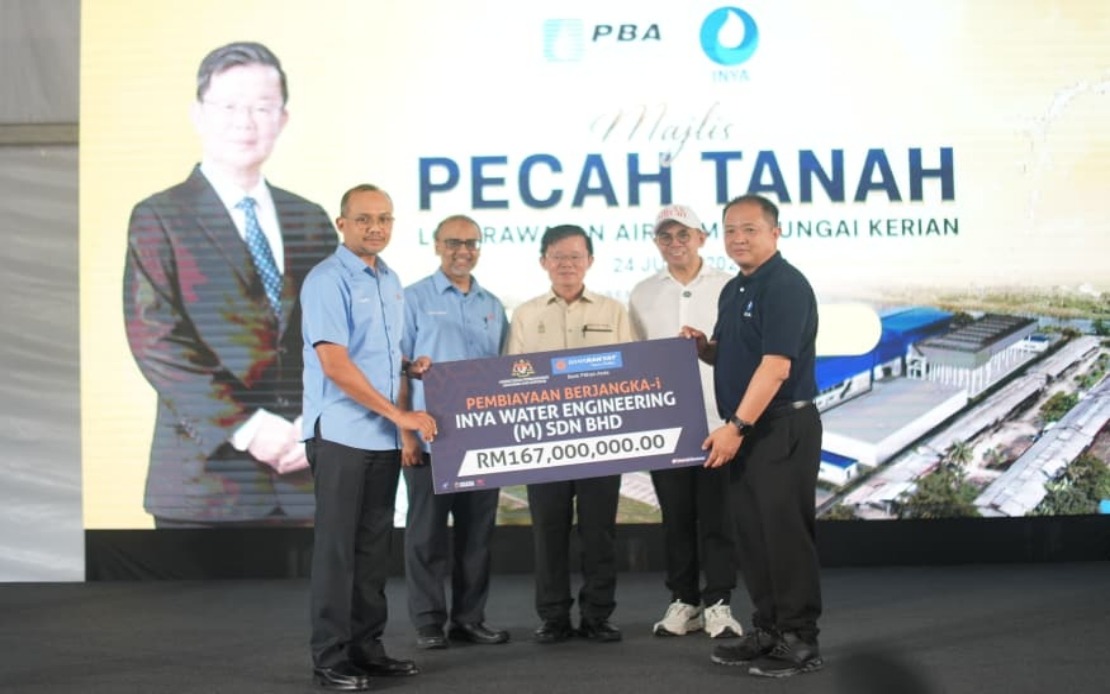
Bank Rakyat has committed RM167 million in financing for the Sungai Kerian Water Treatment Plant in Seberang Perai Selatan, positioning itself as the sole financial backer for what represents a significant diversification in the institution's portfolio beyond traditional small business lending. The amount covers 80 per cent of the overall RM209 million project cost, signalling institutional confidence in Penang's water infrastructure modernisation agenda and the viability of alternative financing models for essential utilities.
Entrepreneur and Cooperatives Development Minister Steven Sim framed the financing decision as emblematic of Bank Rakyat's expanded mandate, which extends beyond supporting micro, small and medium enterprises to encompass critical infrastructure that underpins broader economic growth. According to Sim, this investment reflects a strategic recognition that water security directly influences industrial competitiveness and consumer welfare, positioning the bank as a development institution rather than purely a commercial lender. The move suggests that Malaysian development finance is increasingly flowing toward infrastructure bottlenecks that constrain regional economic activity.
The Sungai Kerian facility will operate under a Build-Operate-Transfer arrangement spanning 30 years, with private operator Inya Water Engineering (M) Sdn Bhd managing construction, operations and maintenance before transferring ownership to the Penang Water Supply Corporation (PBAPP) at the concession's conclusion. Bank Rakyat's commitment extends across a 15-year repayment horizon, supplemented by a two-year grace period that effectively defers debt servicing obligations during the plant's initial operational ramp-up phase. This financial structure reflects emerging best practice in infrastructure financing, where grace periods ease cash flow pressures during revenue-generation commencement.
Penang Chief Minister Chow Kon Yeow emphasised that the treatment plant represents the state's inaugural deployment of the BOT model for water supply infrastructure, marking a departure from the traditional public-sector construction and operation paradigm. Commencing operations in mid-2027, the facility will supply 80 million litres of treated water daily to approximately 223,000 residents across Seberang Perai Selatan and Seberang Perai Tengah, addressing acute supply constraints that have periodically affected these densely populated areas. The 80-megalitre capacity addition, whilst modest relative to PBAPP's total 2023 production of 1,208 megalitres daily, addresses specific geographic demand concentrations.
The water pricing framework underpinning the arrangement establishes an initial rate of RM0.98 per cubic metre, commencing in 2027, with quinquennial price reviews thereafter. PBAPP has absorbed the cost differential for the facility's first two operational years as a means of insulating consumers from tariff increases during the critical stabilisation phase. This subsidy arrangement reflects political sensitivity surrounding utility rate increases in Malaysia, where water pricing remains contentious despite chronic underinvestment. The decision to shield consumers from immediate cost pass-through underscores the tension between cost-recovery principles and electoral considerations in infrastructure financing.
Chow provided explicit assurance that the plant's operation will not precipitate tariff increases in 2027 and 2028, explicitly decoupling the infrastructure investment from near-term consumer impacts. This commitment proves consequential for Penang's competitive positioning, as higher utility costs could discourage industrial expansion and affect household budgets across the middle and working classes. The two-year price freeze signals state government willingness to temporarily absorb incremental water supply costs as an investment in economic stability and social cohesion.
The financing arrangement carries significance beyond Penang's borders, demonstrating the viability of public-private partnership models for water infrastructure across Southeast Asia, where aging systems and rising demand pressures replicate Penang's challenges. Malaysia's experience with BOT concessions spans decades, yet deployment in essential utilities remains relatively circumscribed, partly due to regulatory complexity and the political sensitivity of privatising core services. The Sungai Kerian project consequently offers a template for other Malaysian states grappling with water supply deficits whilst constrained by fiscal capacity.
Bank Rakyat's prominent role as sole financier elevates the institution's profile in infrastructure markets whilst distributing concentration risk across the project's 30-year lifespan. Unlike commercial banks that typically syndicate large infrastructure exposure, Bank Rakyat's assumption of undiversified credit risk reflects either substantial confidence in operational cash flows or a policy mandate encouraging national development institutions to shoulder infrastructure financing responsibilities that private markets consider insufficiently lucrative. The arrangement suggests that state-linked institutions bear disproportionate risk in Malaysia's infrastructure pipeline.
The conventional water treatment technology deployed at Sungai Kerian, combined with the innovative financing structure, reflects pragmatism over technological ambition. Advanced purification systems capable of augmenting supply through wastewater recycling remain absent from the specification, reflecting cost constraints and the comparatively simpler engineering required for conventional treatment. As Malaysia confronts growing water stress, particularly in urbanised regions, the reliance on conventional approaches rather than integrated demand-management and recycling solutions may prove insufficient to address medium-term scarcity.
For Malaysian policymakers, the Sungai Kerian project exemplifies how development finance institutions can catalyse infrastructure investment when fiscal space proves constrained. Bank Rakyat's RM167 million commitment unlocks broader economic benefits whilst establishing a financing precedent that could encourage similar arrangements for transport, energy and sanitation infrastructure across the country. Yet the model's scalability depends on continued willingness of state-controlled institutions to accept infrastructure risk, a sustainability question that becomes acute if project returns deteriorate or macroeconomic conditions tighten capital availability.
The implicit subsidy embedded within the two-year cost absorption period and the extended grace arrangement merit scrutiny regarding long-term fiscal sustainability. If such arrangements proliferate across Malaysia's infrastructure programmes, cumulative contingent liabilities could materially constrain future government expenditure. The Sungai Kerian precedent thus warrants careful evaluation as additional water, energy and transport projects seek similar financing structures, as the aggregate impact of multiple grace periods and cost deferrals could gradually constrain Malaysia's fiscal flexibility during cyclical downturns.

