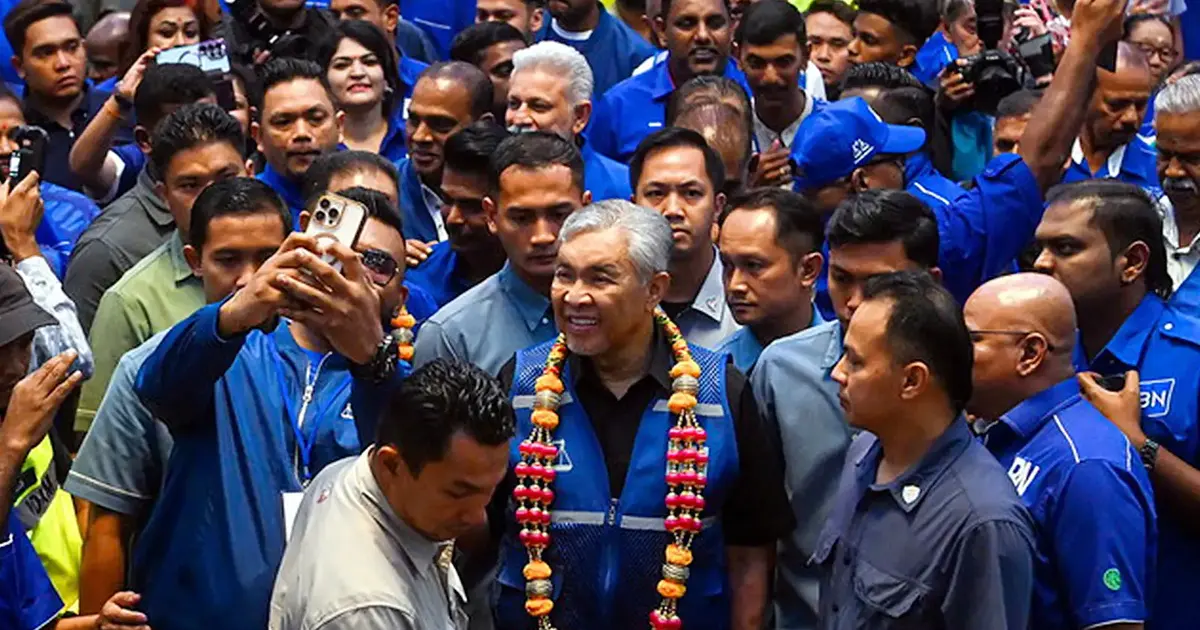
Barisan Nasional chairman Ahmad Zahid Hamidi has publicly committed to allocating two executive council positions specifically for representatives of the Indian community should his coalition triumph in the forthcoming Negeri Sembilan state election. This pledge represents a deliberate strategy by the long-established political alliance to solidify its support base among the Indian electorate, a demographic group that constitutes a meaningful portion of the state's population and has historically formed a core voting bloc for component parties within the BN framework.
Zahid's confidence in securing electoral success appears anchored in the recent performance of the Malaysian Indian Congress (MIC), the BN's traditional representative for the Indian community. The MIC achieved a remarkable hundred-percent success rate in the Johor state election, winning every contested seat fielded under its banner. This exceptional outcome suggests momentum and renewed voter confidence in the party's ability to champion Indian-community interests at the state and federal levels, a dynamic that could prove equally decisive in Negeri Sembilan's political landscape.
The composition of executive councils in Malaysian state governments carries significant symbolic and practical importance. Exco positions grant appointed individuals real authority over state portfolio matters such as education, local government, agriculture, or welfare—areas of particular concern to the communities they represent. By explicitly committing to two such posts for Indian representatives, Zahid signals both a recognition of minority representation principles and a desire to ensure tangible decision-making power flows to Indian-community leaders within any future BN-led Negeri Sembilan administration.
The timing of this announcement reflects BN's broader revival strategy following years of electoral setbacks that culminated in the 2018 general election defeat. Since regaining federal power in late 2021 through the Ismail Sabri administration and subsequently consolidating leadership under Anwar Ibrahim, the coalition has worked methodically to rebuild trust with traditional supporters. Minority communities, particularly the Indian electorate, had drifted toward opposition parties in earlier elections, making their reactivation critical to BN's electoral mathematics in contested states like Negeri Sembilan.
MIC's organisational structure and grassroots networks position it as the primary vehicle through which the Indian community's interests are channelled within the BN framework. Unlike the much larger United Malays National Organisation (UMNO) or the Malaysian Chinese Association (MCA), MIC operates with more concentrated resources and must demonstrate tangible returns on electoral loyalty. The Johor result provided compelling evidence of voter appetite for MIC representation when the party presents a credible campaign and leadership, factors that Zahid evidently believes remain in place for Negeri Sembilan.
Negeri Sembilan's political context differs somewhat from Johor's, presenting both opportunities and risks for the BN coalition. While the state has long been regarded as relatively stable BN territory, emerging political fragmentation and the growing influence of Perikatan Nasional in some constituencies suggest the 2023 state elections will prove more competitive than previously assumed. Indian voters in Negeri Sembilan, scattered across both urban centres and mining-dependent rural districts, represent a swing demographic whose mobilisation could determine tight contests in specific constituencies.
The explicit nature of Zahid's commitment—naming the precise number of exco positions to be allocated—suggests confidence in coalition victory but also reflects evolving norms around affirmative political representation. Malaysian political practice increasingly expects written or public commitments on minority representation as evidence of genuine inclusion rather than patronage. Such pledges serve to legitimise coalition arrangements and formalise the terms of political partnership between major parties and their constituent community wings.
For MIC specifically, the promise of executive council representation offers practical leverage in internal party elections and succession deliberations. Party leaders can point to concrete achievements and anticipated ministerial portfolios when appealing to grassroots members and candidates. This institutional benefit helps sustain party cohesion during campaigns, particularly important given that sustained internal criticism or dissatisfaction could prompt further defections to opposition parties or Perikatan alternatives.
The broader Malaysian context suggests that Indian-community political preferences remain fluid and contest-dependent rather than locked into historical patterns. Recent election cycles have demonstrated that Indian voters respond to local candidacy quality, perceived government delivery on community concerns such as higher education access and economic opportunity, and perceptions of respect and representation at senior levels. Zahid's statement attempts to address the representation component directly through advance assignment of executive council seats.
Further strategic implications for Negeri Sembilan's Indian electorate extend to portfolio allocation. The identity and responsibility areas of the two appointed exco members will significantly shape community perception of whether this promise represents substantive power-sharing or ceremonial inclusion. Strategic portfolios carrying budget authority and decision-making influence over programmes affecting Indian communities would carry far greater weight than positions with limited administrative function or secondary importance.
Looking forward, the Negeri Sembilan election will serve as a barometer of whether BN's reconciliation efforts with minority communities—articulated through pledges such as Zahid's—translate into actual electoral mobilisation and voting shifts. The two exco posts represent a measurable commitment against which the coalition's sincerity can be evaluated both before and after the election, potentially establishing precedents for how BN addresses representation in other contested states.

