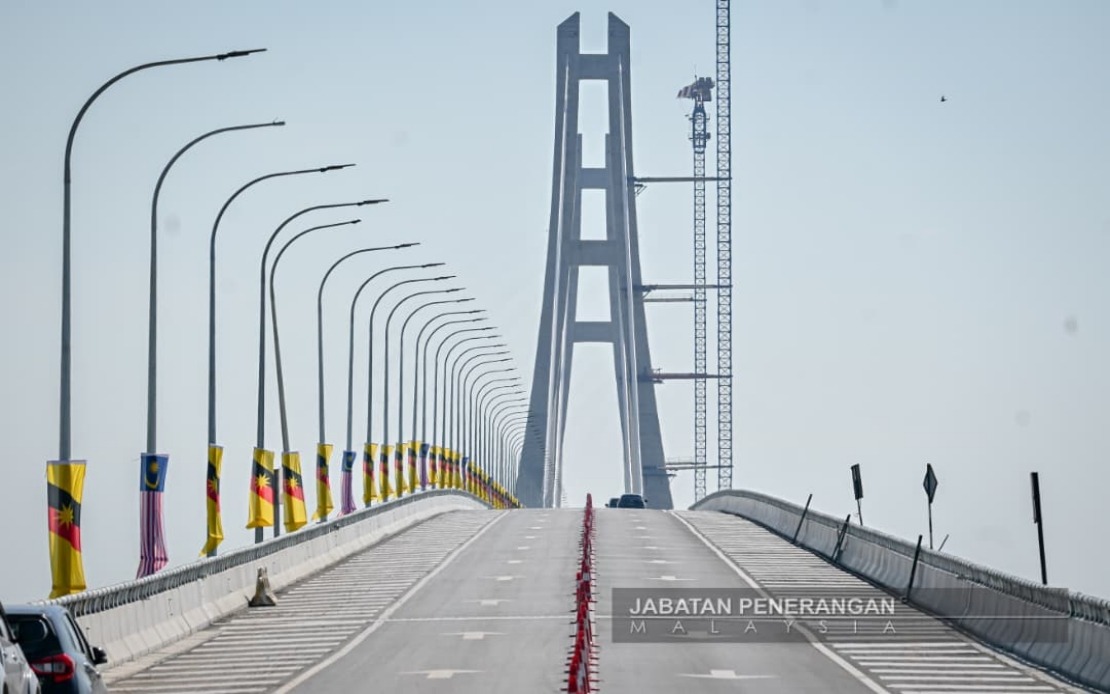
The opening of the Batang Lupar 1 Bridge represents a watershed moment in Sarawak's infrastructure trajectory, promising to reshape economic dynamics and connectivity across the state's coastal regions. At 4.844 kilometres in length and constructed at a cost of RM848.75 million, the bridge has been recognised by the Malaysia Book of Records as the longest river bridge in the country, officially inaugurated by Sarawak Premier Tan Sri Abang Johari Tun Openg. The project emerges as a critical solution to decades of logistical constraints that have hampered development in the coastal districts of Sebuyau, Betong, Sri Aman and Samarahan, promising substantial spillover benefits for the broader region.
The infrastructure development addresses a long-standing vulnerability in the region's connectivity matrix. For generations, residents and commerce across the Batang Lupar River relied on ferry services that proved unreliable and occasionally hazardous, particularly during adverse weather conditions when rough waves and strong winds rendered crossings unpredictable and dangerous. The bridge effectively eliminates this dependency, providing the first permanent road link connecting Kuching with Sri Aman, Betong and Samarahan. This transformation extends far beyond mere convenience, fundamentally altering the operational landscape for agricultural producers, small business operators and individuals whose livelihoods depend on efficient movement across these districts.
Deputy Premier Datuk Amar Douglas Uggah Embas, who oversees the state's infrastructure and port development portfolio, emphasised the dramatic efficiency gains embedded in this project. The bridge forms a cornerstone component of the broader RM3.21 billion Sarawak Coastal Road network, itself part of the larger Sarawak Second Trunk Road initiative targeting completion by 2030. Most significantly, the completed infrastructure reduces travel distance between Kuching and Sibu from 396 kilometres to 252 kilometres—a reduction of 144 kilometres that translates into substantially lower logistics costs, reduced fuel consumption and dramatically shortened transit times for commercial operations.
These efficiency improvements carry substantial implications for Sarawak's agricultural sector and rural economy. The coastal districts have traditionally been constrained by transportation bottlenecks that inflated distribution costs and limited market access for local producers. Agricultural commodities moving from Betong and Sri Aman toward Kuching's urban markets and export terminals now face a fundamentally different operating environment. The bridge removes a critical friction point in supply chains, enabling farmers and agribusinesses to compete more effectively in regional markets and reduce post-harvest losses incurred during extended ferry crossings.
The project also carries strategic significance within Sarawak's broader development vision. Premier Abang Johari characterised the bridge opening as marking completion of crucial connectivity between Kuching, Sri Aman and Betong, describing it as a historic achievement driven by persistent community demands. The infrastructure investment reflects the state government's responsiveness to constituent needs, with both former and current elected representatives channelling local aspirations into concrete development outcomes. This responsiveness to grassroots demands carries political implications beyond immediate infrastructure benefits, potentially strengthening the ruling coalition's legitimacy within these constituencies.
The Sarawak Coastal Road project represents a significant investment in regional reorientation toward maritime and coastal development. Rather than concentrating growth along traditional inland corridors, the coastal road network deliberately channels infrastructure spending toward areas previously marginalised by geography. This development pattern acknowledges that Sarawak's future prosperity increasingly depends on integrating coastal communities into broader economic networks and leveraging their geographic proximity to maritime trade routes and resource extraction zones.
From a Southeast Asian perspective, this bridge fits into broader patterns of infrastructure-driven regional integration accelerating across the ASEAN region. Malaysia's commitment to developing domestic coastal corridors parallels similar initiatives in Indonesia, Thailand and Vietnam, where governments prioritise connecting previously isolated regions to urban markets and international trade networks. Sarawak's coastal road network, when fully completed, will position the state as a more attractive destination for investment and tourism while creating new opportunities for cross-border commerce with Indonesia's adjacent provinces.
The recognition from Malaysia Book of Records carries symbolic weight beyond engineering achievement. Such official acknowledgment transforms the bridge from a functional infrastructure asset into a marquee landmark representing Sarawak's technological capabilities and development ambitions. This symbolic elevation proves particularly valuable for positioning Sarawak as a modern, economically dynamic state within Malaysia's federation and within the broader Southeast Asian economic landscape.
The elimination of ferry dependence warrants particular emphasis given the safety implications embedded in this transition. Ferry services operating in strong tidal conditions presented genuine hazards to passengers and cargo, with documented incidents demonstrating the human costs of inadequate transportation infrastructure. The bridge substitutes predictable, weather-independent road connectivity for an inherently vulnerable maritime transport system. This safety dimension, often overshadowed in economic analyses, fundamentally improves quality of life for residents across these coastal districts while removing a source of chronic uncertainty for businesses depending on reliable transport.
Looking forward, the bridge's opening should catalyse downstream investment and development activity across the coastal corridor. Real estate developers, agricultural enterprises, manufacturing facilities and logistics operators now confront a transformed investment landscape where previously prohibitive transportation costs become manageable. The state government's continued commitment to completing remaining segments of the coastal road network by 2030 establishes clear infrastructure timelines that allow private sector actors to plan investments with greater confidence. This infrastructure-led development approach, while requiring substantial public investment, creates multiplier effects throughout the regional economy.
The project also demonstrates Sarawak's continued divergence from peninsular Malaysia's development patterns. While national infrastructure planning has traditionally concentrated resources along established growth corridors, Sarawak is deliberately extending connectivity into previously peripheral regions. This decentralised development approach reflects the state's geographic realities and governance structure, where vast distances separate population centres and where comprehensive road networks require substantial investment relative to population density.
For Malaysian policymakers and investors monitoring regional infrastructure trends, the Batang Lupar 1 Bridge exemplifies how strategic infrastructure investment can catalyse broad-based development outcomes across dispersed populations. The project's emphasis on connecting agricultural regions to urban markets offers lessons applicable to rural development challenges throughout Malaysia and the broader region. As infrastructure investment becomes increasingly central to development strategies across Southeast Asia, Sarawak's coastal road initiative provides a substantive case study in translating infrastructure spending into tangible regional economic transformation.

