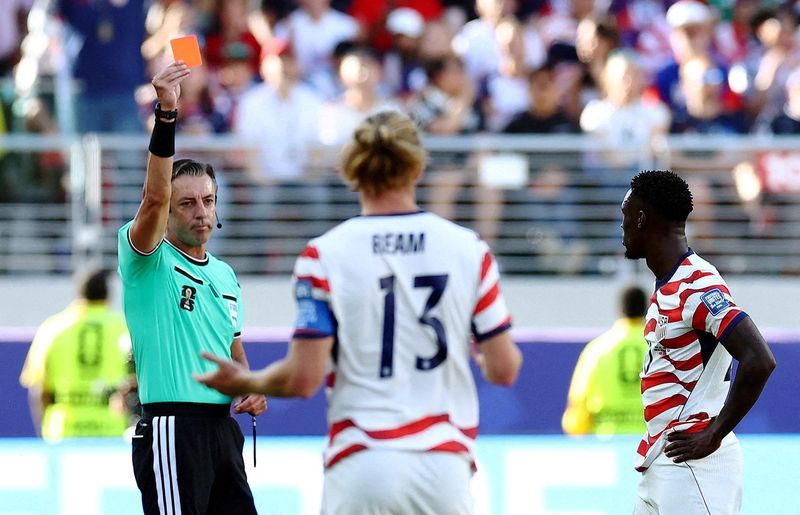
Controversy engulfed the Football World Cup on Monday as Belgium accused FIFA of abandoning its disciplinary standards after the international governing body reversed a red-card suspension for a prominent United States striker, allegedly following direct pressure from U.S. President Donald Trump on FIFA President Gianni Infantino. The decision has sparked a diplomatic and sporting row that extends well beyond the football pitch, raising troubling questions about how political intervention can influence the outcome of major international competitions.
The case centres on FIFA's unprecedented choice to suspend the red-card ban that would have sidelined the American player, enabling him to participate in Belgium's knockout-stage encounter against the United States scheduled for Monday in Seattle. This reversal came after Trump personally contacted FIFA's leadership to reconsider the disciplinary ruling. The move has triggered widespread criticism from Belgian political figures, sporting commentators, and ordinary citizens who view the decision as fundamentally corrupting the integrity of the tournament's established rules.
In interviews conducted across Brussels, members of the Belgian public expressed deep frustration and bewilderment at the circumstances surrounding the suspension's reversal. Therese Kpooubie, a Brussels resident, articulated the core concern animating much of the backlash: the incomprehensibility of erasing a disciplinary decision that was rooted in a player's genuine misconduct during play. She pointed out that referees issue red cards to address serious infractions, and questioned how such a decision could simply vanish from record without addressing whether the original call had been erroneous. Kpooubie suggested that if external political influence had shaped FIFA's reversal, the outcome would represent a shameful betrayal of sporting principles.
Belgium's Deputy Prime Minister Maxime Prevot formally challenged the legitimacy of FIFA's action, issuing a statement suggesting that if Trump's intervention had indeed prompted the disciplinary reversal, the decision would constitute a flagrant violation of fundamental sports governance standards. Prevot's intervention indicates that the matter transcends athletic competition and has acquired the dimensions of a political issue affecting Belgium's national interests and international standing. His statement reflects broader European concerns about the erosion of institutional independence when powerful nations seek to leverage political connections for sporting advantage.
Not all observers interpreted the situation with equal skepticism. Bastien Noel, another Brusselian commentator, counselled the Belgian national team, known colloquially as the Red Devils, to channel any frustration with FIFA's decision into competitive determination on the field. Noel suggested that while the reversal merited acceptance if confirmed, the outcome should not deflect Belgium from its primary objective of demonstrating superior performance and resilience during the match. His perspective reflected a pragmatic acknowledgment that sporting outcomes are ultimately determined by player performance rather than administrative decisions, though he implicitly acknowledged that the fairness question lingered.
The U.S. Embassy in Belgium issued a categorical denial of political interference. Bill White, the U.S. Ambassador to Belgium, stated via Instagram that President Trump would never meddle in FIFA's internal processes, characterizing Trump's involvement merely as offering thanks to FIFA subsequent to the decision rather than preceding it. This formulation, however, proved unconvincing to observers who noted that the timing and nature of Trump's contact with Infantino appeared to precede rather than follow the reversal, suggesting the ambassador's account may have misrepresented the sequence of events.
The incident exposes vulnerabilities within FIFA's disciplinary framework and raises uncomfortable questions about the organization's capacity to insulate itself from political pressure, particularly from leaders of wealthy, powerful nations with significant commercial stakes in tournament outcomes. The reversal of a red-card suspension represents an extreme institutional departure that invites scrutiny of FIFA's governance standards and the consistency with which disciplinary rules are enforced across different national teams and political contexts.
For Malaysia and Southeast Asian football enthusiasts, the episode offers a cautionary lesson about the susceptibility of major international sporting institutions to political manipulation. It suggests that tournament outcomes may be influenced by factors beyond athletic merit when affluent nations leverage diplomatic channels and personal relationships with governing body leadership. The controversy also demonstrates how decisions that affect tournament integrity generate resentment among competing nations and undermine public confidence in the independence of international sports governance.
The broader implications extend beyond this particular World Cup match. If FIFA's disciplinary processes can be substantially altered through political intervention, the credibility of the entire tournament system faces compromised legitimacy. The reversal creates a troubling precedent: future tournament organizers, national associations, and political leaders may interpret the episode as indicating that sufficiently high-level pressure can overturn institutional decisions, thereby degrading the rule-based framework that enables fair competition. For smaller nations like Belgium, such institutional weakness proves particularly disadvantageous, as their limited political influence cannot match the leverage wielded by larger powers.
Kpooubie's closing exhortation to Belgium's national team—urging them to remain focused and deliver victory on the field—captured the sentiment of many Belgian supporters who determined that sporting excellence represented the appropriate response to administrative injustice. Whether Belgium can channel frustration into enhanced performance remains uncertain, but the episode ensures that political controversy will shadow the team's World Cup campaign regardless of match outcomes.

