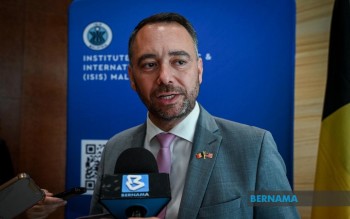
Belgium is positioning itself as a strategic partner in Malaysia's energy transition, with Deputy Prime Minister Maxime Prévot expressing keen interest in collaborating on offshore wind energy development during his inaugural ministerial visit to Kuala Lumpur. Speaking at the 39th Asia-Pacific Roundtable, Prévot highlighted offshore energy as a cornerstone sector for deepened bilateral ties between the two nations, signalling that despite geographic constraints, Belgium's technological prowess in marine renewable energy offers substantial value to Southeast Asian economies navigating their own clean energy pathways.
The significance of Belgium's outreach lies in its counter-intuitive expertise. With merely 60 kilometres of coastline, the European nation has nevertheless developed sophisticated offshore wind capabilities that currently generate two gigawatts of electricity for its population. This achievement becomes more striking when considered against Belgium's ambitious expansion roadmap, which targets scaling capacity to between six and seven gigawatts within the coming years—an energy output equivalent to five to seven nuclear power plants. For Malaysia, which boasts far more extensive maritime resources, such technical knowledge transfer could accelerate the development of comparable renewable infrastructure along its own coastlines.
Prévot positioned offshore energy expansion as integral to Belgium's broader energy security and decarbonisation objectives, framing the sector not merely as environmental imperative but as economic and strategic necessity. The emphasis on energy independence carries particular resonance for Southeast Asian policymakers, where geopolitical vulnerabilities and fossil fuel import dependencies have long constrained policy flexibility. Belgium's experience demonstrates how renewable energy development can simultaneously address climate commitments and reduce external supply vulnerabilities—a dual benefit increasingly important as regional governments calibrate energy strategies against global market volatility and energy security concerns.
Crucially, the Belgian initiative extends beyond bilateral partnership into the broader regional architecture through Europe's substantial financial commitment. The European Union, under its Global Gateway Strategy, has pledged €10 billion to support the ASEAN Power Grid and facilitate region-wide energy transition mechanisms. This funding represents a structural commitment to interconnected energy infrastructure across Southeast Asia, moving beyond isolated national projects toward integrated grid systems that could improve energy efficiency and market stability across the bloc. For Malaysia, participating in such coordinated development offers access to capital and technical expertise while contributing to regional energy resilience.
The ASEAN Power Grid concept itself reflects evolving regional thinking about energy cooperation. Rather than pursuing isolated renewable capacity expansion, the initiative contemplates how neighbouring economies might trade renewable energy across borders, effectively creating a continental renewable energy market. Belgium's involvement signals European confidence in the commercial viability of such models and willingness to support their technical implementation. Malaysian policymakers exploring the economics of offshore wind must consider not only domestic consumption potential but also export prospects to neighbouring markets with high energy demand and limited renewable resources.
Beyond energy, Prévot identified semiconductors, logistics, clinical trials, biotechnology research and pharmaceuticals as complementary sectors offering bilateral cooperation opportunities. This broader portfolio reflects how modern developed economies increasingly view partnerships through multiple industrial vectors simultaneously. Belgium's pharmaceutical and semiconductor capabilities align with Malaysia's strategic positioning as a regional manufacturing and research hub, suggesting possibilities for joint ventures and technology sharing across multiple high-value sectors. The diversification of partnership channels reduces dependency on single sectors and creates cross-sector opportunities for innovation and investment.
The economic dimensions of Belgium-Malaysia engagement are already substantial. Bilateral trade reached RM9.74 billion in 2025, with Malaysian exports comprising RM6.85 billion and Belgian imports accounting for RM2.89 billion. These figures indicate Malaysia's significant role as a supplier to European markets, particularly in raw materials and manufactured goods. Prévot's visit and emphasis on energy cooperation suggests Belgium seeks to deepen this relationship by moving beyond simple goods exchange toward collaborative industrial development, where shared infrastructure and technology create durable competitive advantages for both economies.
Investment patterns underscore growing bilateral engagement. As of 2025, Belgian-backed projects in Malaysia totalled 67 approved initiatives worth RM5.1 billion in committed capital, with potential job creation estimated at 4,605 positions. While these figures remain modest relative to Malaysia's total foreign direct investment, they indicate sustained European interest in Malaysian development opportunities and emerging confidence in the stability of bilateral commercial relationships. Energy sector expansion could substantially increase these figures if offshore wind development proceeds with Belgian technical and financial participation.
Prévot's timing for this inaugural visit—arriving in February 2025 after assuming his ministerial portfolio—reflects Belgium's prioritisation of Asia-Pacific engagement within its broader diplomatic strategy. The EU's increasing focus on ASEAN as a geopolitical counterweight to other major powers has elevated the strategic importance of bilateral relationships with individual Southeast Asian economies. Belgium's emphasis on energy transition and infrastructure investment aligns with European Union policy of building durable economic ties through green technology cooperation, creating constituencies within Asian nations invested in continued European partnership and technological leadership.
The convergence of Malaysia's renewable energy ambitions with Belgium's offshore expertise and European capital availability creates a natural partnership framework. Malaysia possesses maritime geography, growing energy demand, and policy commitment to carbon reduction targets—precisely the conditions where offshore wind investment generates maximum returns. Belgium and the European Union provide technical knowledge, investment capital, and access to advanced technology that Malaysian developers currently source through competitive tendering or foreign partnerships. Direct collaboration could accelerate project timelines and improve technical outcomes while building long-term industrial relationships.
For Malaysian policymakers, the Belgian initiative arrives amid ongoing evaluation of renewable energy pathways. Current electricity generation remains heavily dependent on fossil fuels, though government targets contemplate substantial increases in renewable capacity within the next decade. Offshore wind represents a significant but underdeveloped component of these plans, partly because technical requirements and capital demands exceed those for terrestrial renewables. European partnership could provide both financial accessibility and technical confidence necessary to accelerate offshore development, while contributing to Malaysia's international climate commitments and energy security objectives simultaneously.
The broader context for Belgium's energy outreach includes accelerating European decarbonisation efforts and desire to export renewable technology expertise globally. As European markets mature and offshore wind capacity approaches saturation, companies and governments increasingly target emerging markets with growth potential. Malaysia's combination of maritime resources, economic capacity, and policy openness to foreign investment makes it an attractive market for European renewable energy developers and financial institutions seeking expansion opportunities beyond saturated home markets. Belgian diplomatic engagement essentially creates conditions for expanded commercial engagement across multiple sectors simultaneously.
Moving forward, concrete outcomes from this partnership framework will likely emerge through joint feasibility studies of specific offshore wind projects, technical training initiatives, and potentially direct investment in Malaysian renewable energy ventures. The articulation of offshore energy as a partnership priority, backed by substantial EU financing commitments and Belgian technical expertise, suggests this represents more than diplomatic courtesy. Rather, it reflects genuine strategic alignment where both partners perceive mutual benefit from collaborative energy transition, positioned within broader frameworks of economic engagement and regional infrastructure development across Southeast Asia.

