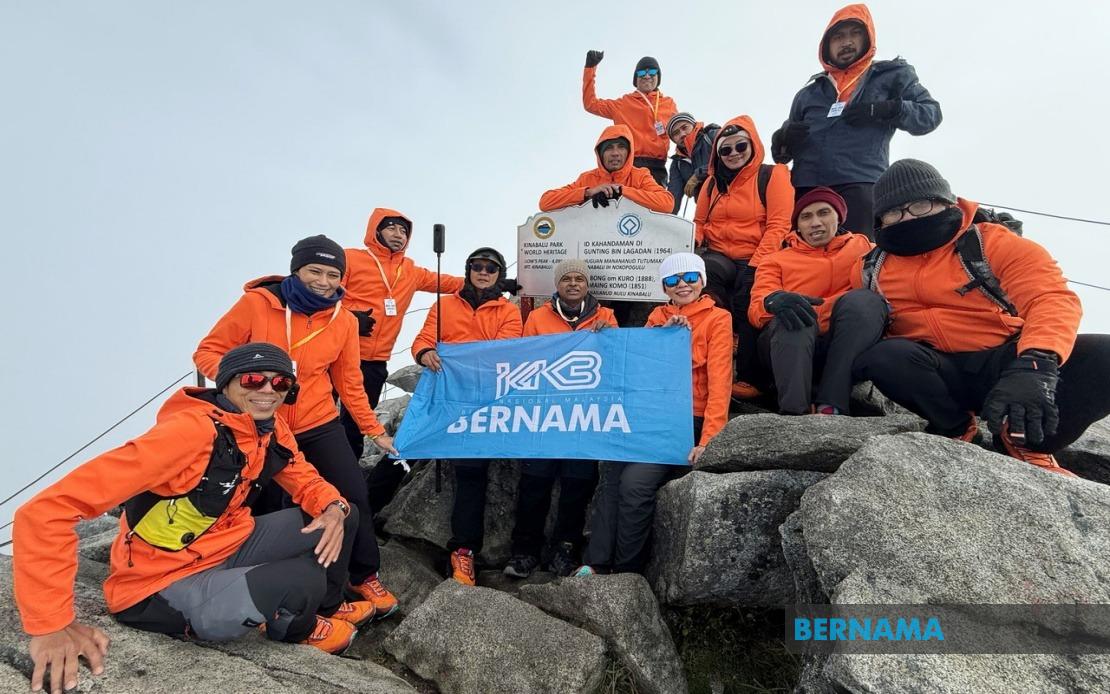
Twenty-three personnel from Bernama, Malaysia's national news agency, successfully completed an expedition to the summit of Mount Kinabalu on July 1, marking a significant moment in the organisation's history during the National Journalists' Day (HAWANA) 2026 celebrations. The ambitious climb brought together journalists, photographers, editors, television crew members and support staff from across the agency's divisions in a coordinated effort that exemplified both professional camaraderie and personal challenge. The team achieved the summit at approximately 7.20 am after an arduous ascent that tested their physical endurance against unforgiving mountain conditions, including heavy rainfall, dense mist and powerful gusts of wind.
Editor-in-Chief Arul Rajoo Durar Raj, who personally led the expedition, underscored the dual significance of the undertaking. The climb was designed not merely as a morale-building exercise but as a deliberate attempt to secure two distinct entries in the Malaysia Book of Records. The first seeks recognition for the largest assemblage of media practitioners from a single organisation to successfully scale Mount Kinabalu, a distinction that reflects the scale and coordination of Bernama's logistical effort. The second aspiration targets an unprecedented achievement: the first media organisation to produce comprehensive news reports in four languages from the mountain's summit, demonstrating Bernama's commitment to multilingual journalism even in extraordinary circumstances.
The expedition route followed the established Timpohon Gate approach, with the team commencing their ascent at 10 am on June 30 before establishing a rest point at Panalaban. This staging location, situated at an intermediate altitude, allowed climbers to acclimate partially to the changing atmospheric conditions before launching their predawn push toward the summit. At 2.30 am on July 1, the exhausted but determined participants resumed their final ascent, navigating steep terrain and treacherous conditions as Mount Kinabalu, which rises 4,095.2 metres above sea level, revealed itself gradually through breaking dawn.
For Arul Rajoo personally, the successful summit marked a historic milestone as the first Editor-in-Chief in Bernama's operational history to reach the peak of Southeast Asia's highest mountain. This achievement carries symbolic weight within the organisation, suggesting leadership commitment to shared challenges and institutional values beyond the conventional newsroom environment. The personal dimension of the expedition underscores how such ventures can humanise organisational leadership while strengthening bonds between senior management and staff across hierarchical structures.
The Bernama Staff Club (KKB), which organised the expedition for the first time, deliberately structured the climb as a multifaceted initiative extending beyond simple tourism or record-chasing. The expedition aimed to reinvigorate the HAWANA 2026 celebrations—an annual recognition of Malaysia's journalism profession—while simultaneously promoting physical fitness, mental resilience and healthy lifestyle choices among agency personnel. In an industry characterised by sedentary desk work and irregular hours, the collective mountain challenge offered staff meaningful opportunities to build institutional cohesion while addressing personal wellness.
Mounting such an expedition requires substantial logistical coordination and financial support. Bernama secured backing from an international sportswear brand BMAI, alongside Malaysian aviation carrier Batik Air and beverage company 100PLUS. Additional organisational partners, including EHH Food Industry Sdn Bhd, Saloma Bistro, Malaysia Airports, Malaysia Insight, UFL, Sabah Parks and Marathon Baker, contributed resources and expertise essential for the expedition's success. This constellation of commercial and governmental support reflects the broader ecosystem surrounding major sporting and cultural events in Malaysia.
Mount Kinabalu itself holds distinctive environmental and cultural significance that contextualises the expedition's symbolic meaning. Designated a UNESCO World Heritage Site, the mountain forms the centrepiece of Kinabalu Park, which encompasses 754 square kilometres of protected rainforest habitat. The broader region, designated as the Kinabalu UNESCO Global Geopark (KUGGp), represents recognition of the area's geological, biological and cultural importance to Sabah and Malaysia generally. Climbing the mountain, therefore, extends beyond personal achievement; it connects participants to environmental conservation narratives and the international prestige attached to UNESCO designations.
The successful expedition carries broader implications for professional journalism in Malaysia. By demonstrating that contemporary news organisations can simultaneously operate in high-pressure professional environments while fostering team development and wellness initiatives, Bernama models an integrated approach to institutional management. The deliberate attempt to produce multilingual news reporting from the summit—an inherently challenging task under extreme conditions—underscores the agency's commitment to linguistic diversity and inclusive journalism across Malaysia's multicultural landscape.
The HAWANA 2026 celebration itself reflects Malaysia's ongoing recognition of journalists' professional contributions to democratic discourse and public information. By embedding an ambitious institutional challenge within this annual commemoration, Bernama signals that professional identity encompasses not merely desk-bound reporting but also shared endeavour, physical resilience and collaborative achievement. Future celebrations may inspire other Malaysian media organisations to undertake comparable initiatives, potentially establishing precedents for industry-wide wellness and team-building practices.

