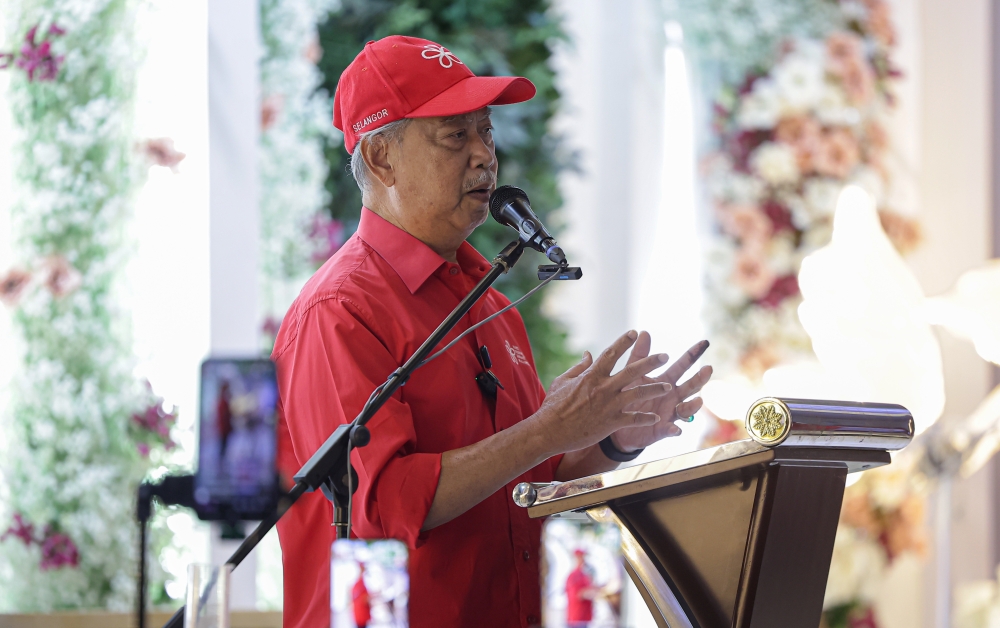
Tan Sri Muhyiddin Yassin has moved to position Parti Pribumi Bersatu Malaysia as Parliament's singular genuine Opposition voice, a declaration that underscores the fractured and increasingly unpredictable landscape of Malaysian politics. The statement reflects not merely Bersatu's organisational standing but signals a fundamental recalibration of power dynamics at a moment when traditional coalition structures have become unmoored from their historical moorings.
The claim hinges on Bersatu's insistence that it maintains an unbending critical posture toward the Federal Government without the compromises that have marked other parties' trajectories. Muhyiddin's assertion arrives as several political entities have navigated towards government alliances, accommodation agreements, or positions of qualified neutrality that blur the conventional Opposition-Government binary. This morphing of the political landscape reflects deeper currents within Malaysian governance: the fluidity of party loyalties, the transactional nature of contemporary coalition-building, and the declining significance of ideological coherence in favour of pragmatic power-sharing arrangements.
Bersatu's positioning as the uncompromising Opposition carries particular resonance given the party's own history of coalition flux. The party's trajectory—from its 2018 role as part of the victorious Pakatan Harapan alliance through its participation in subsequent government configurations, followed by its emergence as a more independently critical force—demonstrates how Malaysian parties have navigated the opportunities and constraints of the post-2018 political settlement. Muhyiddin's current framing effectively repositions Bersatu's political identity, casting its earlier governmental participation not as contradiction but as prudent engagement followed by principled disengagement.
The practical implications of Bersatu's Opposition stance extend beyond symbolic significance. As Parliament's sole authentic Opposition, Bersatu would theoretically command the parliamentary prerogatives and strategic advantages available to that role: enhanced scrutiny rights, elevated speaking opportunities, and positioning as the primary challenger to government policy. These procedural privileges carry weight in a legislature where government supermajorities have become less assured and where even modest Opposition coherence can constrain executive freedom of action. Bersatu's numerical strength in Parliament—while modest compared to the ruling coalition—becomes strategically leveraged when positioned as unified Opposition rather than fragmented dissent.
The timing of Muhyiddin's declaration reflects calculations about Malaysian political momentum. With various political actors exploring realignments ahead of potential electoral contests, establishing Opposition credentials carries value in consolidating support among constituencies disposed toward challenging government authority. Bersatu's appeal to voters discontented with incumbent performance becomes sharpened when the party can present itself as institutionally committed to governance accountability and policy contestation. This positioning particularly resonates in an environment where voter trust in political institutions remains volatile and where perceived authenticity in Opposition politics carries measurable electoral weight.
However, Bersatu's exclusive claim to Opposition authenticity faces substantive challenges. Other parliamentary entities maintain critical independence from government arrangements, and some observers contend that fragmented rather than unified Opposition status may better reflect Malaysia's political reality. The notion of a singular authentic Opposition assumes a clarity of political boundaries that contemporary Malaysian politics has substantially eroded. Party defections, cross-coalitional cooperation, and the multiplication of minor political entities have created a legislature where formal Opposition designation masks complex actual relationships between government, quasi-opposition, and neutrality positions.
The broader regional context illuminates these Malaysian dynamics. Across Southeast Asia, opposition politics faces pressures from government capacity to co-opt potential challengers through selective accommodation, ministerial appointments, and resource distribution. The region's dominant pattern features partially incorporated oppositions rather than cleanly demarcated government-opposition binaries. Malaysia's own experience—with opposition leaders elevated to ministerial positions, government coalitions fractured by defection, and electoral cycles delivering surprising results—reflects these broader patterns. Muhyiddin's assertion of Opposition authenticity thus addresses not merely parliamentary positioning but Malaysia's place within regional political transformation.
For Malaysian constituencies observing this development, Bersatu's Opposition claim invites scrutiny regarding both the party's actual parliamentary conduct and the coherence of its policy alternative to government initiatives. Opposition status carries legitimacy only when coupled with substantive engagement on policy issues, coherent articulation of alternative visions, and demonstrated capacity to mobilise public support around concrete grievances. Bersatu's success in operationalising its Opposition positioning will be measured through its effectiveness in parliamentary committees, its capacity to mobilise public campaigns around government policies, and its ability to articulate compelling alternatives that distinguish it meaningfully from other political actors.
The declaration also reflects calculations about the 2024-2025 political landscape. Positioning as Parliament's sole authentic Opposition potentially offers advantages in future electoral contests, where voters increasingly search for clear alternatives to incumbent governance. If government performance disappoints or if public confidence erodes, an Opposition party with established institutional independence and consistent policy critiques may inherit significant electoral opportunity. Conversely, voters evaluating government alternatives will assess whether Bersatu's Opposition status represents principled commitment or tactical repositioning designed to capture disaffected voters.
This fluid Malaysian political moment—characterised by Muhyiddin's Opposition assertion, ongoing coalition configurations, and uncertain electoral trajectories—demonstrates how Southeast Asian democracies continue negotiating fundamental questions about governance legitimacy, institutional roles, and competitive accountability. Malaysia's experience, more volatile than some regional peers yet more institutionalised than others, occupies significant analytical and practical importance. Bersatu's claim reflects both the possibilities and constraints facing opposition politics in contexts where coalition flexibility undermines traditional partisan boundaries while formal institutional structures remain analytically significant.

