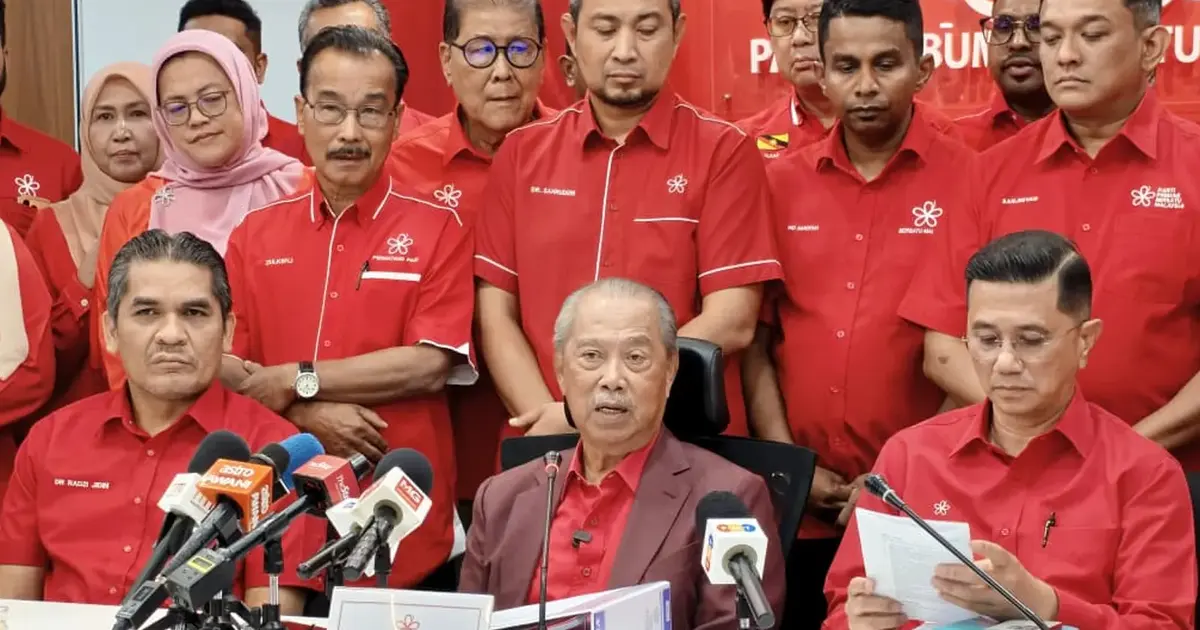
Bersatu president Muhyiddin Yassin has reinforced his party's dedication to the Perikatan Nasional coalition, signalling that the Malay-Muslim majority bloc shows no signs of fracturing despite ongoing political pressures and occasional tensions. The statement represents a firm position on where Bersatu's political future lies, even as Malaysia's coalition landscape continues to shift following the 2022 general election and the subsequent formation of a unity government.
Muhyiddin's assertion places considerable emphasis on what he characterises as public backing for the Perikatan Nasional model. This framing is politically significant because it suggests that the party leadership views the coalition not merely as a pragmatic alliance of convenience, but as one that has earned legitimacy among ordinary Malaysians. For a party that has experienced considerable organisational flux since its establishment in 2020, reaffirming coalition membership provides a degree of stability and strategic clarity to party members and supporters who might otherwise harbour uncertainties about the party's direction.
The Perikatan Nasional, which encompasses Bersatu, PAS, and several other parties, has occupied an increasingly complex position in Malaysian politics. Formed initially as an electoral alliance, the coalition has competed fiercely against Pakatan Harapan and Barisan Nasional in recent contests. Bersatu's explicit reaffirmation therefore deserves close attention as an indicator of how long-term political calculations are being made within the opposition bloc, particularly regarding the question of whether the coalition remains viable as a unified force versus whether individual parties should pursue separate electoral strategies.
From a regional perspective, this development reflects patterns visible across Southeast Asia where political coalitions must constantly negotiate between maintaining ideological coherence and pursuing pragmatic electoral objectives. Bersatu's membership provides the Perikatan Nasional with significant symbolic weight as a Malay-majority party that can claim broader cross-communal appeal compared to its partners. Muhyiddin's statement thus operates on multiple registers simultaneously: reassuring rank-and-file members, signalling stability to supporters, and underlining the coalition's continued relevance to observers of Malaysian politics.
The emphasis on public acceptance warrants closer examination. Coalition leaders frequently invoke popular support as justification for their strategic choices, yet measuring genuine public sentiment for specific political alliances remains notoriously difficult. Muhyiddin's invocation suggests confidence that electoral performance, public opinion surveys, or grassroots feedback validates the Perikatan Nasional model. However, Malaysian voters have historically demonstrated willingness to shift allegiances between elections, suggesting that whatever popular mandate exists for the coalition at present carries no guaranteed durability.
Bersatu's continued membership also reflects the complex position Muhyiddin occupies within contemporary Malaysian politics. As a former prime minister whose tenure ended amid political turbulence, his authority and strategic vision remain influential within his party. By personally reaffirming coalition commitment, he conveys consistency and long-term planning to party machinery that might otherwise feel adrift in Malaysian politics' unpredictable currents. This leadership positioning becomes especially important as Bersatu prepares for potential electoral contests where coalition cohesion directly influences campaign effectiveness and the distribution of candidate nominations across constituencies.
The statement arrives amid Malaysia's broader political realignment. The unity government formed following the 2022 elections consolidated considerable cross-coalition cooperation between Pakatan Harapan and Barisan Nasional, leaving Perikatan Nasional positioned as the primary opposition force. This structural positioning influences Muhyiddin's calculations; affirming coalition loyalty simultaneously affirms his party's role within what remains a meaningful alternative to the government. Without such explicit commitment, individual Bersatu members or factions might attempt to negotiate separate arrangements with the ruling coalition, fundamentally altering the party's political profile and influence.
The timing of this reaffirmation carries implications for Malaysian coalition politics beyond Bersatu itself. PAS, the coalition's ideologically dominant partner, holds the Perikatan Nasional together as the party most committed to Malay-Muslim issues. Bersatu's reconfirmed participation suggests that despite occasional divergences, the coalition partners maintain sufficient alignment on core questions to justify continued cooperation. For Malaysian political observers, this indicates that the 2023-2025 period is unlikely to witness dramatic coalition realignment, though incremental shifts in party positioning remain inevitable.
The public acceptance argument also deserves scrutiny because it raises questions about how coalition leaders define and measure legitimacy. Does Muhyiddin reference electoral performance, membership growth, constituent communications, or more impressionistic assessments of political sentiment? Malaysian coalition politics often obscures such definitional questions, allowing leaders considerable latitude in invoking popular support without detailed substantiation. Nevertheless, the assertion itself signals that Bersatu leadership perceives no existential threat to the coalition's viability based on public opinion.
Bersatu's position within Perikatan Nasional has evolved considerably since the party's founding. Initially emerging from defections and reorganisation within UMNO, Bersatu has gradually established distinct party machinery and candidate networks. Remaining within the coalition allows the party to benefit from collective opposition identity while building independent organisational capacity. Muhyiddin's statement therefore protects this strategic positioning, which would dissolve if Bersatu pursued separate electoral strategies or negotiated individual arrangements with government coalition partners.
For Malaysian voters and political observers, this commitment from Bersatu's leadership suggests continued clarity regarding opposition coalition structure through the foreseeable future. While Malaysian politics remains characterised by volatility and frequent surprises, Perikatan Nasional's continued unity under Muhyiddin's stewardship appears reasonably secure. The party president's emphasis on public acceptance provides ideological grounding for this continued cooperation, anchoring coalition loyalty to democratic legitimacy rather than mere elite arrangement. Whether such public support proves enduring, however, remains a question that only future electoral contests and polling data can definitively answer.