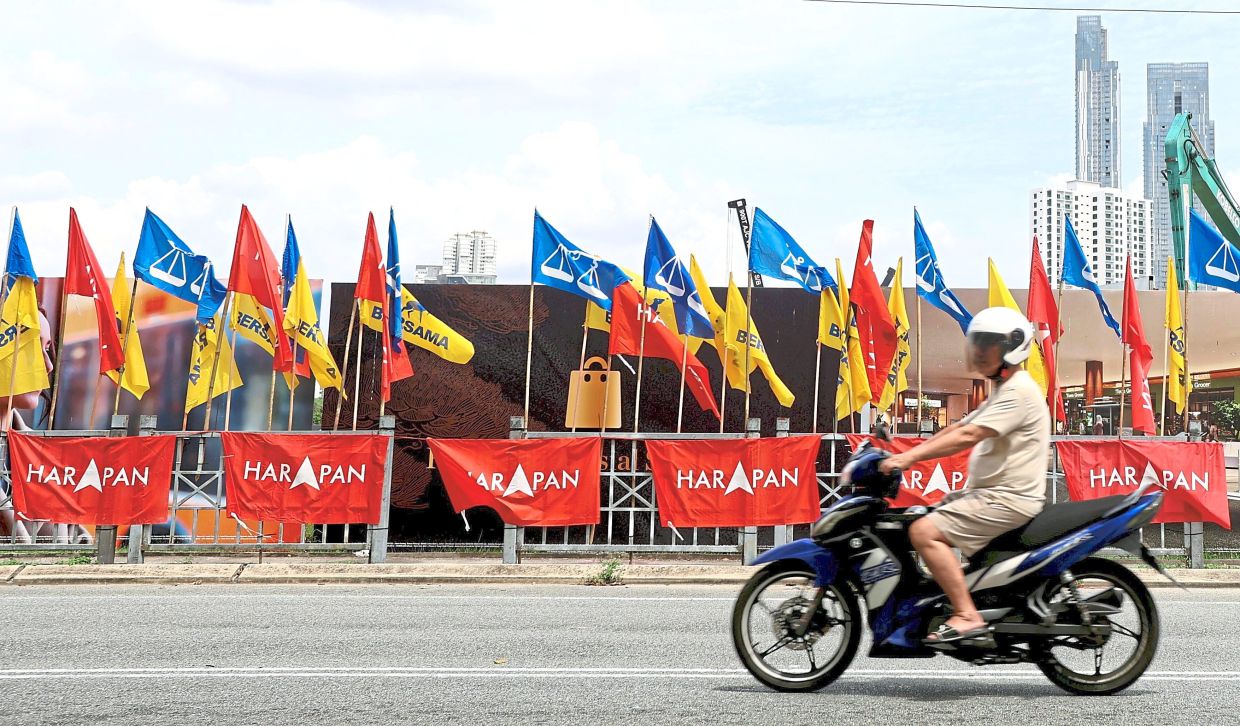
When Negri Sembilan heads to the polls, political observers will fixate on a familiar threshold: the 36 seats needed for outright control of the State Legislative Assembly, with 29 required for a two-thirds majority. Yet this electoral arithmetic, while undeniably important, may obscure a figure with far deeper implications for ordinary Malaysians—the number 65, representing a retirement age that could better align with the country's demographic, economic and technological landscape.
Governance naturally commands immediate attention; elections determine who wields power and shapes state policy for the next five years. A comprehensive victory by Barisan Nasional, potentially achieved through collaboration with Perikatan Nasional and PAS, would validate a particular political coalition's platform. Such results carry genuine significance. Yet retirement policy, far from being a mere technical adjustment, will fundamentally shape the financial security and daily lives of millions of Malaysians across entire decades. The two deserve equal weight in public discourse.
The disruptions Malaysia has endured since 2020 have rendered traditional retirement planning assumptions obsolete. The Covid-19 pandemic triggered cascading economic consequences that extended far beyond the immediate health crisis. Household savings were depleted as families managed lockdowns and income interruptions. Businesses teetered on the brink of insolvency, forcing difficult retrenchment decisions. Both civil servants and private-sector employees found themselves postponing retirement plans that they had meticulously constructed over their working lives. Even as the pandemic receded from headlines, economic normalcy remained elusive.
Fresh instability has continued to complicate recovery throughout 2025. Ongoing tensions in the Strait of Hormuz have kept energy markets volatile, translating into elevated transportation costs, higher food prices, and persistent inflationary pressures throughout Southeast Asia. Malaysian households, still struggling to rebuild depleted savings after the pandemic, now confront another round of cost-of-living challenges that have forced difficult choices between essential consumption and financial restoration. These layered shocks have fundamentally altered the retirement calculations that previous generations could reasonably make.
Negri Sembilan occupies a particularly instructive position in this national conversation. The state embodies a distinctive blend of traditional institutions and contemporary economic ambitions. Its geographic proximity to Kuala Lumpur, Putrajaya and the Klang Valley means substantial portions of its workforce commute to or maintain professional ties with Malaysia's primary economic corridors. Simultaneously, Negri Sembilan preserves robust community networks where multiple generations routinely provide mutual support and financial assistance. This combination creates a genuinely complex social fabric where retirement policy intersects directly with family interdependence and intergenerational obligation.
Consider the generational context confronting Malaysians now approaching their late fifties. This cohort lived through the Asian Financial Crisis of the late 1990s, the Global Financial Crisis of 2008-2009, the Covid-19 pandemic, and subsequent geopolitical turbulence. Their careers have been repeatedly interrupted by systemic shocks entirely beyond individual control. Many experienced forced redundancies, business failures, or extended periods of reduced income. Against this backdrop, the proposal to offer—not mandate—the opportunity to continue working until 65 represents a pragmatic recognition of genuine circumstances rather than ideological overreach.
The emergence of artificial intelligence adds another dimension to this retirement debate, one often obscured by simplistic automation anxieties. While AI will certainly eliminate certain routine tasks, organisations increasingly recognise the irreplaceable value of institutional memory, accumulated judgment, mentoring capacity, and ethical reasoning. These qualities emerge from extended professional experience and cannot be quickly replicated through technology. Experienced workers may therefore become increasingly valuable as organisations navigate disruption, precisely because they bring perspective and stability to rapidly changing environments.
Meanwhile, Gen Z and millennial workers entering Malaysia's workforce confront unprecedented volatility. Skill requirements shift constantly, employment cycles have shortened dramatically, and competition from digital technologies creates persistent uncertainty about career durability. Rather than viewing continued employment among older family members as labour market competition, Malaysian households might increasingly recognise such arrangements as providing crucial financial stability while younger members adapt to this transformed economic landscape. Intergenerational cooperation could transform from a social safety net into an economic strength.
The mechanics of such cooperation could prove remarkably elegant. Experienced professionals mentoring younger colleagues would simultaneously upgrade their own digital competencies while transmitting institutional knowledge. Rather than creating labour market rigidity, this intergenerational exchange could foster greater labour market resilience by maintaining continuity of expertise while enabling adaptation to technological change. Younger workers could access guidance during uncertain transitions, while older workers remained economically productive and engaged.
From a strictly fiscal perspective, extending working lives strengthens government finances through multiple channels. Workers continuing their careers maintain tax contributions, continue funding retirement savings accounts, and sustain consumption expenditure. This broadens the revenue base while reducing immediate pressure on pension systems and social assistance programmes. The arithmetic is straightforward: longer productive careers mean higher aggregate tax collection and lower aggregate benefit expenditure, improving fiscal sustainability without imposing severe austerity on current retirees.
Crucially, extending retirement age need not become a one-size-fits-all mandate. Flexibility must remain paramount. Workers in physically demanding occupations—construction, agriculture, certain manufacturing roles—may understandably prefer earlier retirement to preserve health and quality of life. Conversely, professionals, academics, healthcare practitioners, engineers, educators and administrators often demonstrate strong preferences to continue working if health permits. Public policy should accommodate both aspirations rather than imposing rigid uniformity that disregards genuine individual circumstances.
This is where bipartisan political cooperation becomes essential. Retirement policy transcends conventional left-right ideological divisions. Conservative and progressive politicians alike should recognise that enabling flexible, dignified continued employment while maintaining authentic choice serves broad national interests. Whether viewed through fiscal sustainability, labour market resilience, intergenerational fairness, or individual autonomy, the case for serious national debate on extending retirement age to 65 cuts across traditional partisan lines. Negri Sembilan's voters should expect their elected representatives to engage substantively with this consequential question, regardless of which coalition secures the contested 36 seats.

