Prime Minister Narendra Modi's Bharatiya Janata Party has launched a pointed assault on the activist collective behind last month's major student demonstrations in New Delhi, alleging that the group's divergent responses to protests across different regions reveal an underlying political motive to destabilise the central government rather than champion genuine student grievances. The criticism, levelled by BJP spokesperson Keya Ghosh on Tuesday, underscores deepening tensions between India's ruling party and the Cockroach Janta Party as student unrest continues to roil the country's eastern regions.
The Cockroach Janta Party, which began as a satirical online movement before evolving into an organised pressure group, played a catalytic role in mobilising thousands of students across New Delhi last month to protest examination irregularities. That campaign concluded successfully with the resignation of Modi's Education Minister Dharmendra Pradhan, marking a rare political victory for the decentralised activist coalition. However, as similar demonstrations have erupted in Jharkhand, a mineral-rich eastern state, the group's comparatively muted presence has drawn scrutiny and prompted the BJP to question whether its earlier activism served genuine reform objectives or merely tactical political advantage.
Ghosh's attack focused on the disparity between the group's visible mobilisation efforts in the capital and its limited engagement in Jharkhand, where students have demanded a federal investigation into alleged recruitment examination fraud. She characterised the Cockroach Janta Party as a "mute spectator" to the eastern state's protests and pointedly invited founder Abhijeet Dipke to demonstrate equal commitment by visiting Jharkhand's demonstrators. The rhetoric implicitly suggests that the group's withdrawal from activism once its immediate objective—the minister's resignation—was achieved exposes an opportunistic rather than principled approach to student advocacy.
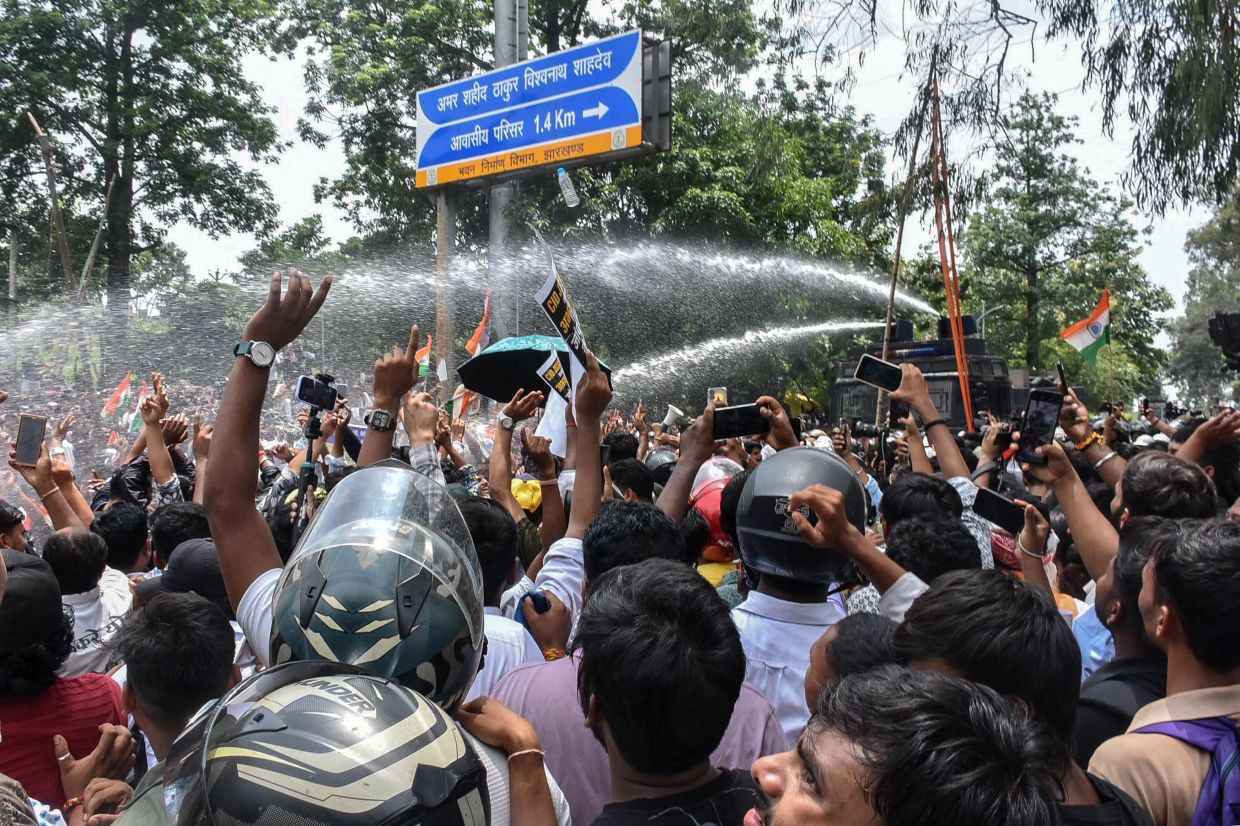
The Jharkhand protests have been substantially driven by local students and job seekers rather than coordinated support from the national pressure group. The demonstrations reflect genuine regional concerns about employment transparency in a state where competition for government positions remains fierce and accusations of procedural irregularities have long simmered beneath the surface. The Cockroach Janta Party has publicly endorsed the Jharkhand protesters' demands and its founder has condemned police tactics, including the deployment of water cannons and batons against demonstrators on Monday, describing such actions as "cruel and inhuman."
Despite the group's overall limited presence in Jharkhand, individual members who participated in New Delhi's mobilisation have travelled to the eastern state to support the ongoing agitation. Akshay Shinde, serving as the national coordinator for the Cockroach Janta Party, stated that committed members are actively contributing to the Jharkhand demonstrations and have pledged to remain engaged until all student demands are addressed. This partial participation complicates the BJP's characterisation of wholesale indifference, though the contrast with the group's intensive efforts in New Delhi remains notable.
The geographical and political dimensions of this dispute carry particular significance within India's federal structure. Jharkhand remains governed by a coalition led by the Jharkhand Mukti Morcha, which includes the Indian National Congress, with the BJP relegated to opposition status in the state assembly. This configuration transforms student activism into a more ambiguous political terrain, where allegations of electoral calculation become more plausible to government observers. Ghosh exploited this context by directly questioning the absence of Congress leader Rahul Gandhi from both protest sites, suggesting that coalition politics rather than principled support for students' rights explains the limited national-level political engagement with Jharkhand's agitation.
Gandhi, who has notably avoided visiting either the New Delhi or Jharkhand demonstration sites, has nonetheless issued statements condemning police violence and affirming students' rights to peaceful protest. His assertion that "only dialogue can yield solutions" represents an attempt to distance the Congress from street-level activism while maintaining nominal support for student demands. This measured approach contrasts sharply with the Cockroach Janta Party's more visible organisational presence during the New Delhi protests and creates an opening for the BJP to portray the broader opposition ecosystem as inconsistent and politically motivated.
The underlying dispute reflects broader questions about how student activism functions within India's complex political landscape, where genuine grievances about institutional failures intersect with opportunistic political positioning by multiple actors. The Cockroach Janta Party's emergence as a significant organising force has disrupted traditional patterns of student activism, which historically remained either non-partisan or closely aligned with established political parties. This novel decentralised model generated considerable public enthusiasm in New Delhi, where educated urban voters responded to the group's satirical brand of dissent and its focus on meritocratic concerns.
However, the group's difficulty in sustaining momentum beyond its initial victory raises critical questions about the sustainability and scalability of protest movements built around specific, achievable demands rather than broader ideological programmes. Once the education minister's resignation was secured, the movement's raison d'être fundamentally shifted. The transition to supporting Jharkhand's protests, which involve different regional actors, different bureaucratic systems, and different political power structures, required sustained organisational commitment and resources that the decentralised Cockroach Janta Party may struggle to mobilise across multiple geographical and administrative boundaries.
For Malaysian observers, the Jharkhand episode offers instructive parallels regarding student activism and state responses in South and Southeast Asia. Like Malaysia, India confronts persistent public concerns about examination integrity and employment transparency in competitive civil service recruitment processes. The willingness of governments to deploy force against peaceful protesters—documented here through water cannons and batons—reflects patterns visible in multiple regional contexts. Similarly, the strategic use of accusations of selective activism and political opportunism as a tool to delegitimise protest movements represents a familiar tactic in the region's political playbook.
The BJP's strategy of attacking the Cockroach Janta Party's consistency and commitment reveals how governing parties across South Asia attempt to fragment protest coalitions by questioning activist motivations rather than substantively addressing underlying grievances. By framing the group as hypocritical and politically motivated, the BJP seeks to undermine the moral authority and popular credibility that student movements often command. Whether this approach will prove effective in dampening broader unrest in Jharkhand or whether it might instead galvanise greater activism remains uncertain as the demonstrations continue to evolve across India's eastern regions.

