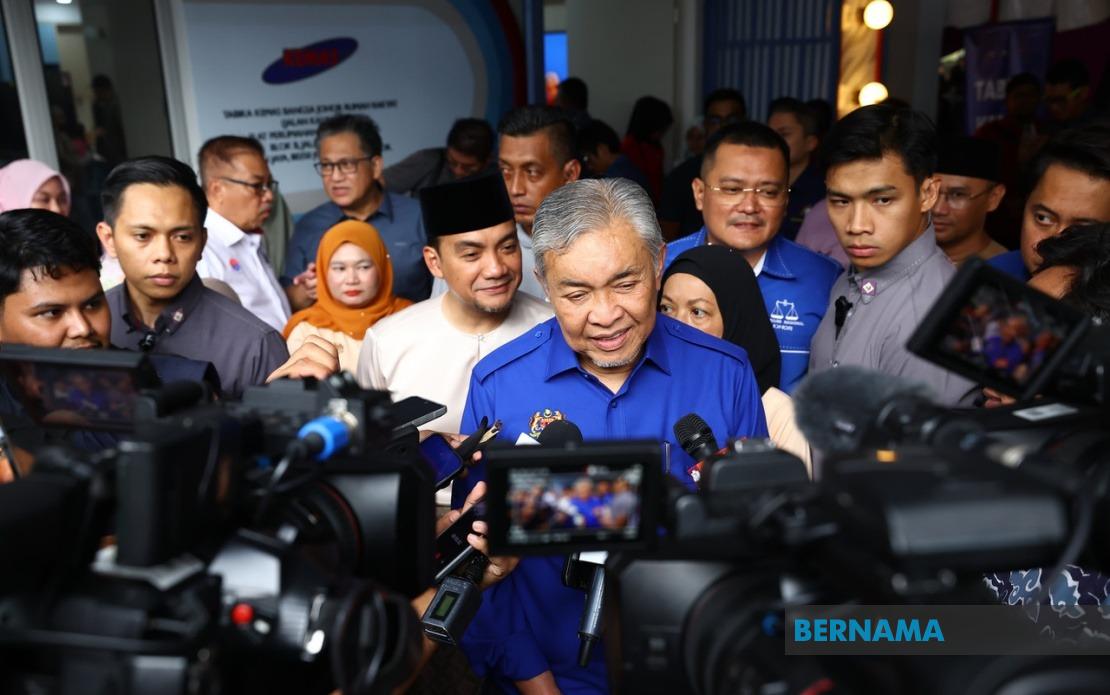
The Johor state election campaign has entered a critical phase as Barisan Nasional's leadership signalled openness to rival proposals, with BN Chairman Datuk Seri Dr Ahmad Zahid Hamidi acknowledging Pakatan Harapan's platform following the opposition coalition's manifesto launch. Speaking to journalists in Johor Bahru on July 3 during a community engagement session at Larkin Court 1, Ahmad Zahid characterised BN's acceptance of competing political visions as consistent with Malaysia's democratic framework, a statement that reflects the increasingly competitive nature of state-level contests in the country.
Pakatan Harapan unveiled its election manifesto featuring ten substantive proposals designed to appeal across demographic and socioeconomic lines. The opposition's platform includes establishment of a Johor Health Scheme to address healthcare accessibility, financial assistance mechanisms for first-time property buyers seeking to enter the residential market, and allocation of RM500 million specifically directed toward youth empowerment initiatives. Additionally, PH emphasised commitments to educational sector improvements, recognising that schooling quality remains a priority issue for Malaysian families planning their children's futures.
Ahmad Zahid, simultaneously serving as Rural and Regional Development Minister, positioned Barisan Nasional's contrasting manifesto as grounded in the incumbent administration's documented performance during the previous electoral term. He highlighted that the state government accomplished more than 90 per cent of its electoral promises from the preceding cycle, a metric BN presents as evidence of organisational capacity and political credibility. This performance narrative functions as BN's primary counter-argument against PH's proposed alternatives, suggesting that voters should evaluate promises through the lens of demonstrated execution capability.
The ruling coalition's manifesto framework, according to Ahmad Zahid, addresses all stages of the lifecycle while maintaining inclusive treatment across ethnic and religious communities. From expectant mothers receiving antenatal support through elderly citizens in their final years, BN claims its proposals eliminate demographic blind spots that might disadvantage specific groups. The emphasis on single mothers and fathers represents an attempt to appeal to non-traditional household structures increasingly common in modern Malaysia, while continuous reference to "Bangsa Johor"—a concept of shared Johor citizenship transcending ethnic boundaries—reflects contemporary political messaging emphasising unity over divisiveness.
The Deputy Prime Minister made particular note of his personal commitment to sustaining Johor's development trajectory, framing his ministerial portfolio as instrumental to channelling federal resources toward state-level infrastructure and social programmes. This positioning underscores how state elections increasingly intertwine with national political dynamics, as federal ministers leverage their portfolios to demonstrate tangible benefits flowing to specific constituencies. Ahmad Zahid's assurance that Johor will receive continued prioritisation contingent on his political longevity implicitly links state electoral outcomes to maintenance of his national political standing.
Also participating in the Larkin Court engagement were Johor Menteri Besar Datuk Onn Hafiz Ghazi and BN's candidate for the Larkin state seat Mohd Hairi Mad Shah, illustrating the coordinated mobilisation of political machinery across federal, state, and local levels. This vertical integration of campaigning ensures messaging consistency while simultaneously allowing senior figures to campaign alongside grassroots candidates, thereby elevating local aspirants through association with higher-ranking officials.
The Johor electoral contest encompasses 172 candidates competing for 56 state assembly seats, a competitive field reflecting genuine multi-party contestation at the state level. Scheduled polling occurs on July 11 with early voting provisions on July 7, compressed timelines that concentrate campaign activity and voter engagement within narrow windows. The electoral architecture allows sufficient candidate nominations across competing coalitions and independent candidates, preventing any single organisation from achieving uncontested dominance through structural mechanisms.
The election represents a significant test for both BN and PH in a state historically receptive to Barisan Nasional's political messaging, though recent national electoral developments have demonstrated Johor voters' willingness to shift allegiances when motivated by specific policy concerns or anti-incumbency sentiment. For Malaysian observers tracking coalition dynamics regionally, the Johor outcome will signal whether PH can consolidate support in peninsular states or whether BN retains sufficient organisational advantages and voter loyalty to maintain state-level dominance. The competing manifestos offer contrasting visions of development priorities, with PH emphasising healthcare and youth investment while BN stresses its implementation track record and inclusive governance philosophy.
For regional Southeast Asian political analysts, the Johor election illuminates ongoing Malaysian debates regarding coalition governance, federalism, and electoral competition intensity. Unlike several regional counterparts experiencing democratic backsliding or dominant-party politics, Malaysia maintains meaningful electoral contestation where incumbent coalitions face genuine defeat risks, though structural advantages favour established organisations with deeper institutional resources and historical legitimacy.

