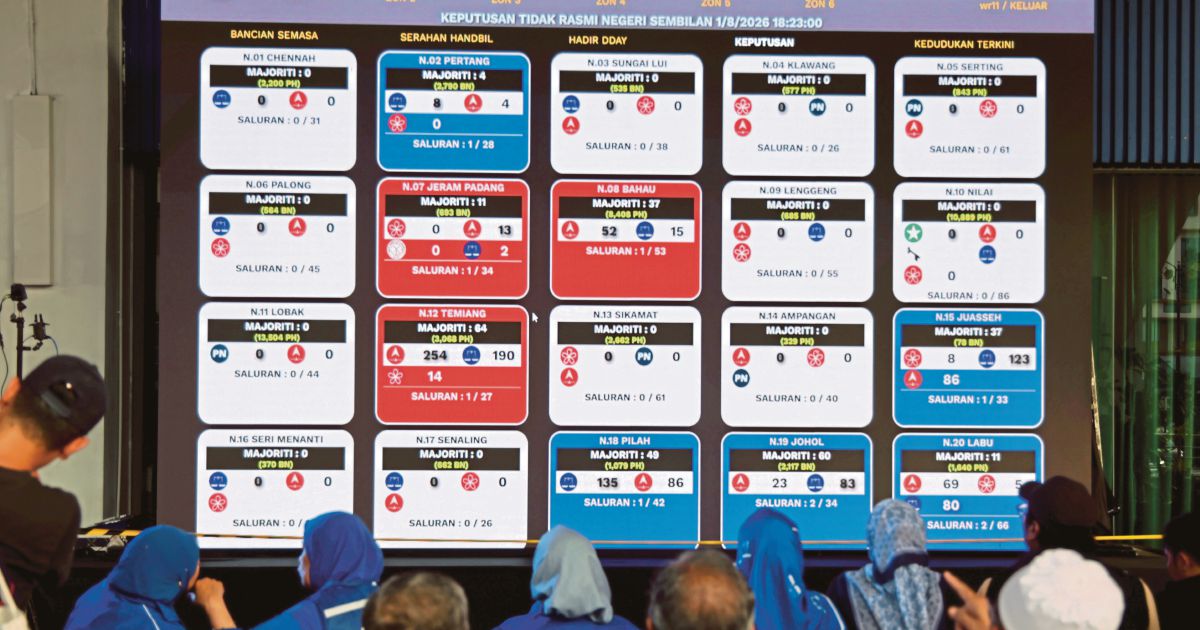
Umno leader Datuk Dr Asyraf Wajdi Dusuki has declared that the combined strength of Barisan Nasional and Perikatan Nasional represents a governing coalition with 23 seats in the Negri Sembilan state assembly—a threshold that would enable them to form the next state administration.
The claim, made in Seremban, reflects the coalition's confidence following the conclusion of state-level polling. With 23 seats, the combined bloc appears positioned to command a working majority, assuming the tally holds and no significant shifts in allegiances occur before government formation proceedings commence. This represents a significant political development in the central Malaysian state, where such coalition arrangements have become increasingly important in determining which political groupings can translate electoral support into executive control.
Negri Sembilan, with its relatively modest assembly size compared to more populous states, sees elections where seat counts in the low 20s can determine governing outcomes. The assertion by Datuk Dr Asyraf Wajdi Dusuki carries weight given his position within Umno's leadership hierarchy. However, such claims made before official verification remain informal until the Election Commission formally announces certified results and any subsequent floor-crossing or coalition negotiations crystallize the actual composition of the assembly.
The potential coalition between Barisan Nasional and Perikatan Nasional mirrors broader political alignments that have emerged across Malaysia in recent years. Both organisations represent different constituencies within the Malay-Muslim political spectrum, and their willingness to cooperate at the state level demonstrates pragmatic calculations about power-sharing arrangements. For Malaysian readers, this reflects the complex realities of contemporary coalition politics, where singular party dominance has given way to negotiated multi-party arrangements.
Barisan Nasional, comprising Umno, MCA, and MIC among others, traditionally commands urban and mixed-demographic constituencies, while Perikatan Nasional—anchored by PAS in many areas—draws support from more rural and religiously-oriented voter segments. Their combined 23 seats indicates that between them they have managed to attract sufficient cross-community support across Negri Sembilan's diverse constituencies to potentially command government formation.
The implications extend beyond Negri Sembilan itself. State governments serve as important laboratories for coalition governance, and how this arrangement—if confirmed—functions will carry lessons for federal-level politics and other state administrations. The stability and functionality of any BN-PN arrangement will influence discussions about potential future alignments in other states or at the national level, particularly as Malaysia heads toward opportunities for political realignment in coming years.
For businesses and investors monitoring Malaysian political stability, the clarity around government formation matters significantly. A decisive result with clear governance arrangements typically provides market confidence, whereas prolonged uncertainty can dampen investor sentiment. The prompt articulation of coalition intent by senior figures like Datuk Dr Asyraf Wajdi Dusuki serves partly to project stability even as formal certification procedures proceed.
The 23-seat threshold also reflects specific constitutional mathematics in Negri Sembilan. The state assembly size determines what constitutes a simple majority—a calculation that becomes crucial in determining whether a coalition genuinely commands governing potential or merely claims it. Malaysian constitutional arrangements require state assemblies to have confidence in any government formation, and claims of seat counts must ultimately withstand procedural scrutiny.
Negri Sembilan's political dynamics have historically involved Umno-anchored administrations, though the specific coalition composition evolves with changing electoral results and political circumstances. The emergence of Perikatan Nasional as a significant political force in recent election cycles has altered the coalition arithmetic across multiple states, necessitating recalibrated partnership arrangements. This particular claim regarding 23 combined seats represents one manifestation of how Malaysian politics continues to reorganise itself across state and federal levels.
The coming days and weeks will clarify whether this informal claim translates into actual government formation proceedings. Official election results, any required recounts or dispute resolution, and subsequent floor negotiations will determine whether the stated coalition actually materialises into constituted government. Until the Election Commission issues its formal certification and constitutional procedures for government formation commence, such claims remain assertions awaiting institutional confirmation.

