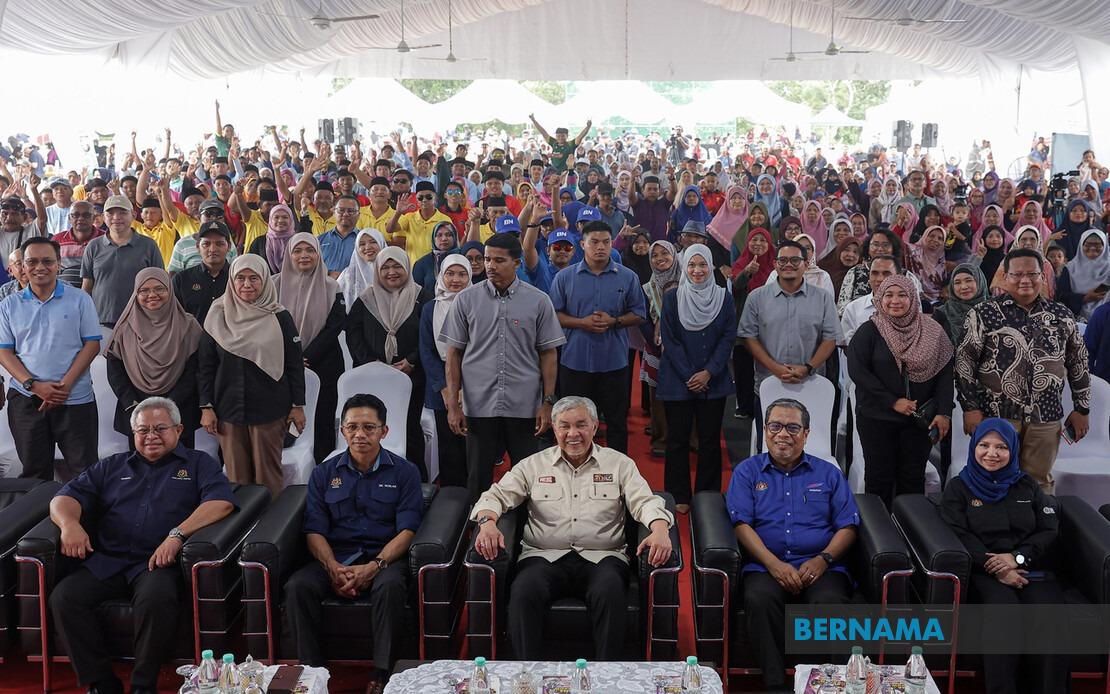
Malaysia's political landscape is entering uncharted territory as the country's major coalitions explore pragmatic cooperation models to safeguard electoral stability. Barisan Nasional chairman Datuk Seri Dr Ahmad Zahid Hamidi outlined this strategic recalibration during a public engagement in Jempol on July 18, indicating that political parties must abandon rigid ideological positions in favour of flexible arrangements capable of responding to an increasingly fractured voter landscape.
The remarks come as the ongoing understanding between BN and Perikatan Nasional in the Negeri Sembilan state election takes on heightened significance beyond that particular contest. Rather than representing a permanent merger or formal coalition structure, the arrangement signals a calculated approach to vote management—essentially a trial mechanism to test whether such coordination can be replicated across other electoral battlegrounds without compromising either coalition's autonomy or political credibility.
Ahmad Zahid's characterisation of the Negeri Sembilan election as a "test case" reveals the cautious incrementalism underpinning current political thinking in Malaysia. The early voting scheduled for July 28, with polling day on August 1, provides a relatively immediate laboratory to measure whether preventing candidate overlaps between the two coalitions genuinely improves electoral outcomes and reduces the fragmentation that has plagued Malaysian politics since the 2018 general election.
The distinction Ahmad Zahid drew between formal coalition structure and pragmatic electoral understanding deserves close examination. By explicitly denying the existence of a binding agreement while confirming operational coordination to prevent contest duplication, BN and PN leadership have crafted an arrangement with sufficient flexibility to retreat from if results disappoint, yet enough substance to demonstrate meaningful cooperation to voters and party members. This language carefully navigates the political minefield where either coalition might face internal criticism for perceived betrayal of principles or abandonment of territorial claims.
For Malaysian readers assessing the broader political trajectory, this approach reflects a maturing recognition that the two-coalition system inherited from Malaysia's post-independence period no longer captures electoral reality. With Pakatan Harapan, BN, PN, and various independent candidates all competing for votes, winner-take-all strategies frequently result in vote splitting that allows least-preferred candidates to prevail. The BN-PN understanding, however tentatively framed, acknowledges this dysfunction.
The potential extension to the Melaka state election carries particular weight given that state's history as a political bellwether. If the Negeri Sembilan arrangement demonstrates measurable success—whether interpreted as improved seat counts, consolidated votes against opposing coalitions, or enhanced stability—the framework could rapidly diffuse across other state elections as parties prepare for GE16. Conversely, failure or ambiguous results would likely consign the model to a one-off accommodation rather than establishing a new norm.
Southeast Asian observers should note that Malaysia's political evolution carries regional implications. The exploration of non-ideological coalition arrangements amid a fragmented multi-party system offers a template potentially relevant to Indonesia, Thailand, and other democracies grappling with similar fragmentation. How Malaysian parties navigate this transition between structured coalitions and flexible arrangements will inform regional discussions about democratic governance under conditions of voter volatility.
The timing of Ahmad Zahid's remarks also merits consideration given the extended runway to GE16. By articulating a willingness to assess and adjust strategies based on empirical performance rather than predetermined commitments, BN leadership is signalling openness to further realignments if political conditions shift. This flexibility could prove advantageous as new parties emerge, demographic changes reshape voter preferences, and international developments create fresh political pressures.
Critically, the success of such arrangements depends entirely on voter perception and internal party management. If party members view the BN-PN understanding as a pragmatic response to political fragmentation, it gains legitimacy. If instead they interpret it as unprincipled opportunism or abandonment of core supporters, the arrangement risks eroding party cohesion precisely when unified organisations are most needed to counter opposing coalitions. The months before and after the Negeri Sembilan election will reveal whether this delicate political balance holds.
For those tracking Malaysia's institutional evolution, the BN-PN arrangement represents a subtle but significant departure from post-1969 coalition politics. Rather than comprehensive ideological coalitions encompassing multiple parties, modern Malaysian politics increasingly features issue-specific, election-specific, and territory-specific accommodations between major players. This fragmentation reflects genuine policy disagreements, personality conflicts, and genuine uncertainty about which electoral configurations voters will reward.
As Ahmad Zahid emphasised, the political environment remains highly dynamic, precluding confident predictions about future alignments. The BN-PN understanding in Negeri Sembilan should therefore be understood not as a definitive answer to Malaysia's coalition puzzle, but rather as one potentially promising experiment within a period of ongoing constitutional adjustment. Whether it succeeds or fails will significantly shape how Malaysian politics organises itself through GE16 and beyond.

