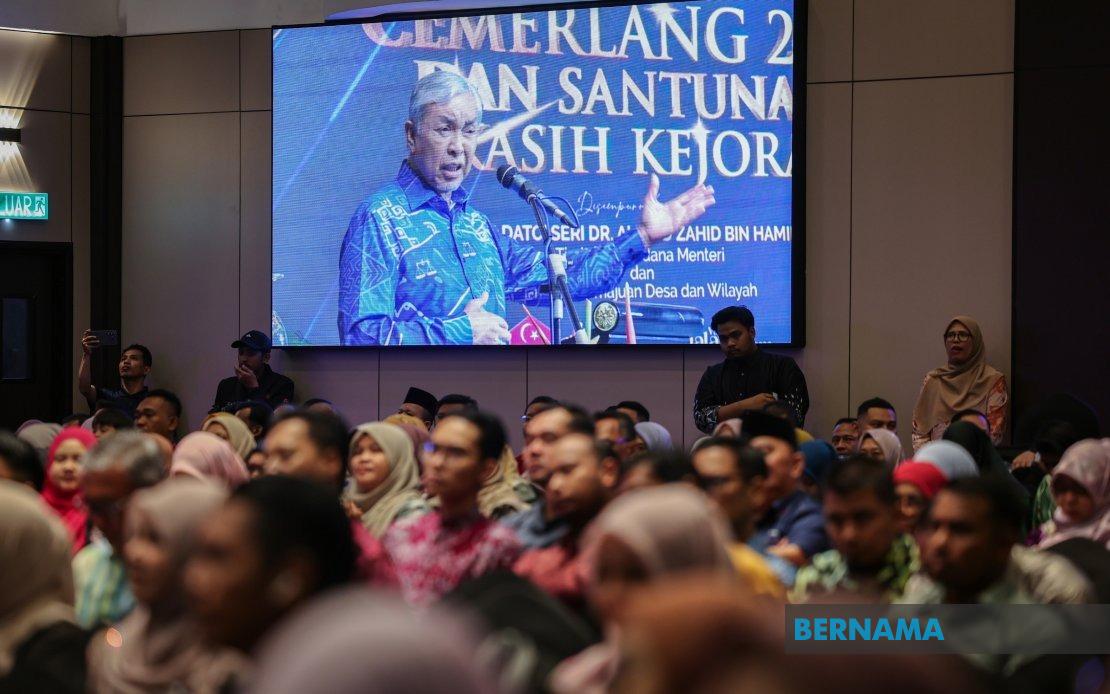
Barisan Nasional's top leadership has pushed back firmly against critics who characterise the coalition's campaign machinery as sluggish heading into Johor's state election, with party chairman Datuk Seri Dr Ahmad Zahid Hamidi arguing that such assessments amount to nothing more than political positioning rather than an accurate portrayal of what is unfolding in constituencies across the state.
Addressing reporters at Kota Tinggi on July 2, Zahid contended that BN's electoral apparatus was operating at full throttle, acknowledging simultaneously that other political coalitions were entitled to express their own interpretations of campaign intensity. The Deputy Prime Minister's remarks came during his appearance at an event honouring excellence in service delivery by the Southeast Johor Development Authority, providing him a platform to reinforce BN's confidence ahead of the July 11 ballot.
The assertion carries significance beyond routine campaign rhetoric, reflecting broader anxieties within BN's leadership about perception management in a state where the coalition has historically commanded strong electoral support but now faces a more fragmented opposition landscape. Zahid's framing of criticism as merely "political perception" rather than substantive evidence suggests BN recognises it must actively counter narratives that could dampen supporter enthusiasm in the final days before voting.
Zahid articulated appreciation for backing that BN has garnered from various quarters, expressing optimism that such support would crystallise into votes that would deliver victory for the coalition's candidates across all 56 state seats it is contesting. This emphasis on converting goodwill into electoral outcomes underscores the gap BN perceives between its existing advantages and the margins it ultimately achieves at the ballot box.
One complication facing BN's campaign involves questions from voters about potential confusion arising from the cooperation the coalition maintains with Pakatan Harapan at the federal level whilst competing against PH at the state level in Johor. Zahid dismissed such concerns as misplaced, emphasising that Johor occupied a distinctive constitutional position where the state administration had taken shape prior to the emergence of the federal Unity Government arrangement. This distinction, he suggested, obviated any conflict between collaborative federal governance and competitive state-level politics.
The Deputy Prime Minister stressed that professional working relationships characterised interactions between state and federal administrations despite their different electoral mandates, normalising what might otherwise strike observers as an unusual political configuration. For Malaysian voters, particularly those in Johor accustomed to clearer ideological divisions between competing coalitions, Zahid's explanation attempts to reframe the BN-PH dynamic as purely administrative rather than as a source of voter bewilderment.
BN's strategy in Johor draws substantially on the administrative record compiled by Menteri Besar Datuk Onn Hafiz Ghazi, whose government recorded state revenue of RM2.26 billion in the preceding year—the highest figure among peninsular Malaysian states. This economic metric forms a cornerstone of BN's argument that returning the coalition to power with an expanded mandate would enable continuation of development initiatives outlined in its electoral platform across the subsequent five-year term.
Zahid's approach to handling PAS president Tan Sri Abdul Hadi Awang's explicit call for voters to reject PH entirely, even in contests where BN faced PH opposition, revealed contrasting strategic philosophies within Malaysia's right-leaning political ecosystem. Whilst PAS adopted a maximalist stance opposing any accommodation with Pakatan parties, BN opted for what Zahid characterised as a "professional approach" centred on promoting its own candidates rather than issuing blanket exhortations against rivals.
This distinction mirrors broader tensions within Malaysia's coalition politics, where component parties of larger coalitions sometimes adopt positions that complicate rather than reinforce the central coalition's messaging. Zahid's measured response—welcoming any additional support whilst declining to demand PAS supporters automatically reject PH—suggested BN calculations that aggressive anti-PH rhetoric might alienate undecided voters it seeks to attract, particularly among younger or more urban demographics.
The electoral landscape in Johor reflects Malaysia's increasingly intricate multi-coalition environment, with Perikatan Nasional fielding 33 candidates, newcomer coalition Bersama entering 15 candidates, and smaller parties including MUDA, Asli, and PSM contesting a combined total of six seats alongside six independents. This fragmentation potentially benefits BN by distributing opposition votes across multiple camps, though it also complicates the electorate's decision-making and potentially reduces turnout if voters perceive limited meaningful choice.
Zahid's invocation of July 11 as the ultimate arbiter—suggesting that ballot box results would definitively demonstrate whether claims about campaign momentum reflected reality—represented a familiar rhetorical device that simultaneously acknowledged scepticism whilst asserting confidence in ultimate electoral performance. For Malaysian observers tracking this contest as a bellwether for the coalition's prospects ahead of the next general election, Zahid's defensive positioning paradoxically signalled that BN's internal assessments might not be entirely as sanguine as public pronouncements suggest.
The election timeline, with early voting scheduled for July 7 and main polling on July 11, compressed the remaining campaign window, meaning final messaging from BN would need to concentrate on voter mobilisation rather than groundwork establishment. Zahid's emphasis on the machinery being in "full swing" served partly to assure BN's own activists and supporters that the coalition remained organised and competitive, an important morale factor in the closing phases of any electoral contest.

