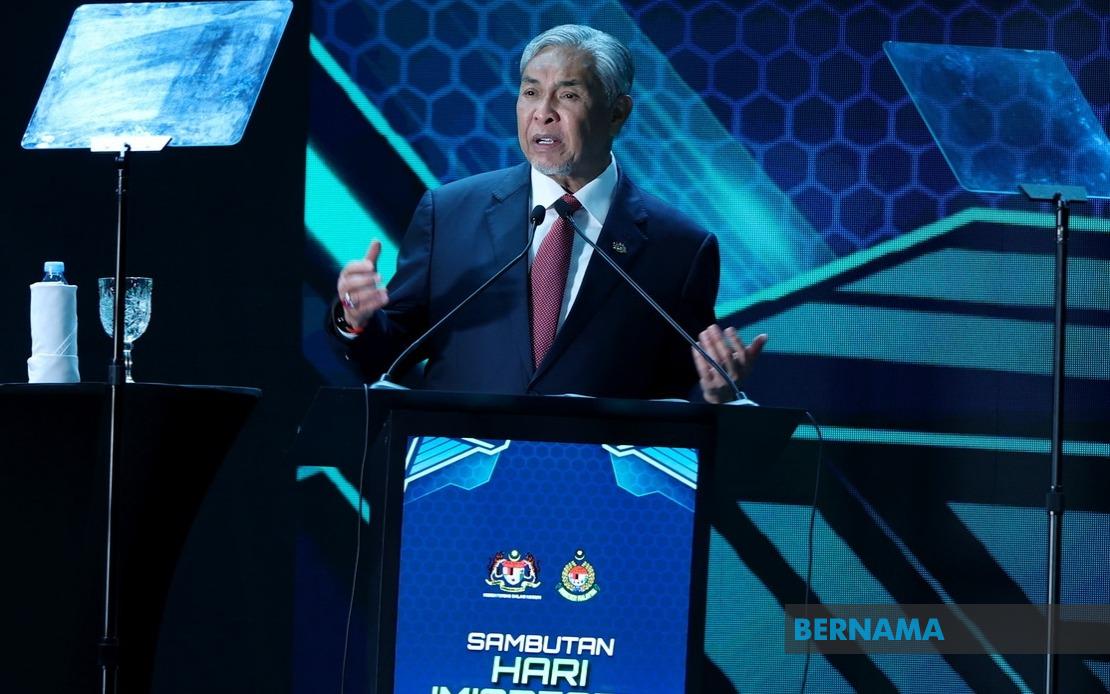
Barisan Nasional has reaffirmed its commitment to remaining within the Unity Government framework, with party chairman Datuk Seri Dr Ahmad Zahid Hamidi emphasizing that the decision reflects the highest-level consensus reached at UMNO's recent General Assembly. Speaking at the 2026 Immigration Day celebration in Cyberjaya, the UMNO president and Deputy Prime Minister sought to dispel any uncertainty surrounding the coalition's stability, stressing that all member parties must abide by the direction established through the assembly process.
Ahmad Zahid's reassurance comes at a time when Malaysia's political landscape continues to navigate the complexities of coalition governance under the Unity Government framework. The affirmation carries particular weight given UMNO's historic role in Malaysian politics and its influence over BN's strategic direction. By anchoring his statement to the assembly resolution, Ahmad Zahid invoked what he described as the party's supreme decision-making body, underscoring that no authority supersedes the General Assembly's determinations.
The emphasis on respecting assembly decisions reflects broader efforts to maintain internal party cohesion amid ongoing political pressures. In the context of Malaysia's competitive electoral environment, coalition stability sends important signals to both voters and international observers about the government's viability and longevity. BN's continued participation in the Unity Government carries implications for regional representation, as the coalition encompasses significant numbers of parliamentarians from both peninsula and East Malaysian constituencies.
Separately, Ahmad Zahid clarified the constitutional allocation of ministerial powers, noting that Prime Minister Datuk Seri Anwar Ibrahim possesses absolute authority over cabinet appointments and dismissals. This delineation of executive prerogatives becomes relevant given reports that the Prime Minister had warned government office-holders against using their positions to criticize or attack Unity Government coalition partners during state-level election campaigns. The warning reflected concerns about maintaining the delicate balance of interests within the broader coalition structure.
According to media accounts, the Prime Minister had explicitly stated that any minister, deputy minister, or government agency official who contravenes this expectation by publicly attacking coalition partners would face demands to resign. Such warnings represent attempts to enforce party discipline while maintaining the integrity of the coalition's public positioning, particularly during electoral periods when factional tensions tend to intensify.
The governance dynamics at play highlight the inherent tensions within multi-party coalitions, where member parties retain distinct organizational interests and electoral ambitions while nominally supporting shared government objectives. For BN specifically, maintaining its role within the Unity Government requires balancing its traditional constituencies against the imperative to demonstrate commitment to broader coalition goals. This equilibrium becomes especially crucial during state elections, when individual parties seek to maximize their performance while avoiding actions that might fracture the federal government.
Malaysian coalition politics has historically depended upon clear understandings about party prerogatives, resource allocation, and mutual forbearance from public criticism. The Prime Minister's intervention signals heightened attention to ensuring that these informal rules remain operative, particularly as the country approaches various electoral contests. The warning implicitly acknowledges that government positions can become platforms for intra-coalition messaging if not carefully managed.
For opposition observers and political analysts, Ahmad Zahid's reaffirmation of BN's commitment provides confidence that the coalition structure will persist, at least in the near term. However, the need for such explicit reassurances also suggests underlying uncertainties about coalition durability, a common phenomenon in multi-party arrangements where member parties retain alternative political options. The reliance on General Assembly decisions as the authoritative expression of party will further insulates leadership from accusations of unilateral decision-making.
The intersection of coalition management and ministerial accountability raises broader questions about governance effectiveness in Malaysia's current political configuration. When government officials must simultaneously serve executive functions and represent distinct party interests, potential conflicts emerge regarding the proper hierarchy of loyalties. The Prime Minister's approach of delegating enforcement responsibilities to the implicit threat of ministerial dismissal attempts to create incentive structures for compliance without requiring direct confrontation.
Moving forward, BN's continued presence within the Unity Government framework will likely influence regional political developments, particularly in states where the coalition retains significant representation. The party's commitment carries implications not only for federal stability but also for how coalition principles translate into practice at subnational levels, where different electoral mathematics and regional dynamics may create distinct pressures. Ahmad Zahid's statement thus serves both as reassurance to coalition partners and as a signal to BN's membership that party leadership remains aligned with the Unity Government project, at least for the present political cycle.

