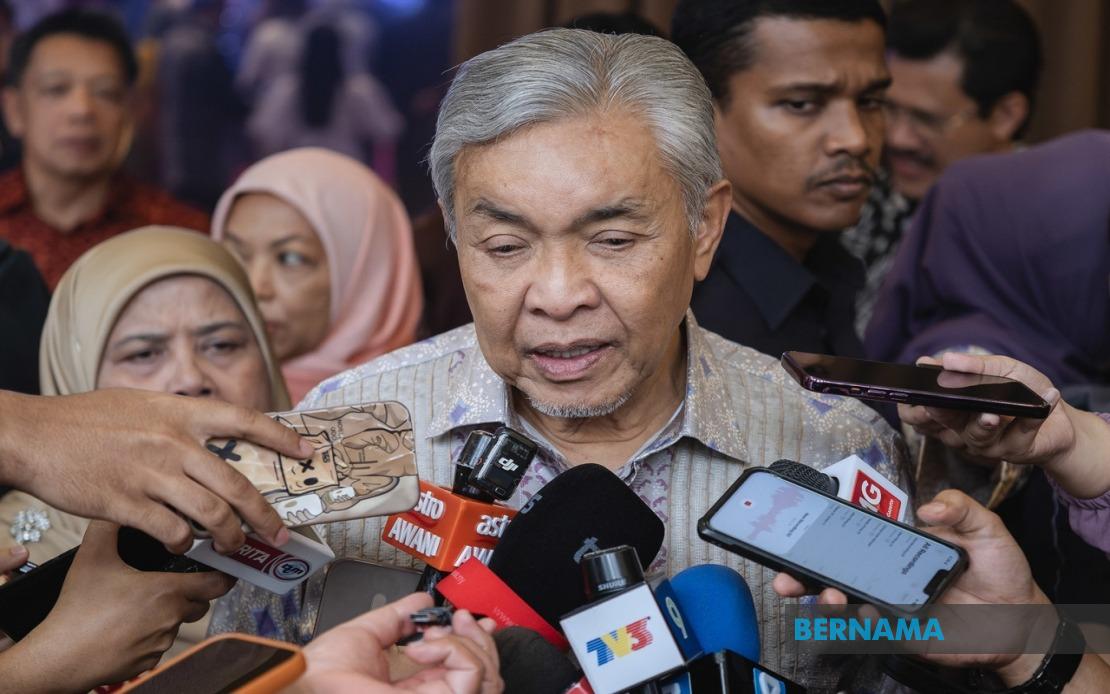
Barisan Nasional has pledged to maintain strict neutrality regarding affairs concerning Negeri Sembilan's royal institution and the state's Council of Justice and Laws (Dewan Kehakiman Undang-Undang, or DKU), according to Deputy Prime Minister Datuk Seri Dr Ahmad Zahid Hamidi. The declaration came during discussions with state party leadership as the coalition gears up for electoral contests in Negeri Sembilan, underscoring BN's determination to keep constitutional and legal matters beyond the bounds of partisan politics.
Ahmad Zahid, who leads the UMNO party alongside his role as Deputy Prime Minister, articulated this position following his attendance at a Ministry of Rural and Regional Development service excellence ceremony in Kuala Lumpur. His explicit statement that "we will never interfere in legal matters, particularly those involving the royal institution and the DKU" signals a deliberate effort by the coalition to establish clear boundaries between electioneering activities and governance of sensitive institutions. The emphasis on remaining "outside of that sphere" reflects awareness that royal and judicial matters carry constitutional weight and public sensitivity that transcends routine political competition.
The timing of this commitment carries particular significance for Negeri Sembilan's political landscape, which has experienced considerable institutional turbulence in recent years. By declaring categorical non-interference, BN appears intent on reassuring stakeholders—including the state's Ruler and judicial structures—that electoral ambitions will not encroach upon institutional autonomy. This approach contrasts with patterns in Malaysian politics where royal and legal institutions have occasionally become entangled in partisan disputes, creating constitutional and governance complications.
BN's primary focus heading into the August 1 state election now centres on fortifying internal party cohesion across all organisational levels. The coalition recognises that electoral success in Negeri Sembilan, where 36 state seats will be contested, depends fundamentally on unified messaging and mobilised membership rather than external institutional involvement. Ahmad Zahid stressed that party leadership at every tier must operate with singular purpose and coordinated strategy to maximise electoral performance.
The political situation confronting BN in this particular state election differs markedly from the 15th Negeri Sembilan election, when the coalition collaborated with Pakatan Harapan component parties in a multi-party arrangement. This time, BN contests as an independent electoral force, without such institutional partnerships. The shift necessitates recalibrated campaign strategies and renewed emphasis on internal organisational strength. Party leaders must mobilise their respective grassroots organisations with greater intensity to compensate for reduced coalition complexity.
Such reconfiguration of political alliances underscores broader realignments within Malaysian politics since the 15th state election. The decision to stand independently rather than within a broader pact suggests either changed strategic calculations about electoral viability or shifted political relationships at state level. For Negeri Sembilan voters, this means a clearer two-sided or multi-sided contest without the complicating factor of formal inter-coalition cooperation, potentially sharpening partisan differentiation.
The emphasis on party unity assumes heightened importance given current economic conditions and public sentiment in Negeri Sembilan. Rising cost of living, infrastructure development demands, and concerns about employment remain pressing issues for state voters. BN's capacity to project coherent policy solutions depends on presenting unified party positions rather than fractured messages from competing internal factions. Ahmad Zahid's insistence on solidarity across party ranks acknowledges that electoral momentum builds through consistent, coordinated communication from party structures.
For Malaysian federalism and constitutional governance, BN's explicit pledge regarding royal and judicial non-interference carries broader resonance. As the dominant national coalition that has governed Malaysia for decades, its positioning on institutional autonomy influences norms governing state-level politics throughout the federation. When senior coalition figures declare categorical separation between electoral activity and royal or judicial spheres, they establish precedents that other political actors are expected to respect, theoretically strengthening institutional independence across Malaysia's constitutional landscape.
The August 1 polling date now looms as a significant test of whether BN can reconstitute effective electoral machinery in a state without formal coalition arrangements. Historical patterns suggest that Negeri Sembilan has demonstrated volatility in state elections, with power shifting between competing political blocs. BN enters this contest with established institutional infrastructure but without the coordination mechanisms that formal coalition partnerships provide. Success will require demonstrating that the coalition can mobilise sufficient support through internal strength alone while respecting institutional boundaries that define Malaysia's constitutional order.

