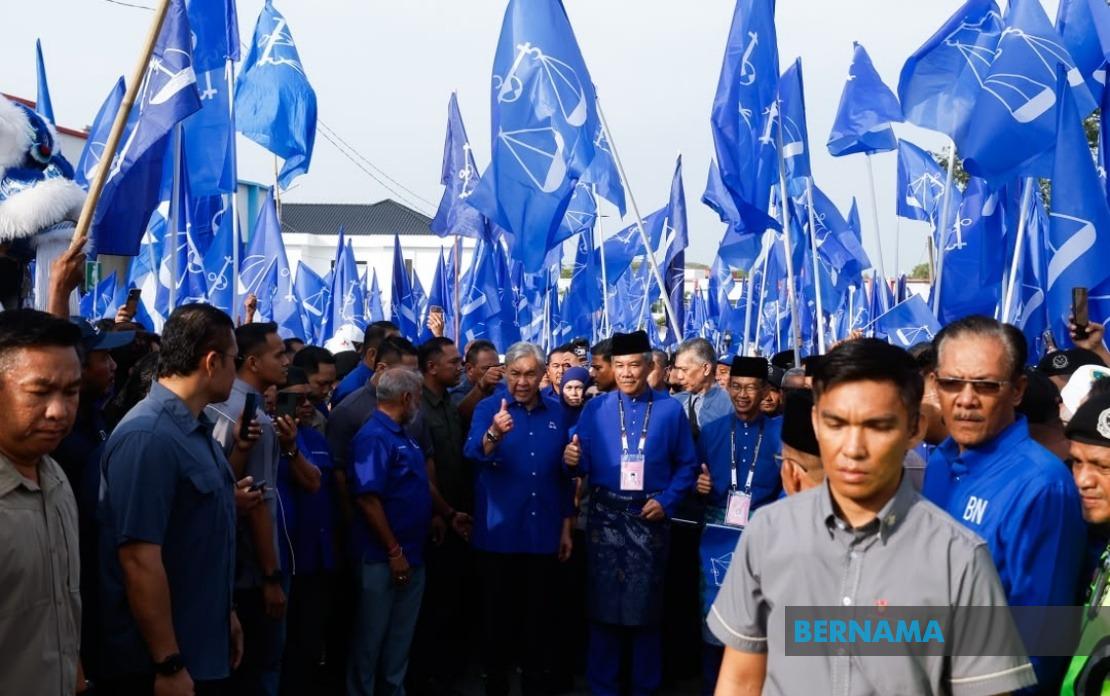
The Barisan Nasional's upper echelon moved swiftly into campaign mode on Thursday as the coalition fielded candidates across Negeri Sembilan for the state's 16th legislative assembly election. Party chairman Datuk Seri Dr Ahmad Zahid Hamidi arrived at the Dewan Seri Rembau nomination centre before 8.40 am to personally escort his deputy Datuk Seri Mohamad Hasan, who filed papers to retain the Rantau seat he has represented since 2004. The gesture underscored BN's determination to project organisational cohesion and leadership commitment during a critical political juncture in the state.
Nomination proceedings unfolded across eight centres simultaneously, opening at 9 am and concluding after one hour. The compressed timeframe reflected Election Commission protocols designed to streamline the candidacy submission process while maintaining transparency. Port Dickson witnessed parallel mobilisation efforts as BN secretary-general Datuk Seri Dr Zambry Abd Kadir brought Datuk Mohd Faizal Ramli to lodge nomination documents for the Linggi seat. Concurrently, UMNO vice-president Datuk Seri Johari Ghani championed Suhaimizan Bizar's candidacy in the Gemencheh division within Tampin parliamentary constituency, indicating the coalition's systematic deployment of senior representatives across contested areas.
The coordination extended into Jempol parliamentary constituency, where UMNO secretary-general Datuk Dr Asyraf Wajdi Dusuki accompanied three consecutive candidates: Datuk Mustapha Nagoor for Palong, Datuk Mohd Zaidy Abdul Kadir for Jeram Padang, and Chong Fui Ming for Bahau. This concentration of leadership presence in a single zone reflected BN's strategic priorities, suggesting efforts to consolidate support in a potentially competitive region. The symbolic pairing of senior party operatives with candidate submissions served multiple purposes—lending gravitas to individual candidacies whilst demonstrating institutional backing that might influence voter perception during the campaign proper.
Coalition partners contributed to the nomination theatre. PAS president Tan Sri Abdul Hadi Awang facilitated his party's nominee Mohd Fairuz Mohd Isa in filing for the Serting seat, maintaining the Islamist party's presence within the broader BN framework. Parti Orang Asli Malaysia's participation through president Rashid Ka, who guided candidate Dayana Dal through the Jeram Padang nomination process, highlighted the coalition's inclusive composition. These auxiliary movements, whilst drawing less media attention than the dominant UMNO contingent, reinforced the broad-church positioning that BN traditionally emphasises during state-level campaigns.
Negeri Sembilan's electoral timeline establishes clear momentum toward the decisive August 1 polling date. Early voting operations commence July 28, enabling advance participation among deployed security personnel, election officials, and voters unable to attend on the main day. The compressed campaign calendar—barely two weeks separating nomination from election day—places premium value on rapid grassroots mobilisation and media exposure during this critical window. For BN, which governed the state continuously until 2018 before recent electoral fluctuations, the candidate-unveiling stage carries particular weight in rebuilding momentum and reasserting dominance in the peninsula's central region.
The state assembly's dissolution on June 5 followed constitutional procedures requiring the Yang Dipertuan Besar of Negeri Sembilan, Tuanku Muhriz Tuanku Munawir's formal consent. This dissolution paved the way for the 16th election cycle, representing a regular electoral franchise renewal rather than extraordinary circumstances. The dissolution marked the formal commencement of the political cycle that culminates on August 1, with the intervening period dedicated to candidate registration, campaign articulation, and voter persuasion across the state's diverse constituencies ranging from urban centres to rural hinterlands.
For Malaysian political watchers and regional observers, the Negeri Sembilan contest carries significance beyond provincial boundary markers. The state functions as a barometer for coalition stability and voter sentiment, positioned between Selangor's Pakatan Harapan stronghold and Johor's traditional BN dominance. Electoral shifts in Negeri Sembilan often prefigure broader peninsular trends, making the 2024 outcome potentially indicative of changing political allegiances across central Malaysia. The nomination day activities, whilst seemingly procedural, reflect the methodical preparation requisite for navigating this consequential election cycle.
The visible coordination between BN's apex leadership and rank-and-file candidates also communicates hierarchical discipline and strategic clarity within the coalition during a period when internal cohesion occasionally faces strain from factional jostling. By ensuring personal attendance at nomination centres, senior figures like Ahmad Zahid and his deputies signalled that the party's leadership maintains direct engagement with electoral operations rather than delegating such matters to middling operatives. This hands-on approach carries symbolic resonance in Malaysian politics, where demonstrations of personal commitment by top figures are interpreted as indicators of institutional seriousness.
The nominating process itself serves as a crucial checkpoint whereby election authorities verify candidate qualifications, financial declarations, and administrative compliance. Nomination day thus functions simultaneously as procedural necessity and political theatre—a stage upon which parties project organisational prowess whilst technical apparatus ensures electoral probity. In Negeri Sembilan's case, the successful filing of candidates across eight nomination centres attested to logistical capability whilst furnishing the state's voters with their final slate of choices for the legislative contest.

