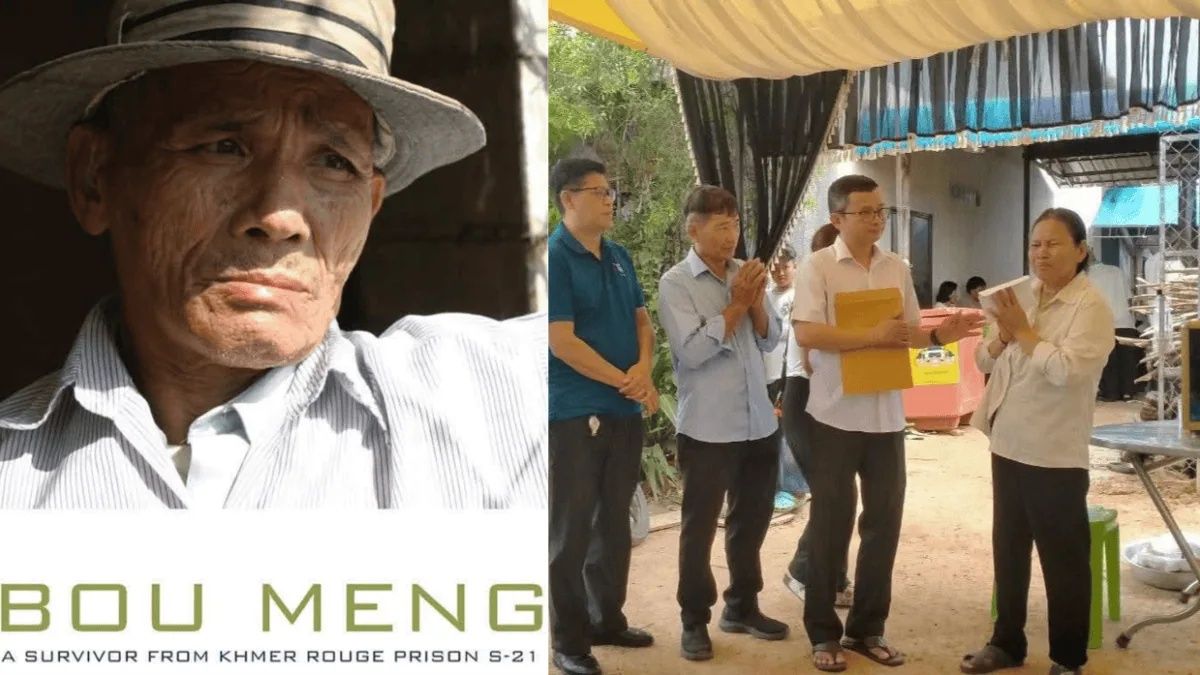
Bou Meng, among the rarest of survivors from Cambodia's darkest chapter, has died at the age of 85. The Tuol Sleng Museum announced his death on Friday, August 14, 2026, at 11pm, marking the end of a life defined by extraordinary trauma and an unflinching commitment to bear witness. His departure removes from the world one of only seven documented individuals who lived through the horrors of S-21, the Khmer Rouge's most infamous detention and torture centre, where an estimated 17,000 people were murdered between 1975 and 1979.
The significance of Meng's passing extends far beyond Cambodia's borders. For Southeast Asian societies grappling with the legacies of authoritarianism and mass atrocity, Meng represented an irreplaceable bridge to historical truth. The Tuol Sleng Museum's statement underscored this reality, noting that his death constitutes "a loss of a crucial historical witness to the crimes that the Pol Pot genocidal regime committed against the Cambodian people." In an era where survivor testimonies grow increasingly rare as decades pass, the death of someone who endured such systematic brutality and lived to document it carries profound implications for how future generations will understand genocide.
Meng's imprisonment began in 1977 when both he and his wife were taken to S-21, then operating as the nerve centre of Pol Pot's killing machine under the command of Kaing Guek Eav, known as Comrade Duch. The separation was absolute and permanent. While Meng entered the prison's torture chambers, his children were sent to separate children's camps. He would never see his wife or children again. This fractured family history reflects the deliberate terror architecture of the Khmer Rouge, which systematically destroyed kinship bonds as an instrument of control and psychological warfare. Unlike many prisoners who perished within weeks of arrival, Meng somehow endured.
What kept Meng alive in this place of systematic death was his particular utility. As a painter, he possessed skills that Duch and his regime deemed valuable enough to preserve. The Khmer Rouge, despite their ideological commitment to destroying intellectuals and skilled professionals, occasionally retained specialists for propaganda purposes or technical needs. Meng's artistic abilities granted him a precarious reprieve from the immediate execution that befell most arrivals. This survival mechanism—the chance utility of a skill—reveals how arbitrary the boundary between life and death became under the Khmer Rouge's rule. Many equally talented individuals perished; Meng's survival owed as much to circumstance as to fortune.
Following Cambodia's liberation from Khmer Rouge rule in 1979, Meng emerged from the ruins of S-21 into a profoundly altered nation. The prison, renamed the Tuol Sleng Genocide Museum in 1980, transformed into a memorial space and historical documentation centre. Rather than retreat into private recovery, Meng became integral to this institutional memory-keeping, working to preserve testimonies and share his experiences with researchers and visitors. His decision to remain publicly engaged with Cambodia's traumatic past positioned him as a living archive, embodying in his person the documentary evidence of state-sponsored terror.
Meng's most significant public contribution came through his testimony at the Extraordinary Chambers in the Courts of Cambodia, the hybrid tribunal established to prosecute surviving Khmer Rouge leaders. When Duch—the man who had orchestrated his torture and presided over his imprisonment—finally faced justice decades later, Meng provided crucial eyewitness accounts. His courtroom testimony transformed personal trauma into juridical evidence, contributing to accountability mechanisms designed to prevent impunity for mass atrocity crimes. This participation in the ECCC represented not merely personal catharsis but active engagement in the regional and international architecture of transitional justice.
In recent years, Meng dedicated himself to educational work at the museum, meeting visitors and recounting his story with the explicit intention of transmitting historical consciousness to younger generations. This pedagogical mission reflected a conviction that survivor testimony holds irreplaceable moral and educational weight. By personalizing the abstract statistics of genocide—the 17,000 murdered at S-21, the estimated 1.7 to 2 million killed across Cambodia—Meng helped visitors grasp the human reality underlying these numbers. His presence at the museum served as a constant reminder that the Khmer Rouge genocide was not historical abstraction but lived experience, endured by individuals whose names and faces remained etched in memory.
The loss of survivors like Meng poses a genuine challenge for Southeast Asian societies committed to preserving and transmitting knowledge of mass atrocity. As the generation that experienced the Khmer Rouge era directly passes away, the burden of historical documentation and moral witness shifts increasingly to archives, institutions, and secondary testimonies. The implications extend beyond Cambodia itself. Throughout Southeast Asia and globally, societies confronting legacies of authoritarianism and mass violence depend on survivor voices to authenticate historical narratives and sustain moral imperatives against repetition. Meng's death coincides with the gradual disappearance of first-hand testimony from the region's most devastating recent tragedy.
For Malaysian observers, Meng's passing offers a sobering reminder of the fragility of historical memory and the necessity of actively preserving testimony while survivors remain living. Malaysia itself grapples with contested historical narratives and periods of political repression that remain incompletely documented. The Cambodian example illustrates both the power and the peril of relegating historical documentation to the final years of survivors' lives. It also underscores the importance of institutional commitment to maintaining memorial spaces, research centres, and educational programs that can sustain historical consciousness long after individual testimonies end. Meng's work at the museum demonstrated that such preservation remains possible, even essential.
Bou Meng's death marks the crossing of another threshold in Cambodia's reckoning with its traumatic past. His life trajectory—from torture victim to survivor, from witness to educator—embodied the difficult journey many Cambodians undertook in attempting to construct meaning and justice from unimaginable suffering. The seven-person cohort of Tuol Sleng survivors grows smaller. Each departure diminishes not merely a statistical category but the living repository of irreplaceable historical knowledge. Yet the institutional frameworks Meng helped build, the testimonies he provided, and the educational work he undertook will persist. In this sense, his legacy extends beyond his individual survival to encompass the collective memory work that continues at the Tuol Sleng Museum and in Cambodia's ongoing engagement with its genocidal past.

