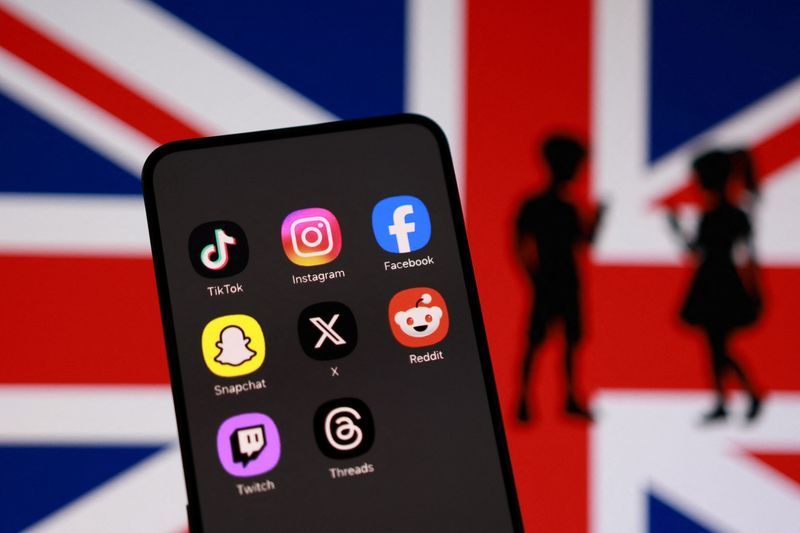
The British government is moving to restrict teenage social media use beyond its previously announced ban on under-16s, this time targeting the older adolescent population through mandatory overnight curfews. Under the new safeguarding framework unveiled on Tuesday, users aged 16 and 17 will find themselves automatically locked out of social media platforms between midnight and 6 a.m., representing a significant intervention in how technology companies manage younger users' access to their services.
The measure extends a policy direction announced just weeks earlier when the government revealed plans for a blanket prohibition on social media use for anyone under 16 years old. The sequential announcement suggests a comprehensive rethink of digital governance in Britain, moving from outright bans for the youngest users to time-based restrictions for older teenagers. This graduated approach reflects government concern that preventing access entirely for slightly older adolescents might prove either impractical to enforce or excessively paternalistic, while still acknowledging the documented risks associated with late-night social media consumption.
Under the proposed system, the blocking mechanism would activate automatically unless teenagers deliberately adjust their account settings. Equally important to the time-based restrictions, the government plans to disable features specifically designed to encourage continuous engagement and extended scrolling. These so-called "infinite scroll" functionalities and algorithmic recommendations that promote prolonged usage would be deactivated by default, forcing platforms to redesign their interfaces for younger users or require explicit permission to activate more addictive features.
Technology minister Liz Kendall framed the initiative as essential support for teenage wellbeing and development. She argued that adequate sleep, academic concentration, and face-to-face relationships with family and friends are being compromised by unrestricted social media access during critical evening and early morning hours. This rationale taps into growing scientific evidence about adolescent sleep patterns and the documented impact of blue light exposure and psychological engagement with social content on sleep quality and duration.
Online safety minister Kanishka Narayan underscored that technology companies will not have discretion in implementing these measures. Speaking to LBC Radio, he stated explicitly that the government is "forcing the tech companies to do it," signalling zero tolerance for voluntary compliance or diluted implementation. He warned that platforms failing to implement robust age verification mechanisms—a prerequisite for any teenager-specific restrictions—would face severe regulatory consequences, positioning accurate age-checking as non-negotiable.
The enforcement framework represents a substantial escalation in government leverage over technology companies operating in Britain. Rather than relying on self-regulation or industry best practices, the government is establishing legal obligations backed by regulatory sanctions. This approach reflects lessons learned from years of failed voluntary commitments by tech giants, where promised safety features either never materialized or were implemented half-heartedly.
Major social media companies including Meta (owner of Instagram), ByteDance (parent of TikTok), and Google (which operates YouTube) have not yet publicly responded to the proposed measures. Their silence is notable given the operational complexity of implementing differential restrictions based on age and time zones, particularly for global platforms serving millions of simultaneous users across multiple jurisdictions. Implementation challenges include authenticating user age reliably, managing regional time differences, and preventing workarounds that tech-savvy teenagers might exploit.
The Conservative Party's education policy chief Laura Trott dismissed the plans as incoherent, arguing that opt-out curfews fail to achieve meaningful protection. Her criticism hinges on a logical inconsistency: if 16- and 17-year-olds are considered mature enough to use social media at all, then allowing them to simply disable safety features undermines the stated protective purpose. This argument exposes a fundamental tension in the government's position—treating the age group as simultaneously both capable enough to use these platforms and vulnerable enough to require protection.
The government intends to present the first regulatory framework to parliament before year-end, with implementation targeted for spring 2027. This extended timeline reflects the complexity of translating policy intentions into enforceable technical standards and the need for parliamentary scrutiny and industry consultation. The lengthy lead time also provides technology companies with notice to begin compliance planning, though it may allow sufficient opportunity for lobbying efforts.
Context from Australia's experience with its recent social media ban for children under 16 offers cautionary lessons. Teams advising on that legislation discovered that technology platforms were failing fundamentally at age-verification implementation, the foundational requirement for any age-based restrictions. Without reliable mechanisms to confirm a user's age, even comprehensive legislative frameworks become unenforceable, potentially rendering Britain's initiative similarly vulnerable to circumvention.
Recent legal developments suggest mounting institutional concern about social media's impact on youth mental health. Both Google and TikTok have settled a United States lawsuit brought by a minor alleging that these platforms directly caused psychological harm, establishing a potentially significant precedent. These settlements, while not constituting legal admission of liability, indicate that platforms face real legal and financial risks, which may increase compliance incentives for the British regulations.
For Malaysian policymakers and regulators monitoring this development, Britain's approach offers both a template and a cautionary tale. As Southeast Asian nations increasingly grapple with regulating technology platforms and protecting young users, the British framework demonstrates ambitious government intervention backed by substantial regulatory power. However, the implementation challenges revealed by Australia's experience suggest that technical capability to enforce such restrictions, particularly age verification, remains underdeveloped globally—a reality that should inform any comparable efforts in the region.

