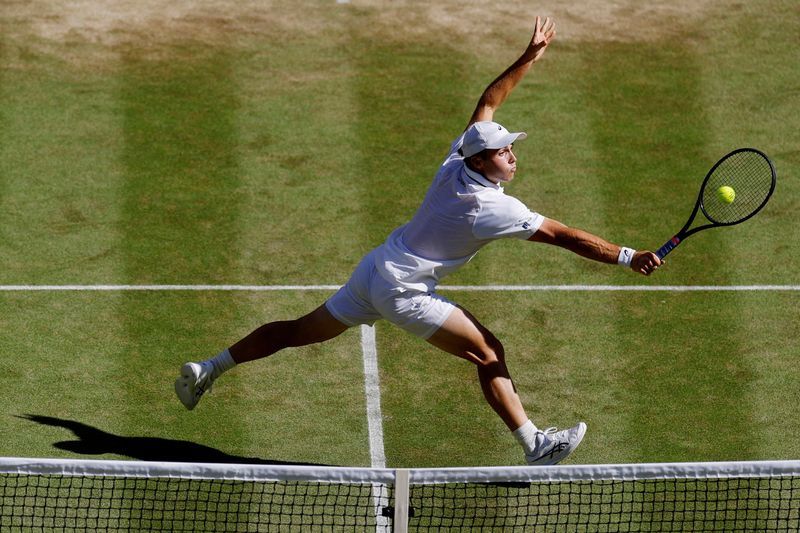
Arthur Fery's improbable journey through Wimbledon has unfolded like a narrative scripted for Hollywood, with the French-born British wildcard carving out space in the tournament's consciousness through sheer determination and emotional dramatics. The 24-year-old, who celebrates his birthday on the same day as the men's singles final on Sunday, has positioned himself to potentially mark the occasion on the sport's most hallowed ground—a possibility that seemed fantastical merely weeks ago when he held world ranking of 114th.
Fery's ascent through the draw has been marked by a pattern of heart-stopping comebacks that have energised Centre Court crowds in ways that transcend typical sporting theatre. His second-round victory over fellow wildcard Grigor Dimitrov, sealed 7-5 3-6 4-6 6-4 7-6(7), exemplified his capacity to absorb pressure and respond when the match appeared slipping away. The 35-year-old Dimitrov, a former world number three whose pedigree carries significant weight, held a commanding position at 4-3 with a break secured in the fourth set. Yet Fery summoned reserves of resilience that turned the tide in dramatic fashion, his breakthrough mirroring the manner in which British sporting fortunes had shifted hours earlier when England defeated Mexico in the World Cup last-sixteen.
The timing of Fery's victory created an extraordinary synchronicity that amplified the emotional resonance of his performance. The crowd, still reverberating from England's football triumph staged in the early hours of British time at Mexico City's Azteca Stadium, channelled that collective euphoria into unprecedented vocal support. When Fery converted match point, the roar that erupted from Centre Court reached levels rarely achieved in recent Wimbledon history, transcending the typically genteel atmosphere the championships maintain and approaching the fervour more commonly associated with football stadiums.
His earlier progression past Zizou Bergs in the third round demonstrated that Fery's success was no fleeting phenomenon born of favourable circumstances. That encounter required him to recover from a seemingly insurmountable position—trailing by two sets and a double break in the fourth set—while simultaneously contending with successive nosebleeds that would have provided legitimate justification for withdrawal. Instead, Fery persisted through physical discomfort to secure the longest match contested at this year's championships, establishing himself as the tournament's most compelling narrative beyond the tournament's seeded contenders.
The contrast between Fery's trajectory and the broader British singles contingent underscores both his exceptionalism and the domestic challenges facing British tennis. Of the nineteen British singles players who contested the championships, fifteen departed in the opening round, leaving Fery as the nation's primary standard-bearer. This burden of representation, while substantial, has appeared to invigorate rather than constrain him, his performances suggesting an athlete who thrives under the pressure of competing before his home audience.
Fery's pedigree includes formative years at Stanford University, where collegiate tennis shaped his development as a competitor. This background, combined with his London upbringing despite French birth, has created a hybrid identity that resonates particularly with British audiences seeking homegrown talent achieving excellence on the global stage. His next assignment against Flavio Cobolli, the world number ten Italian whom Fery defeated at this year's Australian Open, presents a significant step in difficulty but also an opportunity to demonstrate that his victories possess substance beyond the drama of circumstance.
The recognition of Fery's potential predates his Wimbledon breakthrough among those intimately acquainted with professional tennis. Taylor Fritz, the American sixth seed, publicly credited Fery's practice sessions prior to the 2024 World Tour Finals in Turin with impressing him sufficiently to recognise emerging quality. Fritz recounted how Fery consistently prevailed during their preparatory sessions, displaying particular strength in his forehand execution and serving capability that compensated for his relatively compact frame compared to the modern tour standard. These observations, offered retrospectively once Fery had announced himself at Wimbledon, validate the assessment that his current run, while surprising to broader audiences, represented the fulfilment of promise already evident to discerning observers within professional circles.
Fery's ranking trajectory reflects the tangible impact of his tournament performance, his ascent from 114th to inside the top seventy within days illustrating how a fortnight of high-level victories can fundamentally reshape a player's standing. This rapid accumulation of ranking points represents not merely numerical improvement but genuine elevation in status, potentially opening doors to future tournament invitations and seeding considerations that remained inaccessible during his entry to this year's championships as a wildcard.
The broader implications of Fery's emergence extend beyond individual sporting achievement into questions regarding British tennis's structural health and the role that homegrown talent can play in inspiring broader participation. At a moment when domestic representation had become notably sparse at Wimbledon, Fery's performances have reignited investment in the possibility that talented British competitors can achieve distinction on tennis's premier stage. His authenticity as a competitor—evident in his emotional engagement with crowds and visible commitment to every point—has cultivated support that transcends typical sporting tribalism, drawing spectators who might not typically follow tennis closely but have responded to the narrative of a young athlete defying expectations.
The convergence of personal milestone, sporting achievement, and national sporting enthusiasm on a single day promises extraordinary theatre if Fery extends his run to the final. Should he secure his quarterfinal victory, his birthday celebration would unfold amid the most pressurised circumstances professional tennis offers, transforming what might have been a personal observation into a moment of historical significance for British sport. Whether or not that outcome materialises, Fery's already secured his place in this year's championship narrative as the player who captured imaginations and provided British audiences with a compelling reason to believe in domestic tennis talent.

