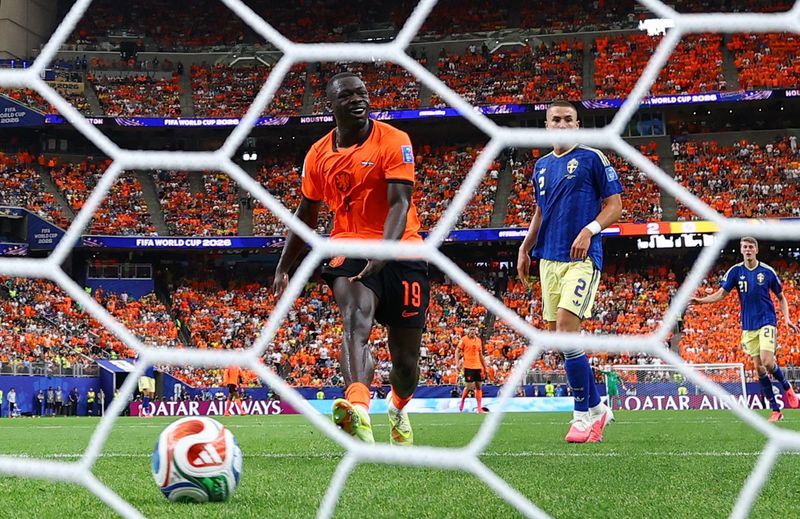
Ronald Koeman's tactical gamble paid enormous dividends when the Netherlands dismantled Sweden 5-1 on Saturday, vindicating the Dutch coach's decision to hand Brian Brobbey the role of lead attacker. The result stands in stark contrast to the uncertainty that clouded the Netherlands' campaign opener against Japan, where a 2-2 draw in Dallas saw Koeman openly acknowledge that his in-game substitutions had failed to deliver the intended impact. Yet within the span of a single match day, the narrative shifted dramatically, with Koeman's selection of the 24-year-old striker proving to be the pivotal move that transformed the Group F encounter into a dominant display of attacking football.
Brobbey's contribution to the Swedish rout was immediate and decisive. The striker found the net twice within the opening 17 minutes, establishing a commanding platform from which the Netherlands could build their superior second-half performance. This clinical finishing provided the foundation for an evening that ultimately positioned the Dutch atop their qualifying group, a position of considerable significance at this stage of the tournament being held across Canada, Mexico and the United States. The performance also offered a tangible answer to a question that has gnawed at Dutch football management: who will lead the attack in the post-Memphis Depay era?
Brobbey's path to this moment has been decidedly unconventional within the context of elite international football. The striker spent considerable time operating on the periphery of the Netherlands squad, notably absent from the qualifying campaign for the 2026 World Cup. His exclusion during that period suggested he had fallen out of favour with the coaching staff, a position from which few players resurface. However, a recall to the squad in March of this year signalled a shift in thinking, suggesting that Koeman and his technical team recognised untapped potential in the striker. That rehabilitation proved timely, arriving just as the tournament began to take shape.
The transformation in Brobbey's profile has been underpinned by his loan spell at English Premier League side Sunderland, an experience that appears to have fundamentally altered his approach to the game. When speaking to journalists at the Dutch training facility earlier in the month, Brobbey articulated the nature of his development with remarkable clarity, describing himself no longer as a player whose primary strength lay in physical battles with opposing defenders. Instead, he outlined a more nuanced offensive skill set that encompasses intelligent movement from deeper positions, spatial awareness, and the ability to execute penetrative runs that catch defensive units off guard. This evolution suggests a player maturing beyond reliance on athleticism alone, integrating tactical sophistication into his performance.
The support structure surrounding Brobbey within the Dutch attacking setup provides additional reason for optimism regarding his continued development at the tournament level. On the left flank, Cody Gakpo presents a creative threat capable of manufacturing chances through either direct play or incisive passing. On the right, fullback Denzel Dumfries offers the width and athleticism that transforms traditional defensive duties into forward-thinking opportunities, while the introduction of Crysencio Summerville adds another dimension to the attacking arsenal. This constellation of offensive talent means that the player occupying the central striker position possesses inherent advantages in terms of service delivery and creative support.
When evaluating Brobbey's performance against Sweden within the broader context of the position he seeks to occupy, his finishing prowess emerges as a critical asset. Memphis Depay, the incumbent and record scorer for the Netherlands, arrives at the tournament carrying the burden of an extended injury absence that raises legitimate questions about his sharpness and rhythm in front of goal. By contrast, Brobbey demonstrated the alertness and composure required to convert the opportunities that materialised in the opening phase of the Swedish encounter. This distinction—between a player operating at peak sharpness and one returning from enforced layoff—could assume considerable significance as the tournament progresses through its knockout phases.
The Netherlands' recognition that succession planning at the striker position represents an urgent matter has been implicit in recent squad decisions and tactical selections. Depay's stature within Dutch football transcends his individual performances, given his status as the national team's leading goalscorer across all competitions. Yet the inexorable march of time, combined with the physical demands of professional football, necessitates the identification and development of a successor capable of maintaining the attacking potency upon which Dutch football has traditionally relied. Brobbey's emergence as a credible candidate represents the culmination of months of assessment and, latterly, the provision of opportunity to demonstrate his suitability.
The psychological dimension of Brobbey's display should not be underestimated in evaluating his candidacy for the role. International football rewards players who can absorb the pressure that accompanies high-profile opportunities, responding with composure rather than anxiety. His two goals in a tournament context, achieved in circumstances where the Dutch needed decisive intervention to shift the momentum of their Group F campaign, indicate a temperament capable of functioning effectively at the tournament's elevated intensity. Furthermore, his willingness to articulate the technical improvements he has incorporated into his game suggests a player engaged in genuine self-improvement rather than merely capitalising on a fortunate sequence of results.
Looking toward the Netherlands' remaining group-stage fixtures, Brobbey's performance has established clear parameters for expectation. Should he maintain the standard demonstrated against Sweden, the Dutch can approach their subsequent matches with considerable confidence regarding their attacking threat. Conversely, the competitive dynamic within international football ensures that opponents will now pay closer attention to countering his specific attributes, potentially making subsequent opportunities more difficult to manufacture. The striker's capacity to evolve within matches and find impact through means beyond the direct scoring opportunities will ultimately determine whether Saturday's two-goal contribution represents the beginning of a sustained elevation or a momentary breakthrough that fails to sustain itself across the tournament's duration.

%22%2F%3E%3C%2Fpattern%3E%3C%2Fdefs%3E%3Crect%20width%3D%22100%25%22%20height%3D%22100%25%22%20fill%3D%22url(%23ph4sxcmg)%22%2F%3E%3Crect%20width%3D%22100%25%22%20height%3D%22100%25%22%20fill%3D%22url(%23ph4sxcmp)%22%2F%3E%3Ctext%20x%3D%2250%25%22%20y%3D%2250%25%22%20text-anchor%3D%22middle%22%20dominant-baseline%3D%22central%22%20fill%3D%22rgba(255%2C255%2C255%2C0.95)%22%20font-family%3D%22Georgia%2C%20'Times%20New%20Roman'%2C%20serif%22%20font-weight%3D%22700%22%20font-size%3D%22320%22%20letter-spacing%3D%22-0.02em%22%3EMOH%3C%2Ftext%3E%3C%2Fsvg%3E)
%22%2F%3E%3C%2Fpattern%3E%3C%2Fdefs%3E%3Crect%20width%3D%22100%25%22%20height%3D%22100%25%22%20fill%3D%22url(%23phdjsag)%22%2F%3E%3Crect%20width%3D%22100%25%22%20height%3D%22100%25%22%20fill%3D%22url(%23phdjsap)%22%2F%3E%3Ctext%20x%3D%2250%25%22%20y%3D%2250%25%22%20text-anchor%3D%22middle%22%20dominant-baseline%3D%22central%22%20fill%3D%22rgba(255%2C255%2C255%2C0.95)%22%20font-family%3D%22Georgia%2C%20'Times%20New%20Roman'%2C%20serif%22%20font-weight%3D%22700%22%20font-size%3D%22320%22%20letter-spacing%3D%22-0.02em%22%3EIJN%3C%2Ftext%3E%3C%2Fsvg%3E)