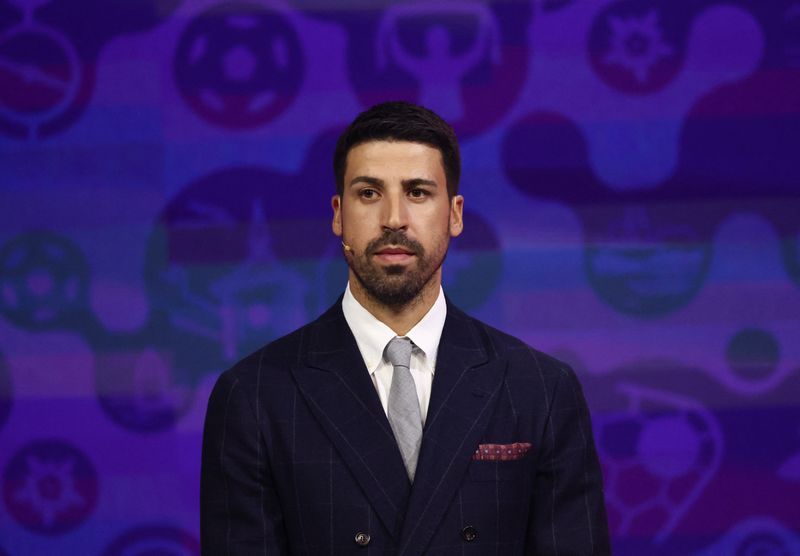
Sami Khedira, a crucial member of Germany's 2014 World Cup triumph, has emerged as an unlikely voice of acceptance regarding one of modern football's most emotionally charged phenomena: brothers representing different nations on the same tournament stage. Speaking at the Home of Football museum in New York, the veteran midfielder articulated a perspective that reframes what many view as a footballing anomaly into something altogether more profound—a natural consequence of our interconnected, migratory world. His stance carries particular weight given that his own brother Rani currently plays international football for Tunisia, the nation of their father's origin, while Sami represented Germany throughout his career.
The 2026 World Cup will showcase at least eight pairs of brothers competing across the tournament, with half of these sibling relationships spanning international borders. Among the notable splits is Inaki and Nico Williams, whose decision to represent Ghana and Spain respectively reflects a broader pattern among European-based players with African heritage. Similarly, Guela and Desire Doue have chosen Ivory Coast and France, while the cases of Derrick Luckassen and Brian Brobbey—brothers through their mother who adopted their fathers' surnames—represent yet another layer of complexity in how identity and national affiliation intertwine in contemporary professional football. The tournament will also feature Harry and John Souttar divided between Australia and Scotland, alongside various other combinations that underscore football's increasingly cosmopolitan reality.
For Khedira, who grew up in Germany with a German mother and Tunisian father, the question of national identity was never presented as a binary choice but rather as an accumulation of influences. His perspective challenges the notion that competing allegiances create internal conflict or compromise authenticity. Instead, he frames dual heritage as a source of distinction, suggesting that players carrying two cultures simultaneously possess psychological and tactical advantages that purely monocultural athletes cannot replicate. This worldview becomes particularly significant in a sport where cultural identity, national pride, and personal achievement are deeply interwoven, often creating pressure on young players to deny half their heritage in service of a singular footballing narrative.
Khedira's observations gain additional resonance when contextualised against broader European attitudes toward identity and belonging. He openly acknowledged experiencing questions about his authenticity in both Germany and Tunisia—scrutinised for his name and appearance in his birthplace, yet considered foreign in his father's homeland. His response articulates a mature understanding that national identity need not be mutually exclusive: both nations can simultaneously claim space within a single heart. This perspective carries implications beyond football, touching on fundamental questions about citizenship, belonging, and what it genuinely means to represent a country on the international stage.
The emotional authenticity of dual-national representation became visceral for Khedira when he witnessed Guela and Desire Doue singing both the French and Ivorian national anthems before their nations' friendly match earlier this month. This moment crystallised for him football's extraordinary capacity to transcend sporting competition and communicate something profoundly humanistic to a global audience. In an era when football is frequently critiqued for promoting narrow nationalism and divisiveness, such scenes offer countervailing evidence of the sport's capacity to celebrate human complexity and multicultural solidarity. Khedira explicitly recognised this symbolic power, describing the image as fundamentally beautiful and reflective of football's potential as a vessel for progressive social messaging.
The expanded 48-team World Cup format has democratised access to the tournament in ways that complement rather than contradict the dual-nationality phenomenon. Countries such as Cape Verde, Curacao, and Haiti—nations historically excluded from the expanded tournament structure—now possess genuine pathways to world football's grandest stage. This structural expansion has enabled smaller footballing nations to recruit talent from diaspora communities and dual-national players, fundamentally altering competitive dynamics. Simultaneously, African and Asian federations have demonstrably narrowed the traditional performance gap separating them from European and South American powerhouses, a development Khedira attributed to systematic improvements in coaching infrastructure, player education, and development pathways.
However, Khedira tempered optimism with institutional critique, noting that wealthy European nations have benefited disproportionately from dual-nationality players without reciprocally investing in grassroots development across Africa and Asia. This observation highlights a structural inequity within global football: established confederations essentially harvest talent from developing nations through dual-nationality provisions while investing minimally in the source countries' fundamental infrastructure. The arrangement perpetuates a brain drain dynamic whereby emerging football nations lose access to their most talented players precisely when they most need them for development purposes. Genuine progress, Khedira suggested, requires European and South American federations to recognise their institutional obligations toward development assistance rather than merely exploiting regulatory provisions.
The most ethically complex dimension of dual-nationality football, according to Khedira, involves the psychological burden placed on adolescent players navigating multiple federation recruitment efforts simultaneously. Young athletes, frequently still forming coherent understandings of identity and belonging, encounter intense pressure from multiple national federations pursuing their allegiance through arguments rooted in heritage, opportunity, and national patriotism. Khedira articulated the profound difficulty inherent in asking minors to make potentially career-defining decisions based on nationality considerations they scarcely comprehend. His own experience at eighteen—when facing identical choices—crystallised for him the immense psychological weight carried by teenagers forced to publicly commit to singular national identities.
Khedira's philosophy regarding these decisions emphasises intuition over coercion, suggesting that the right national choice cannot be manufactured through political pressure, familial obligation, or heritage alone. Instead, he advocated for a more organic approach wherein young players follow internal conviction—what he termed "a gut feeling"—rather than external directives. This perspective grants agency to adolescent athletes while simultaneously acknowledging their vulnerability to manipulation by powerful institutional interests. Notably, Khedira referenced his own respectful engagement with Tunisia's football federation, demonstrating that declining to represent a nation need not constitute disrespect toward that nation's footballing heritage or the players' cultural background.
The broader implication of Khedira's stance involves recognising that modern professional football operates within a fundamentally transformed social reality. Migration, diaspora communities, intermarriage, and cosmopolitan identity formation are not anomalies but rather defining characteristics of contemporary global life, particularly within Europe. Football's institutional frameworks—national team structures, federation eligibility rules, and international competition formats—were conceived during a different historical moment when population mobility and multicultural family formation were substantially less prevalent. As these frameworks encounter an increasingly diverse player population, the tension between traditional national team models and modern demographic reality becomes increasingly pronounced. Khedira's recognition of this tension, coupled with his advocacy for player agency and celebration of multicultural identity, suggests a potential pathway toward more humane, inclusive approaches to international football that honour both competitive integrity and individual authenticity.