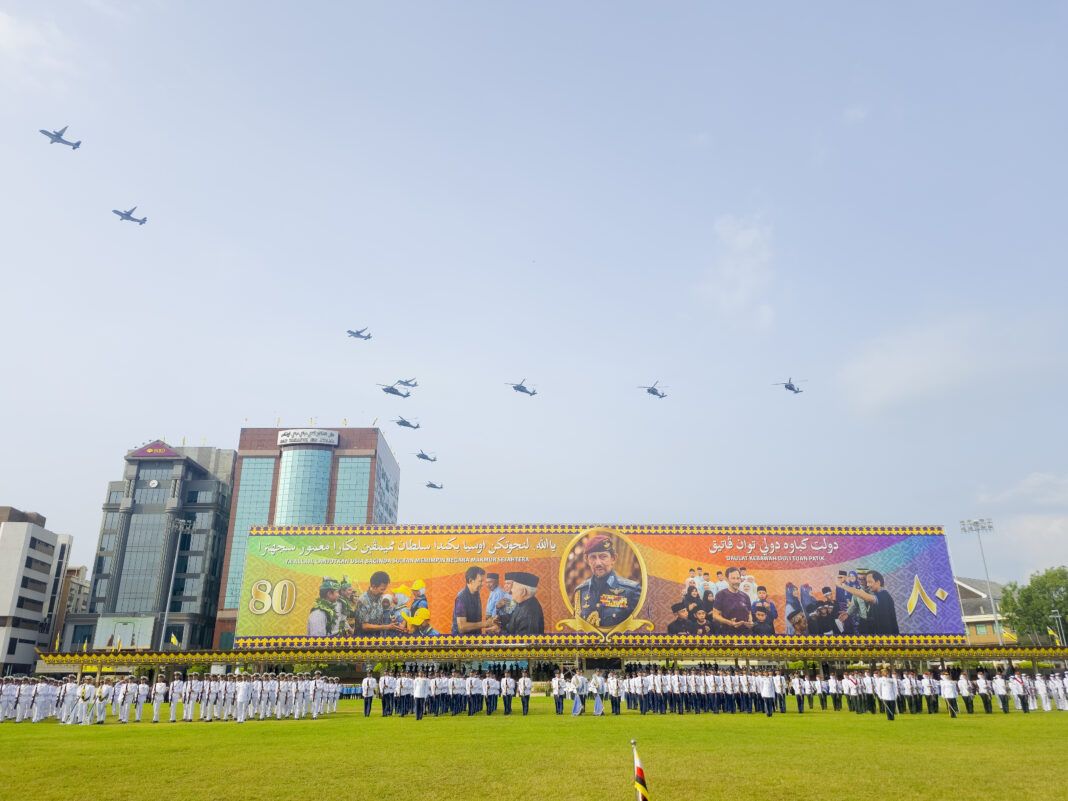
Brunei is moving into the final preparatory phase for one of its most significant state occasions in recent years: the ceremonial celebrations honouring Sultan Hassanal Bolkiah's 80th birthday. The sultanate conducted an extensive full-scale rehearsal at Taman Haji Sir Muda Omar 'Ali Saifuddien on Saturday, July 11, testing all the ceremonial protocols and logistical arrangements that will define the formal proceedings. The guard of honour parade, a centrepiece of the commemorative events, represents a crucial moment for the nation to demonstrate its respect and affection for its long-reigning monarch through meticulously choreographed military and ceremonial displays.
The involvement of Brunei's most senior government figures underscores the national significance placed on these celebrations. Chief of Adat Istiadat Negara Yang Amat Mulia Pengiran Indera Setia Diraja Sahibul Karib Pengiran Anak Idris Pengiran Maharaja Lela Pengiran Muda Abdul Kahar presided over the rehearsal in his dual capacity as head of national protocol and as a co-adviser to the National Committee for His Majesty's 80th Birthday Celebration for 2026. His presence ensures that every element of the ceremony adheres strictly to Brunei's deeply rooted traditions of state protocol and Islamic customs governing royal ceremonies.
The calibre of ministerial attendance demonstrates the whole-of-government approach Brunei has adopted toward these celebrations. Five ministers serving as co-chairs of the organizing committee witnessed the rehearsal: Datuk Seri Setia Awang Ahmaddin Abdul Rahman, who coordinates social policies and oversees home affairs; Pehin Datu Lailaraja Major General (Rtd) Datuk Paduka Seri Awang Halbi Mohd Yussof, responsible for national security and defence; Datuk Seri Setia Awang Nazmi Awang Mohamad from the Prime Minister's Office handling public service governance; Datuk Seri Setia Dr Mohd Isham Jaafar overseeing health matters; and Pengiran Datuk Seri Setia Shamhary Pengiran Datuk Paduka Mustapha leading culture, youth and sports initiatives.
The choice of venue carries particular resonance within Brunei's national consciousness. Taman Haji Sir Muda Omar 'Ali Saifuddien is not merely a ceremonial ground but a space laden with historical and symbolic weight in the sultanate's public life. The park's selection for both rehearsal and the official parade itself reflects the carefully considered decision-making that characterizes state occasions in Brunei, where every detail from location to timing carries meaning and reflects the nation's values.
Such extensive preparation, months in advance of the actual celebrations, reveals the meticulous planning standards that Brunei maintains for royal occasions. Full dress rehearsals of this nature serve multiple purposes: they allow security personnel to coordinate crowd management and protection protocols, enable ceremonial units to perfect their formations and timing, test communication systems across multiple departments, and identify any logistical challenges before the actual event. The scale of participation from both military and civilian government agencies suggests a complex operation requiring seamless coordination among numerous stakeholders.
For Southeast Asian observers, Brunei's approach to celebrating Sultan Hassanal Bolkiah's octogenarian milestone offers insights into how the sultanate balances tradition with contemporary governance. The Sultan, having ruled since 1967, represents continuity and stability in a region marked by political transitions. His 80th birthday celebrations serve not only as personal tribute but as affirmation of institutional permanence and the enduring nature of Brunei's monarchy within the broader regional context of Southeast Asian governance.
The national committee's organizational structure reveals how Brunei integrates ceremonial observance with substantive policy coordination. By assigning defence, security, health, and cultural affairs ministers to leadership roles, the government ensures that the celebrations connect to broader national priorities and messaging. This approach transforms what might appear as merely ceremonial into an opportunity for demonstrating governmental competence and national unity across multiple domains.
The Wednesday morning ceremonial guard of honour parade will likely feature Brunei's armed forces, police contingents, and various paramilitary units marching in precise formations before the Sultan and assembled dignitaries. Such displays have become signature elements of Southeast Asian royal ceremonies, combining British Commonwealth ceremonial traditions—a legacy of Brunei's historical connections—with Islamic protocols and regional ceremonial innovations. The parade will serve as a television event for the broader Bruneian population unable to attend in person, extending the celebratory reach throughout the nation.
From a regional diplomatic perspective, Brunei's birthday celebrations for its Sultan often attract official delegations from neighbouring countries and international partners. These occasions provide opportunities for bilateral engagement and reaffirmation of diplomatic relationships within ASEAN and beyond. The formality and grandeur of such ceremonies communicate Brunei's status as a recognized state actor worthy of international respect, particularly significant for a nation whose oil wealth and small population might otherwise limit its regional profile.
The extensive preparation timeline also reflects Brunei's preference for controlled, well-orchestrated public events that project an image of governmental efficiency and national pride. The rehearsal process allows authorities to train security personnel in crowd control, test emergency protocols, and ensure that every ceremonial participant understands their role precisely. For Brunei's population and international observers, the flawless execution of such ceremonies reinforces perceptions of administrative competence and national stability.
Looking ahead to the actual celebration, the momentum generated by these preparations suggests that Brunei intends to mark this milestone with appropriate grandeur and reverence. The involvement of multiple government ministries, the scheduling of dress rehearsals, and the selection of prestigious venues all indicate that these will be significant state occasions reflecting not merely personal celebration but national affirmation of continuity and institutional pride in the sultanate's leadership.

