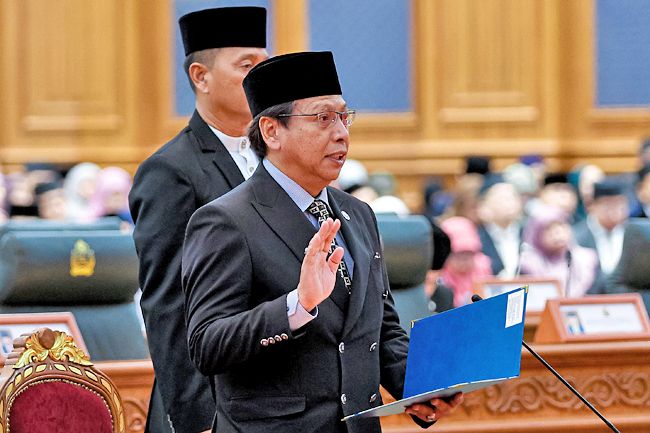
Brunei's government has formally admitted four senior Cabinet ministers into the Legislative Council through a constitutional oath-taking ceremony, reinforcing the institutional link between the executive and legislative branches. The swearing-in took place on Monday, August 3, on the opening day of the Second Meeting of the 22nd Legislative Council Session, held in Bandar Seri Begawan. The ceremony reflects Brunei's adherence to its 1959 Constitution, which prescribes specific procedures for integrating ministerial representatives into the LegCo as ex-officio members—a mechanism that ensures direct executive participation in legislative affairs and policy deliberation.
The four newly sworn ministers bring significant portfolios affecting Brunei's governance across multiple sectors. Datuk Seri Setia Awang Sufian Sabtu assumes his seat representing the Prime Minister's Office with responsibility for security and law matters, a role of particular importance in the region's strategic landscape. Datuk Seri Setia Awang Mohamad Azmi Mohd Hanifah joins the council representing energy affairs, encompassing both upstream and downstream operations—a critical mandate given Brunei's dependence on petroleum and liquefied natural gas revenues for national finances and economic stability.
The inclusion of the Minister of Religious Affairs, Pengiran Datuk Seri Setia Mohammad Tashim Pengiran Hassan, underscores the continuing integration of religious governance into the broader legislative framework, reflecting Brunei's constitutional status as an Islamic monarchy. His presence in the LegCo reinforces the formal recognition of religious policy as a core state function. Meanwhile, Datuk Seri Setia Awang Mohammed Riza Datuk Paduka Mohammed Yunos brings the Transport and InfoCommunications portfolio, areas essential for Brunei's regional connectivity and digital transformation agenda amid broader Southeast Asian economic integration.
The ceremonial induction of ex-officio members represents a constitutional tradition that distinguishes Brunei's legislative system from purely parliamentary democracies. Rather than separating executive and legislative powers, Brunei's framework permits Cabinet ministers to participate directly in council debates and deliberations, enabling closer alignment between policy formulation and parliamentary oversight. This arrangement, grounded in the 1959 Constitution, has persisted through various iterations of Brunei's governance structures and reflects the country's particular institutional approach to balancing executive authority with legislative engagement.
The timing of this swearing-in ceremony, occurring at the commencement of the second parliamentary session, signals the renewal of the council's cycle and the reaffirmation of ministerial commitments to legislative duties. The Second Meeting of the 22nd Session typically involves comprehensive reviews of government operations, budget appropriations, and legislative agenda items accumulated during recess periods. The fresh oath-taking by these four ministers thus symbolises the council's operational continuity and renewed focus on pressing national issues.
Legislative Council Speaker Pehin Orang Kaya Seri Lela Datuk Seri Setia Awang Abdul Rahman Datuk Setia Mohamed Taib presided over the proceedings, a role that underscores the institutional importance of the occasion. As Speaker, Mohamed Taib maintains responsibility for regulating council proceedings, ensuring constitutional compliance, and facilitating productive dialogue between executive representatives and elected members. His presence at the ceremony confirms the formal nature of the induction process and the legislative council's central role in Brunei's constitutional architecture.
For regional observers, Brunei's legislative practices offer insights into alternative governance models within Southeast Asia. While many ASEAN nations have adopted Westminster-style parliamentary systems or presidential structures with clearer separation of powers, Brunei maintains a more integrated approach that emphasises executive-legislative collaboration through direct ministerial participation. This model reflects both Brunei's historical constitutional development and its contemporary emphasis on efficient governance within a smaller nation-state framework.
The energy portfolio represented by Azmi Mohamad Hanifah carries particular significance for Brunei's economic future and regional standing. As a major liquefied natural gas exporter competing in increasingly crowded Asian markets, Brunei requires strategic coordination between energy policy, infrastructure development, and legislative oversight. The minister's presence in the LegCo enables transparent dialogue on energy strategies, investment priorities, and environmental considerations affecting extraction and production operations.
Similarly, the security and law portfolio under Sufian Sabtu reflects Brunei's ongoing commitment to maintaining robust governance frameworks amid regional security challenges. His participation in legislative discussions allows the government to brief parliament on security initiatives, counter-terrorism efforts, and law enforcement priorities while building legislative confidence in executive security operations. This transparency mechanism, institutionalised through the ex-officio membership system, helps prevent the concentration of security decision-making outside democratic oversight.
The InfoCommunications dimension of Mohammed Riza Yunos's portfolio speaks to Brunei's broader digital ambitions and modernisation agenda. As Southeast Asian governments increasingly prioritise digital infrastructure and cybersecurity, the presence of this ministerial portfolio in the legislative council ensures that technology policy receives adequate parliamentary attention and resources. This participatory approach facilitates more informed legislative decision-making on digital investment, telecommunications regulation, and data protection frameworks.
Brunei's constitutional framework, while unique within the ASEAN context, demonstrates that diverse governance models can coexist within the region's institutional landscape. The integration of executive and legislative functions through ex-officio membership represents one approach to ensuring governmental coherence and efficient policy implementation, particularly in smaller polities where economies of scale in governance structures become important. The continuation of this practice through successive legislative sessions affirms Brunei's institutional stability and commitment to constitutionalism.

