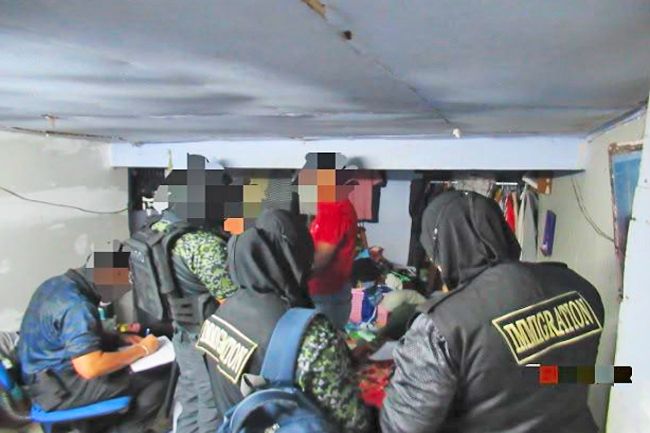
Brunei's Immigration and National Registration Department has mounted a sustained campaign to tackle illegal work arrangements and immigration violations throughout the country, signalling the government's commitment to enforcing stricter labour migration controls. The latest phase of 'Operasi Kakas 2026' has resulted in the detention of multiple foreign nationals across separate enforcement sweeps, reflecting an increasingly rigorous approach to border compliance that mirrors regional trends towards tighter immigration management.
The first operation, designated 'Operasi Kakas 86/2026', concentrated on a commercial hub in Mukim Sengkurong, where immigration officers descended on a busy market area to conduct systematic inspections. Out of 13 foreign nationals checked during this sweep, seven were taken into custody for alleged breaches of immigration law. The primary violation concerned individuals engaged in employment while holding only a visit pass—a technical category that permits entry into Brunei for tourism or short-term business purposes but explicitly prohibits any form of paid work. This appears to represent a common pattern across Southeast Asia, where migrant workers sometimes exploit the relative simplicity of obtaining visit passes compared to proper employment visas, creating an informal labour market that evades regulatory oversight and deprives host governments of tax revenues.
A second enforcement action, 'Operasi Kakas 87/2026', shifted focus to residential areas in Mukim Berakas 'A', where officers inspected rental properties known to house transient populations. Three foreign nationals were examined in this operation, with two subsequently detained pending investigation. These individuals similarly faced allegations of working whilst on visit passes, suggesting that the practice extends beyond informal market labour into domestic and service sectors. The targeting of rented accommodation reflects an administrative strategy of examining accommodation hotspots where irregular migrants typically cluster, allowing enforcement teams to intercept multiple violators efficiently whilst building intelligence on local networks that facilitate illegal employment.
The third operation yielded the highest number of detentions. During 'Operasi Kakas 88/2026', officers inspected a rented house in Mukim Berakas 'A' and encountered eight foreign nationals, six of whom were taken into custody. This particular operation uncovered more serious violations than mere work permit breaches. All six detainees failed to present original immigration documentation, a fundamental requirement under Brunei's immigration framework. Upon preliminary questioning, investigators determined that five of the six had committed overstaying offences, remaining in the country after their authorised immigration passes had expired. Additionally, five individuals appeared to have violated employment regulations by working for employers other than those originally authorised on their visa applications, a practice known as job-switching that undermines bilateral labour agreements between nations and complicates government tracking of migrant worker distribution across economic sectors.
The fourth operation, 'Operasi Kakas 89/2026', demonstrated a different enforcement outcome. Conducted at a residential property in Mukim Berakas 'B', this sweep examined four foreign nationals whose documentation proved entirely compliant with immigration requirements. All possessed valid permits and proper immigration passes, illustrating that enforcement operations occasionally encounter lawful residents, though media reporting typically emphasizes successful prosecutions. The inclusion of this successful verification in official statements suggests departmental transparency regarding the scope of enforcement activities, even when they produce no violations.
These operations reveal a coordinated strategic approach targeting known residential and commercial zones where irregular migration clusters. The pattern of violations—visit pass misuse, overstaying, and unauthorised employment—indicates that enforcement authorities have identified specific loopholes in the immigration system that migrant workers exploit. The emphasis on document verification, particularly the absence of original paperwork, suggests that migrants may deliberately discard identity documents or operate under false credentials, complicating investigation processes. The frequency of employment violations across multiple operations underscores the reality that Brunei's formal employment visa categories may be either expensive, bureaucratically cumbersome, or genuinely unavailable for lower-skilled positions that nonetheless generate sustained labour demand across domestic services, construction, and informal commerce.
The broader implications for the region are significant. Brunei's intensified enforcement mirrors parallel initiatives across Malaysia, Singapore, and Thailand, reflecting a collective recognition among Southeast Asian governments that irregular migration requires systematic rather than ad hoc intervention. The operations demonstrate administrative capacity to coordinate multiple enforcement teams across different municipalities simultaneously, suggesting institutional learning from previous years' experiences. For Malaysia, these developments are particularly relevant given the substantially larger migrant population in the peninsula and the analogous enforcement challenges that arise from documenting, tracking, and regulating foreign workers across diverse economic sectors.
The detainees face potential prosecution under multiple provisions of Brunei's Immigration Act and Immigration Regulations, with overstaying carrying particular severity given that extended unauthorised residence constitutes a deliberate breach of territorial sovereignty rules. Unauthorised employment carries additional significance because it represents evasion of payroll taxation and official labour registries, depriving the state of revenue and statistical information necessary for workforce planning. Job-switching violations, meanwhile, undermine the bilateral labour agreements that regulate Brunei's relationship with sending nations, potentially straining diplomatic ties if patterns of violation become systematic.
The Immigration and National Registration Department explicitly characterised these operations as integral to maintaining compliance with the nation's immigration law and regulatory framework. This public articulation serves multiple functions: it communicates deterrence messaging to would-be violators, demonstrates governmental commitment to law enforcement constituencies, and reinforces international reputation regarding border security and labour market regulation. The naming convention 'Operasi Kakas'—with sequential numbering reaching at least 89 iterations—suggests an established institutional practice of regular, numbered operations rather than sporadic enforcement, indicating sustained resource commitment to immigration compliance monitoring. For Malaysian observers, these developments illustrate how neighbouring jurisdictions are institutionalising immigration enforcement as permanent administrative function rather than episodic response, a model increasingly adopted across the region.

