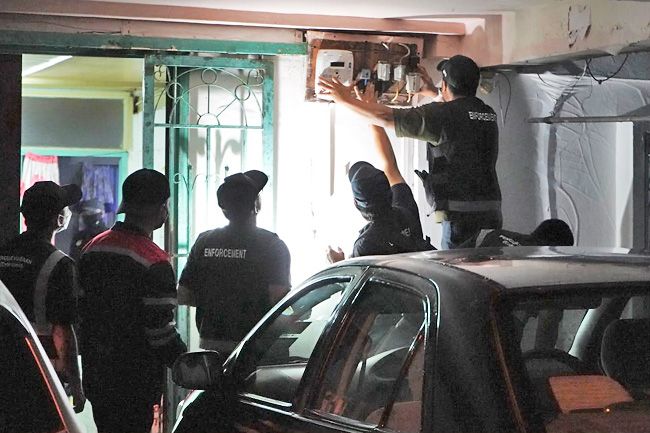
Brunei's law enforcement agencies have concluded a substantial coordinated operation that exposed multiple regulatory breaches across Bandar Seri Begawan, marking another phase in the nation's intensified compliance drive. The joint enforcement activity, conducted across two sites in the capital district, involved more than 200 personnel drawn from the Brunei-Muara Police District, immigration authorities, labour inspectors, customs officials, and municipal regulators, underscoring the government's commitment to comprehensive multi-sector oversight.
The Immigration and National Registration Department (INRD) took custody of two foreign nationals—a man and a woman—for questioning relating to potential violations of immigration regulations. While limited details were provided regarding the specific nature of their alleged offences, the detention reflects growing scrutiny of migration compliance, a persistent concern across Southeast Asia where irregular employment and documentation breaches remain endemic issues affecting both national security and labour market integrity.
The Labour Department's findings proved particularly significant, identifying five separate workplace infractions that expose systemic vulnerabilities in employer accountability. Three violations centred on Section 81 of labour legislation, involving employers' failures to furnish workers with adequately maintained living quarters and their inability to sustain required standards of environmental sanitation. These breaches touch directly on worker welfare—a concern that Malaysian employers and regulators increasingly monitor, given the region's reliance on migrant labour and international scrutiny of employment practices.
Two additional labour violations emerged under Section 86, specifically concerning employers' neglect to register worker accommodation within their Foreign Worker Licence documentation. This administrative failing, though seemingly procedural, carries substantial implications for labour trafficking prevention and worker protection frameworks. Accurate housing registration enables authorities to track vulnerable populations and intervene against exploitation, making these compliance gaps more than mere bureaucratic oversights.
The Department of Electrical Services identified two separate breaches of the Electricity Act (Chapter 71), a component of the operation that highlights how multi-agency sweeps capture violations spanning diverse regulatory domains. Electrical safety breaches pose genuine public hazard risks, particularly in densely populated urban districts where faulty installations or unlicensed electrical work can endanger residential and commercial premises. The detection of these offences illustrates how coordinated operations capture violations that single-sector inspections might overlook.
The Human Trafficking Investigation Unit conducted interviews with nineteen individuals during the course of both operations, though investigators determined that no human trafficking offences met evidentiary thresholds for charges. This negative finding proves noteworthy given the frequency with which labour violations and immigration breaches often intertwine with trafficking concerns. The unit's presence reflects Brunei's recognition that coercive labour practices and migration abuse frequently travel together, making integrated investigative approaches essential.
Superintendent Mohamad Noor Abd Rahman, serving as Acting Commanding Officer of the Brunei-Muara Police District, directed the overall operation, commanding a coalition that encompassed the Narcotics Control Bureau, Royal Customs and Excise Department, Internal Security Department, Bandar Seri Begawan Municipal Department, and Religious Enforcement Division. This breadth of participation demonstrates how modern law enforcement in Southeast Asia increasingly operates across traditional silos, recognising that regulatory effectiveness demands coordinated intelligence sharing and joint authority.
For Malaysian observers, Brunei's approach merits attention as both nations confront comparable challenges around migrant worker management, workplace safety enforcement, and border security. The scale of Brunei's operation—mobilising over 200 personnel across multiple agencies—reflects resource commitments that suggest serious governmental intent to drive compliance. Malaysia's own framework of multi-agency operations through bodies like the Federal Territory Enforcement Coordinating Unit mirrors this structural evolution toward integrated oversight.
The operation's emphasis on labour accommodation violations particularly resonates regionally. Throughout Southeast Asia, inadequate worker housing serves as both a human rights concern and a vector for labour trafficking, making accommodation standards enforcement a strategic intervention point. Brunei's detection of five separate workplace breaches in a single operation suggests these violations remain disturbingly common, even in smaller economies with more concentrated regulatory reach.
The regulatory landscape these violations expose reflects broader Southeast Asian patterns. Immigration systems across the region continue struggling with verification and documentation compliance, particularly among lower-wage workers where documentation irregularities correlate strongly with exploitation vulnerability. Foreign worker licensing requirements, while sound in principle, often fail in execution when inadequate employer record-keeping goes undetected through routine compliance gaps.
The operation underscores how electrical and infrastructure violations frequently coexist with labour and immigration breaches, often indicating larger patterns of systemic non-compliance within particular business entities or geographic clusters. Where employers demonstrate willingness to breach one set of regulations, regulatory capture often extends across multiple domains, making coordinated multi-sector inspections more efficient than isolated enforcement efforts.
Moving forward, the effectiveness of this operation ultimately depends on follow-through enforcement action. Detentions and regulatory findings matter little without consequential penalties and corrective action orders that reshape future employer behaviour. The involvement of diverse agencies suggests Brunei is building institutional infrastructure to sustain integrated enforcement beyond individual operations, though sustained commitment to this coordination remains essential for meaningful compliance gains.
Brunei's operation reflects Southeast Asia's gradual movement toward recognising that effective modern law enforcement requires breaking down agency boundaries and deploying coordinated intelligence. While the specific violations discovered remain circumstantially limited to Bandar Seri Begawan, the broader enforcement architecture on display suggests a region increasingly committed to comprehensive regulatory compliance, with potential lessons for Malaysia's own multi-agency coordination mechanisms.

