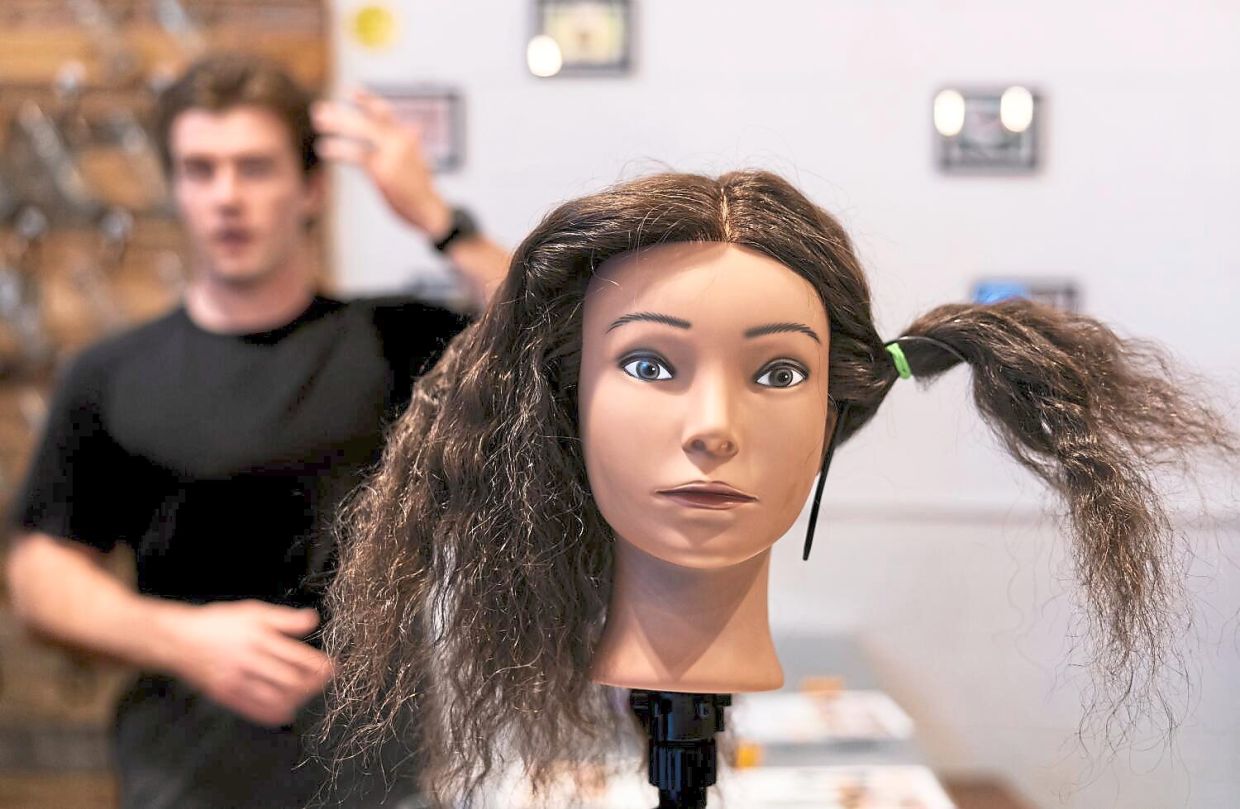
Austin Nieves transformed a brewery gathering into something unusual one May evening: fifteen fathers learning to braid hair on mannequin heads while sharing drinks at Captain Fatty's Brewery in Santa Barbara County. The event, modelled on a viral British concept called "Pints and Ponytails," highlighted an emerging trend across America—organised father communities designed to tackle the emotional and practical challenges of modern parenting. Nieves, who relocated to Santa Barbara in April 2025 from Pasadena, founded the Santa Barbara Dads group and orchestrated the sold-out hair-braiding workshop that transformed initially anxious fathers into confident participants.
The initial hesitation Nieves observed among attendees reflected a broader discomfort many men experience when entering traditionally female-dominated parenting spaces. What began as an awkward, quiet gathering dissolved into animated conversation once the men overcame their initial apprehension. This pattern mirrors what researchers have long documented: fathers increasingly desire community and mentorship as they embrace more active roles in child-rearing, yet struggle to find appropriate venues for connection. The Santa Barbara Dads group holds monthly meetups, establishing themselves as a genuine alternative to the well-established mother-focused support networks that dominate parenting communities.
Nieves' personal journey illuminates why such groups matter. When his wife gave birth to their son Hudson, now three years old, she immediately joined multiple mother groups and classes offering practical advice, emotional support, and friendship. Nieves, by contrast, relied primarily on his brothers for guidance—a stark asymmetry in institutional parenting support. This experience catalysed his broader mission to equalise access to father-centred community. The realisation struck him acutely when conversations with childless friends diverged dramatically from his lived reality; while they discussed entertainment and television, he was marvelling at his infant's ability to lift his head.
Academic research validates the genuine need underlying these informal gatherings. Researchers Chris Knoester and David J. Eggebeen documented in their 2006 Journal of Family Issues study that active fatherhood correlates with declining well-being and reduced social participation, as men sacrifice friendship time for caregiving duties. Clinical psychologists Hillary Halpern and Maureen Perry-Jenkins further established that the transition from single life to fatherhood frequently triggers emotional turbulence. More recently, a 2021 Karolinska Institute study from Stockholm determined that fathers specifically benefit from structured group support during this life transition. The research revealed that men participating in father groups reported enhanced self-confidence, decreased loneliness, and improved family dynamics and relationship equality with their partners.
Nieves first established the Orange County Dads club in October 2023 while living in Costa Mesa with his wife Katie. The club quickly evolved beyond simple social meetups, organising gatherings at coffee shops and zoos, coordinating holiday music jam sessions, and offering practical CPR training. Despite positioning itself strictly as a fathers' club, the organisation grew substantially through word-of-mouth marketing by wives and partners who shared Nieves' social media content with their husbands. This dynamic reveals an important insight: while fathers may face barriers to seeking support independently, partner encouragement can effectively bridge the gap between awareness and participation. Mikhail Alfon, founder of Blue Light Media social media strategy agency, exemplified this pattern, attending multiple Orange County Dads events with his son Santos after his wife introduced him to the group.
Alfon's reflections capture what many first-time fathers experience. Recognising that parenthood fundamentally altered his life trajectory, Alfon valued discovering peers navigating identical life stages. This peer-to-peer validation proves psychologically significant; fatherhood often involves isolation and self-doubt, particularly for men conditioned to view emotional expression or help-seeking as weakness. When Alfon stated that "finding peers and friends that are in the same stage of life is great," he articulated a fundamental human need that traditional male friendship networks often fail to address. The compartmentalisation of modern life—where work friendships, childhood friendships, and family responsibilities occupy separate spheres—leaves many fathers without natural communities of same-stage peers.
When Nieves relocated to Santa Barbara in April 2025, he quickly replicated his Orange County success by launching the Santa Barbara Dads group. Their inaugural May 2025 meetup established monthly gatherings as the community standard, demonstrating that father-group enthusiasm extends beyond coastal California enclaves. Austin Jones, a local real estate agent and investor who discovered Nieves through Instagram, exemplified the appeal of these networks. Juggling multiple adult responsibilities—being simultaneously a husband, father, and businessman—Jones found himself chronically under-supported despite his professional accomplishments. The Santa Barbara Dads group offered something his existing networks could not: a space where all three identities were acknowledged and valued equally.
The "Pints and Ponytails" event itself illustrated the practical dimension of these gatherings. Jones, struggling with his two-and-a-half-year-old daughter Noa's textured, curly hair, attended specifically to develop this often-neglected parenting skill. Professional hairstylists trained the fathers using salon mannequins in a deliberately masculine environment—the brewery setting—designed to eliminate the self-consciousness men might experience in traditional salon settings. This pedagogical approach proved remarkably effective; within the event duration, Jones progressed from merely securing headbands to confidently executing ponytails, and he committed to practicing the technique with Noa imminently. The workshop exemplified how dad groups address the practical knowledge gaps that working mothers in dual-income households encounter but which many fathers never develop.
Beyond hair care and occasional entertainment, father groups address a silent crisis in contemporary parenting: the loneliness epidemic among men transitioning to active fatherhood. Previous generations of fathers often remained peripheral to daily childcare, limiting emotional investment but also insulating them from the identity disruption and social dislocation current fathers experience. Modern fatherhood—characterised by hands-on involvement in feeding, dressing, bathing, and emotional caregiving—requires psychological recalibration many men undertake entirely in isolation. When fathers suddenly experience the relentless demands of toddler care, the interrupted sleep, and the erasure of spontaneous leisure time, they frequently lack the vocabulary or community frameworks to process these experiences constructively. Mother groups have long provided this processing space; father groups are now filling an equivalent void.
The geographical expansion from Orange County to Santa Barbara suggests a replicable model gaining momentum. Word-of-mouth expansion through social media and partner networks indicates that the underlying demand far exceeds current supply. Unlike formal parenting classes or therapy, these groups offer casual, peer-driven support that many men find more accessible than institutional alternatives. The brewery setting—far removed from children's play centres or parenting classrooms—communicates that fatherhood community need not entail abandoning adult identity or masculine spaces. This apparent simplicity masks sophisticated understanding of male socialisation patterns: men often resist vulnerability-oriented conversations until trust is established through low-pressure, activity-based engagement.
For Southeast Asian readers, the emergence of father-focused community groups in the United States warrants attention as regional family structures evolve. As Malaysian, Singaporean, and regional professionals increasingly adopt more equitable co-parenting arrangements, the loneliness and isolation Nieves and others experience domestically may begin manifesting regionally. Many Southeast Asian fathers, particularly those in professional urban environments, inhabit similar psychological terrain: balancing career advancement with deepened parenting engagement, lacking institutional support structures, and experiencing social discontinuity as peers without children follow divergent life trajectories. The success of informal father communities in the US context suggests potential for similar initiatives in Malaysian and regional contexts, whether organised through existing networks or emerging digital platforms.
Ultimately, the Santa Barbara Dads group and similar communities represent a broader cultural recalibration: explicit recognition that active fatherhood constitutes a significant life transition warranting emotional and practical support. Nieves' trajectory—from isolated new father in Costa Mesa to community organiser spanning two counties—demonstrates that this need transcends demographic boundaries. The men gathering at Captain Fatty's Brewery ranged from thirty to sixty years old, encompassing diverse family structures and professional backgrounds, yet shared fundamental experiences of disconnection and desire for fraternity. By creating deliberately inclusive spaces where fatherhood becomes central rather than peripheral to male identity, these groups implicitly challenge long-standing assumptions about emotional expression, community participation, and what contemporary masculinity might encompass. As parenthood becomes increasingly demanding and professionally consequential, such communities may prove essential infrastructure for family stability and paternal well-being.

