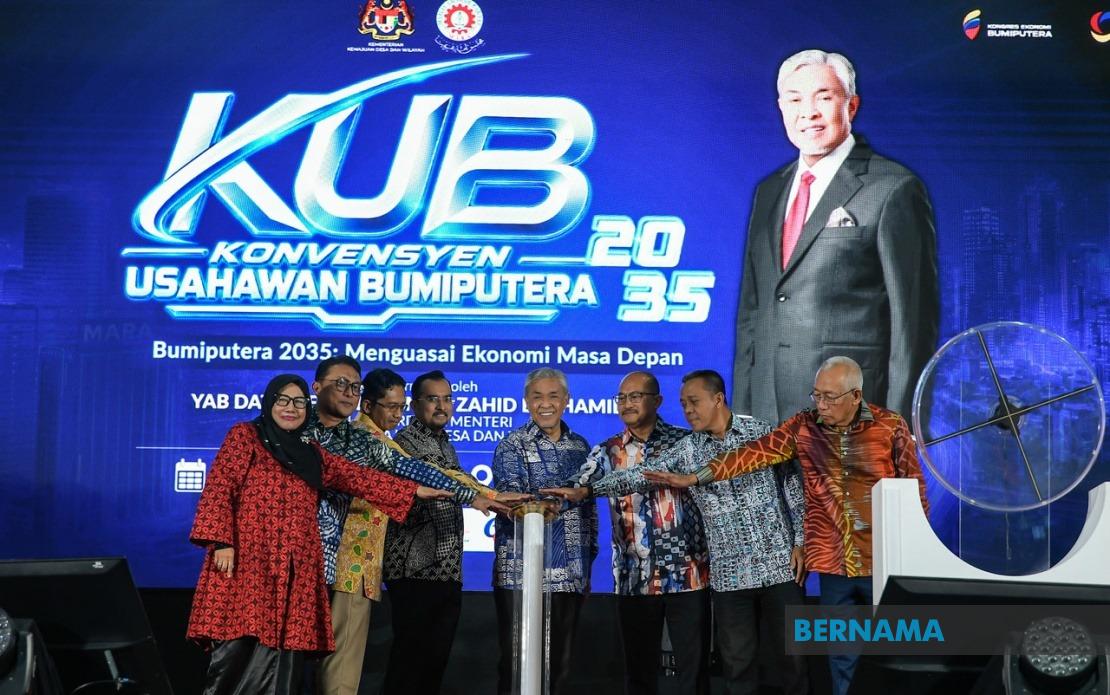
Deputy Prime Minister Datuk Seri Dr Ahmad Zahid Hamidi has called for a fundamental transformation in how Bumiputera entrepreneurs approach business development, arguing that the sector must evolve beyond its current focus on market participation towards establishing genuine ownership and exercising meaningful control within their industries. Speaking at the Bumiputera Entrepreneurs Convention (KUB) 2035 Declaration closing ceremony in Alor Setar, Ahmad Zahid, who also holds the portfolio of Rural and Regional Development Minister, emphasised that decades of foundation-building have created an adequate launching pad for more ambitious entrepreneurial growth.
The deputy prime minister's remarks reflect a strategic reassessment of Bumiputera economic policy, signalling that the government recognises the limitations of earlier participation-focused approaches. Rather than simply ensuring Bumiputera entrepreneurs have access to value chains established by larger enterprises, Ahmad Zahid indicated that the next phase requires these business owners to develop competitive advantages, expand their operational footprints substantially, and ultimately shape the sectors in which they operate. This conceptual shift represents a departure from historic protective mechanisms that emphasised inclusion over autonomy.
Acknowledging the government's continued commitment to supporting Bumiputera business development, Ahmad Zahid outlined the administration's intention to sustain its role in creating favourable conditions, strengthening institutional frameworks, and broadening pathways for entrepreneurial access. However, he stressed that state support alone cannot guarantee success, placing responsibility squarely on entrepreneurs themselves to demonstrate initiative, embrace competitive pressures, and actively generate economic value rather than relying on preferential arrangements. This balance between government facilitation and individual enterprise reflects contemporary thinking about sustainable economic development.
The deputy prime minister identified three critical transformations necessary for the Bumiputera entrepreneurship ecosystem to evolve effectively toward 2035. The first involves integrating fragmented support systems that currently operate through disconnected channels. Financing mechanisms, skills development programmes, and market access initiatives are presently delivered through separate institutional pathways, creating inefficiencies and limiting entrepreneurs' ability to access comprehensive, coordinated assistance. Consolidating these instruments under a more unified framework would enable entrepreneurs to navigate support systems more effectively and leverage multiple resources simultaneously.
The second transformation entails shifting institutional focus from producing large quantities of entrepreneurs to nurturing the development and growth of existing entrepreneurs. This distinction carries significant implications: rather than measuring success through the number of new business registrations or startup initiatives, the ecosystem would prioritise supporting entrepreneurs through their growth trajectories, helping them overcome scaling challenges, and enabling them to achieve sustainable expansion. This represents a quality-over-quantity approach that acknowledges entrepreneurship as a developmental journey requiring ongoing support rather than a one-time intervention.
The third element involves ensuring that national economic growth actively strengthens local enterprises rather than simply benefiting multinational corporations or large established players. Ahmad Zahid's inclusion of this point suggests concern that broad economic expansion may not automatically translate into improved prospects for small and medium Bumiputera businesses. Strategic integration of local enterprises into broader economic development pathways would require intentional policy design to create procurement opportunities, technology transfer arrangements, and collaborative partnerships that genuinely enhance local business competitiveness.
The fragmentation Ahmad Zahid highlighted reflects longstanding structural challenges within Malaysia's entrepreneurship support infrastructure. Financial institutions, government agencies, professional associations, and educational providers often operate according to different priorities, timelines, and performance metrics, making it difficult for entrepreneurs to access holistic support. An entrepreneur seeking capital might secure financing from one institution while unable to access targeted management training or market research services from coordinated sources. This fragmentation places burden on entrepreneurs to identify, access, and coordinate disparate resources independently, diverting attention from actual business operations.
The emphasis on moving from entrepreneurship production to entrepreneur development carries particular relevance for Malaysia's regional position. As Southeast Asian economies increasingly compete for business talent and innovation-driven growth, countries that effectively nurture and retain high-potential entrepreneurs gain competitive advantage. Malaysia's history of supporting business creation could be channelled more strategically toward developing world-class enterprises capable of competing internationally and establishing regional headquarters in sectors ranging from technology to manufacturing to services.
Ahmad Zahid's messaging also addresses persistent concerns about whether Bumiputera economic participation translates into substantive wealth creation or merely symbolic inclusion. Shifting emphasis toward ownership and control addresses these concerns by establishing measurable outcomes beyond mere participation rates. Entrepreneurs who build ownership stakes in substantial enterprises, create employment, generate innovation, and contribute to sectoral development represent tangible economic progress that extends beyond statistical participation metrics.
The three-pillar transformation framework proposed by the deputy prime minister suggests that sustaining Bumiputera entrepreneurship growth requires synchronised institutional changes rather than isolated interventions. Integrating support systems, shifting to developmental focus, and ensuring inclusive growth represent interdependent changes that collectively reshape the entrepreneurship environment. Implementing one pillar without the others would likely produce suboptimal results, emphasising the need for coordinated policy execution across multiple government agencies and private sector partners.
For Malaysian entrepreneurs across ethnic lines and for foreign investors considering market entry, Ahmad Zahid's speech signals that the government is recalibrating Bumiputera policies away from protectionism toward competitiveness enhancement. This shift could create opportunities for strategic partnerships, technology transfer arrangements, and collaborative business ventures that strengthen local enterprises while opening pathways for broader market participation. The focus on building ownership and control suggests that future Bumiputera economic initiatives will emphasise capability development and competitive positioning rather than preferential access alone.
The practical implications for the Bumiputera entrepreneurship ecosystem remain substantial. Integrating fragmented support systems requires substantial coordination among agencies including Bank Negara Malaysia, the Ministry of Domestic Trade and Consumer Affairs, state development corporations, and various training institutions. Shifting institutional culture from production metrics toward developmental outcomes necessitates redefining success measures and adjusting resource allocation patterns. Ensuring inclusive economic growth while maintaining competitive standards requires sophisticated policy design that avoids creating artificial opportunities disconnected from genuine market demand.

