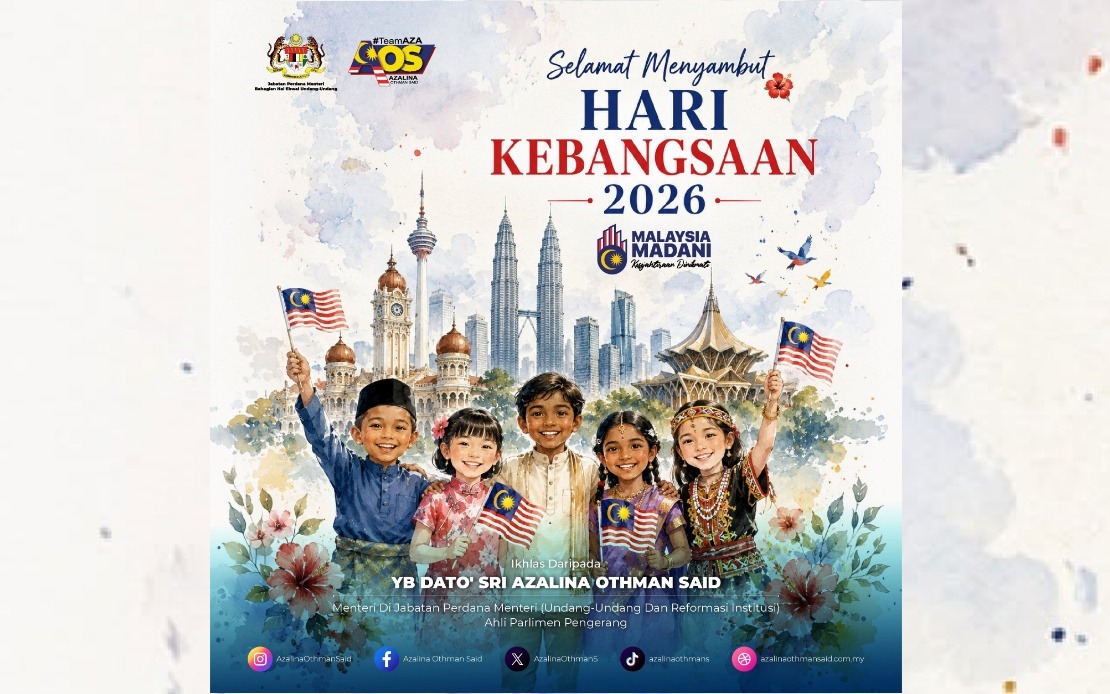
Malaysia's Cabinet establishment commemorated the nation's 69th National Day on August 31 by broadcasting carefully coordinated messages through social media platforms that centred on continuity of national unity, intergenerational responsibility and the preservation of independence. The coordinated messaging from senior government figures reflected an overarching theme: that Malaysia's foundational strength rests upon its ability to maintain cohesion across religious, ethnic and socioeconomic divides in an increasingly fractured global environment.
Minister in the Prime Minister's Department (Law and Institutional Reform) Datuk Seri Azalina Othman Said positioned independence not as a singular historical achievement but as an ongoing obligation requiring continuous renewal through mutual respect and collective purpose. Her framing acknowledged a persistent tension in Malaysian political discourse: the nation's multicultural character demands active preservation rather than passive assumption. By emphasising that "Malaysia's strength has always been in its united people," she articulated a thesis that resonates with policymakers concerned about centrifugal social forces. Azalina's invocation of generational continuity and prosperity suggested that national development cannot be disaggregated from social cohesion—a philosophical underpinning of government planning that extends beyond ceremonial rhetoric into budgetary allocation and legislative priorities.
Home Minister Datuk Seri Saifuddin Nasution Ismail shifted the rhetorical emphasis toward temporal reflection, characterising National Day as a deliberate pause for introspection about the sacrifices undertaken by the independence generation. His assertion that contemporary Malaysians bear responsibility for safeguarding that historical legacy introduced an implicit social contract: citizenship demands active stewardship, not merely passive enjoyment of inherited freedoms. The formulation—"We may differ in race, religion and background, but we share one homeland and one love for Malaysia"—deployed a rhetorical strategy common across Southeast Asian governance, collapsing diversity into nationalist sentiment while acknowledging demographic realities that cannot be erased.
Works Minister Datuk Seri Alexander Nanta Linggi extended this spatial and social geography by invoking territorial comprehensiveness from "cities to villages" and across the peninsular-Sabah-Sarawak axis. This geographic enumeration carried implicit political weight, addressing occasional separatist sentiment in East Malaysian territories by positioning them as integral to an indivisible national project. Alexander's emphasis on shared futurity rather than merely historical commemoration suggested that National Day functions as more than nostalgic remembrance—it serves as a vehicle for renewing collective commitment to forward-looking development priorities.
Minister in the Prime Minister's Department (Religious Affairs) Senator Dr Zulkifli Hasan introduced theological and philosophical dimensions often absent from secular nationalist discourse. His characterisation of independence as "a sacred trust from Allah" and his citation of founding figures including the late Tunku Abdul Rahman Putra Al-Haj and independence intellectual Dr Burhanuddin Al-Helmy grounded contemporary governance in historical and spiritual legitimacy. This rhetorical manoeuvre proved significant for Malaysian audiences: it acknowledged that many Malaysians, particularly among the Muslim majority, conceptualise national identity through religious frameworks, thereby integrating religious and civic nationalism rather than maintaining strict separation.
Zulkifli's invocation of National Laureate Datuk Seri Dr A. Samad Said's poetry reinforced the notion that independence sustains itself through cultural and intellectual production, not merely institutional apparatus. By quoting literary works addressing generational responsibility and communal coexistence, he positioned government messaging within a broader humanistic tradition rather than reducing it to policy announcement. This cultural anchoring has particular salience for Malaysian readership accustomed to intellectual discourse that transcends partisan politics.
The minister's substantive discussion of MADANI Government initiatives—expanding BUDI MADANI subsidy eligibility, allocating infrastructure for inclusive education, providing free artificial intelligence subscriptions, and accelerating healthcare service delivery—connected abstract unity rhetoric to concrete distributional mechanisms. This linkage addressed a persistent critique of Malaysian political messaging: that appeals to harmony ring hollow without demonstrable governmental action to reduce inequality and address cost-of-living pressures. By positioning social spending as an expression of independence values rather than technical economic management, Zulkifli reframed welfare expansion as ideologically consonant with nationalism.
Minister in the Prime Minister's Department (Federal Territories) Hannah Yeoh's minimalist contribution—three repetitions of "Merdeka"—demonstrated that even ceremonial brevity carried communicative weight in this orchestrated moment. The three-fold invocation functioned as rhythmic affirmation, its simplicity contrasting with more discursive interventions yet reinforcing collective sentiment through ritualistic repetition.
Higher Education Minister Datuk Seri Dr Zambry Abd Kadir's observation about crowd attendance at Dataran Putrajaya—specifically noting people's early arrival and diverse representation—interpreted demographic participation as evidence of authentic patriotic sentiment. This ethnographic reading of public behaviour suggested that genuine national feeling manifests through voluntary physical presence and enthusiasm, not merely rhetorical assent. For Southeast Asian readership, this emphasis on observable public comportment reflected wider regional preoccupations with distinguishing performative nationalism from substantive civic commitment.
National Unity Minister Datuk Aaron Ago Dagang's characterisation of displayed unity as "remarkable" and as "manifestation of the government's aspiration" revealed the normative stakes underlying these celebrations. The assessment that unity requires active cultivation and governmental stewardship acknowledged that harmony cannot be assumed but must be continuously negotiated across Malaysia's plural society. This realism distinguished such messaging from more triumphalist national narratives that posit diversity as automatically conducive to cohesion.
Digital Minister Gobind Singh Deo positioned Malaysia's multicultural character as a globally distinctive competitive advantage, invoking external comparative perspective to frame domestic diversity as source of national strength rather than vulnerability. His assertion that Malaysia demonstrates capacity to "govern it well" extended nationalist sentiment toward institutional performance metrics, suggesting that legitimacy derives not merely from historical founding but from contemporary governance effectiveness. This framing carried particular resonance for younger demographics concerned with economic opportunity and social mobility.
The 2026 National Day theme—"Malaysia MADANI: Kesejahteraan Dinikmati" (Malaysia MADANI: Shared Prosperity Enjoyed)—integrated the government's policy agenda into the national calendar, embedding aspirational social outcomes within ceremonial nationalism. For Malaysian and Southeast Asian observers, this rhetorical architecture revealed how contemporary governments mobilise tradition to legitimise reform programmes, linking historical independence to contemporary development objectives and positioning both as components of seamless national narrative extending from past through present into anticipated future.

