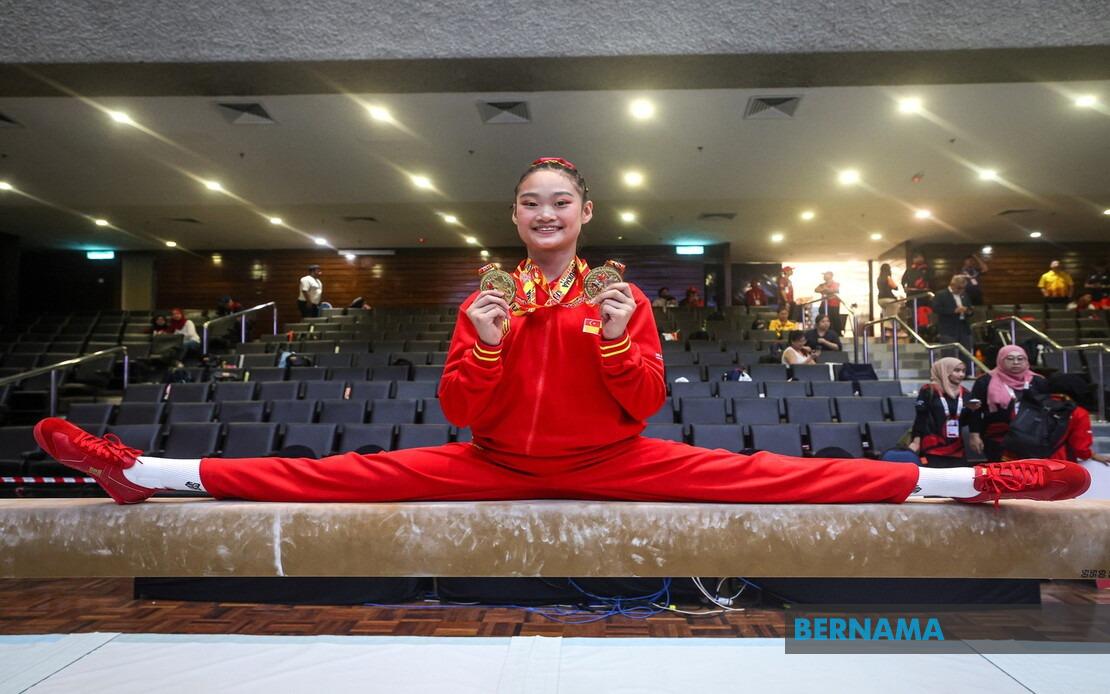
Selangor's rising gymnastics talent Cadence Teh Zi Qi delivered a commanding performance at the Malaysia Games (SUKMA) 2026 artistic gymnastics finals on Wednesday, capturing two gold medals at Dewan Canselor Tun Abdul Razak on the Universiti Kebangsaan Malaysia campus in Bangi. The 17-year-old successfully retained her women's individual all-around crown whilst propelling her home state to victory in the team event, cementing Selangor's position as the nation's gymnastics powerhouse at this edition of the Games.
Teh's winning aggregate of 48.550 points demonstrated her consistent excellence across all four apparatus. Her performance breakdown revealed a gymnast firing on multiple fronts: she posted 12.050 on vault, 11.400 on uneven bars, 13.350 on balance beam, and 11.750 on floor exercise. The balance beam score of 13.350 underscored her technical mastery on the apparatus most often associated with dramatic falls, whilst her vault and floor scores showed no significant weakness in any discipline. This balanced excellence, rather than dominance in a single event, characterizes the evolution of modern elite gymnastics where consistency across disciplines determines champions.
The competition for silver highlighted the competitive depth at SUKMA 2026. Sarawak's Aurin Zulkarnain claimed the runner-up position with 44.500 points, finishing nearly 4 points adrift of Teh's total. The bronze medal was shared between Federal Territories' Annabelle Ho Syin Yee and Penang's Amanda Ching Lee Wern, both of whom accumulated 42.250 points. This distribution of medals across multiple states reflects the geographic spread of gymnastics talent development programmes across Malaysia, though Selangor's commanding margin suggests superior training infrastructure and investment in the sport.
Teh's contribution to Selangor's team gold was part of a broader collective triumph. Alongside Teh, the victorious squad included Nicole Wong Ziyi, Airisha Zuraidi, Wong Zi Qi, Leong Yee Shean, and Haifa Izzazi Mohd Faizul, combining to accumulate 169.300 points. Federal Territories finished second with 166.300 points, whilst Johor secured bronze with 157.000 points. The 3-point margin separating Selangor from their nearest challengers indicates that whilst Teh is undoubtedly the standout performer, the depth of Selangor's roster provides the state with a significant advantage in team competitions where aggregate scoring determines outcomes.
Despite her eventual success, Teh's journey through the all-around competition was not without complications. The gymnast revealed that her opening apparatus, the uneven bars, proved problematic as nerves and body awareness issues led to a fall that jeopardized her overall position. This vulnerability on bars, historically one of the most technically demanding women's apparatus, highlighted the psychological dimension of elite gymnastics where mental composure separates champions from competitors. The fall could easily have derailed a younger athlete's confidence, yet Teh's recovery demonstrated the mental resilience required for success at the highest levels.
What distinguished Teh's response was her ability to compartmentalize the setback and elevate her performance on subsequent apparatus. Her balance beam routine earned 13.350 points, effectively neutralizing the damage inflicted by the bars mishap and establishing dominance in a discipline where precision and nerve are paramount. The transition from a failure to a career-standard performance within minutes of each other exemplifies the competitive psychology that separates national champions from their peers.
When reflecting on her performance, Teh provided insights into her competitive strategy and training philosophy. She acknowledged that decreasing the difficulty of her vault routine to a simpler Tsukahara pike represented a pragmatic choice rather than a technical limitation, suggesting that risk management formed part of her tactical approach to the all-around competition. The floor exercise, her final apparatus, proceeded without incident and scored 11.750, maintaining momentum toward her inevitable victory.
What garnered particular attention was Teh's decision to elevate the difficulty of her balance beam routine to the standard she intends to deploy at the 2026 Asian Games. This strategic choice transforms SUKMA into a proving ground for international competition preparation rather than merely a domestic showcase. By testing elevated difficulty ratings at the Games, Teh gains competitive experience with routines that will define her performance at continental and potentially Olympic levels. This training methodology reflects sophisticated long-term planning within Malaysia's gymnastics development framework.
Teh identified two critical areas for further improvement as she progresses toward major international competitions. Managing nervous tension remained a concern despite her overall success, with the uneven bars mishap directly attributable to anxiety and physical disconnect. Similarly, maintaining focus across the four-apparatus gauntlet of all-around competition represents an ongoing challenge requiring mental training alongside physical preparation. These self-identified weaknesses suggest a gymnast engaged in genuine critical analysis rather than basking in immediate achievement, a mindset conducive to sustained improvement.
Looking forward, Teh's schedule at SUKMA 2026 remains demanding. She is entered in three apparatus finals scheduled for Thursday and Friday, specifically the uneven bars, balance beam, and floor exercise events. These individual apparatus championships allow specialists to showcase discipline-specific mastery and provide additional medal opportunities for both Teh and her rivals. Given her performance in the all-around, particularly her 13.350 balance beam score, the beam apparatus final appears particularly promising for another gold medal.
The performance also carries implications for Malaysia's artistic gymnastics trajectory heading toward the 2026 Asian Games in Thailand. Teh's progression and the depth demonstrated by Selangor's team suggest that Malaysian gymnastics is developing pipeline talent at multiple levels. The state's success in team events particularly indicates that investment in sports science, coaching infrastructure, and facility development is translating into measurable competitive advantage. For Southeast Asian gymnastics, where Thailand, Vietnam, and the Philippines have historically dominated regional competitions, Teh's emergence as a world-class all-around gymnast signals that Malaysia is establishing itself as a regional force in the discipline.

