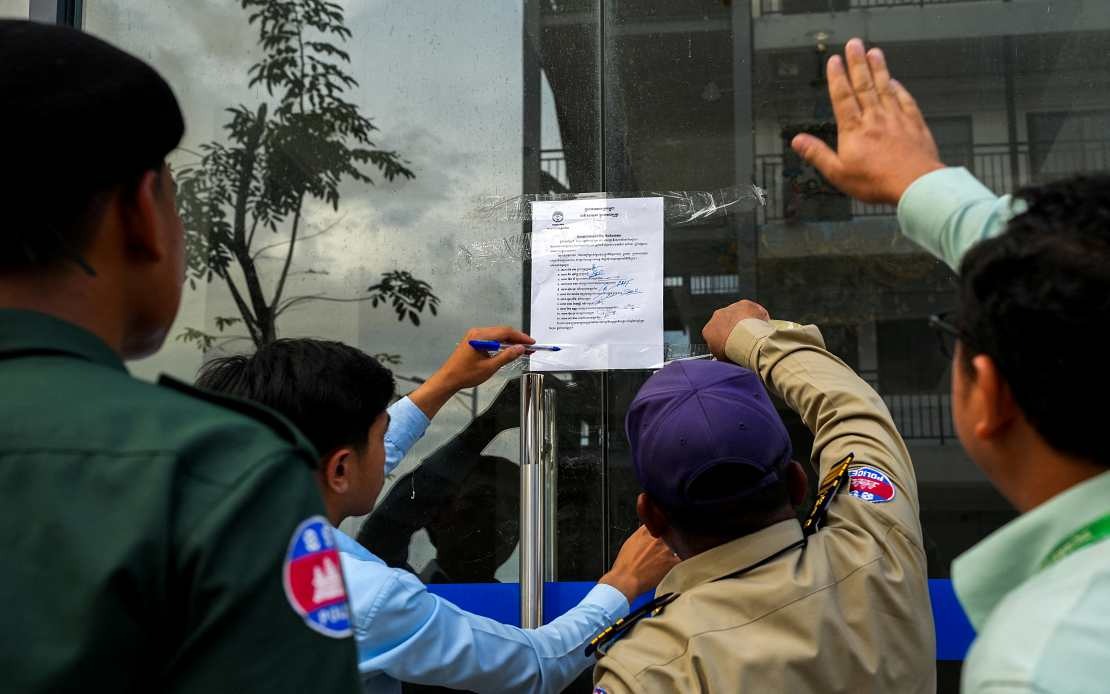
Cambodia has taken aggressive action against transnational cybercriminal networks, removing over 16,000 foreign nationals suspected of orchestrating online fraud schemes during the opening half of 2026. The mass deportations, which form part of a broader enforcement campaign that saw more than 45,000 foreigners expelled overall in the same period, signal a dramatic intensification of Cambodia's response to a crisis that has tarnished its reputation throughout Southeast Asia and beyond. Police Lieutenant General Sok Veasna, the General Department of Immigration's director general, outlined the scale of these operations during a mid-year review meeting, underscoring the sustained momentum behind the government's crackdown initiative that commenced in January.
The Cambodian authorities have implemented a permanent exclusion policy for all individuals deported in connection with cyber-scam activities, effectively barring them from legal re-entry to the country. This measure reflects the seriousness with which the kingdom is treating the problem and represents a significant hardening of immigration enforcement against suspected organised fraud operatives. The breadth of these expulsions demonstrates the sheer magnitude of the foreign criminal presence that had become embedded within Cambodia's borders, a phenomenon that security officials acknowledge had reached crisis proportions before the escalated response began earlier this year.
Cambodia's legislative response to the cyber-scam epidemic represents another pillar of the nation's comprehensive counter-strategy. In April, parliament enacted the Law on Combating Online Scams, a statute designed to impose severe criminal sanctions against the architects and coordinators of fraudulent schemes. The legislation targets the hierarchical structure of organised cyber-crime operations, particularly focusing penalties on those occupying leadership positions within these networks. This legal framework reflects international best practices in cybercrime prosecution and signals Cambodia's intention to move beyond tactical deportations toward dismantling the criminal ecosystems themselves.
Yet according to Thong Mengdavid, a senior analyst at the China-ASEAN Studies Centre based at Cambodia University of Technology and Science, the deportation campaign—while undeniably necessary and substantive—addresses only the surface manifestations of a far more complex problem. His assessment, delivered to international media on Wednesday, emphasises that the expulsion of rank-and-file operatives, however numerous, cannot by itself resolve the structural vulnerabilities that allowed these networks to flourish in the first place. The analyst's critique introduces a sobering note of realism into what might otherwise be celebrated as an unqualified policy success.
The deeper challenge that Mengdavid identifies centres on the protection mechanisms that permit cyber-scam operations to persist and expand within Cambodia's territory. He specifically identifies the need to target the senior leadership figures—the kingpins and strategic architects—who orchestrate these criminal enterprises from positions of relative insulation. Equally significant is his emphasis on dismantling what he characterises as local protection networks, a euphemistic but clear reference to the corruption and complicity within Cambodian institutions that facilitate these operations. Without addressing these systemic enablers, the analyst contends, Cambodia will merely cycle through repeated waves of tactical enforcement without achieving genuine strategic victory.
The human trafficking dimensions of Cambodia's cyber-scam ecosystem further complicate the picture. Many foreign nationals now being deported were themselves victims of labour trafficking or debt bondage, lured to Cambodia under false pretences and compelled to participate in fraud schemes under coercive conditions. Mengdavid's reference to addressing human trafficking alongside cyber-crime reflects the interconnected nature of these phenomena. Transnational criminal syndicates have systematised the recruitment and exploitation of vulnerable foreign nationals, transforming them into operational assets within larger fraud networks. Breaking this cycle requires simultaneous intervention across multiple enforcement and victim protection domains.
For Malaysia and other Southeast Asian nations, Cambodia's struggle against cyber-scam networks carries direct relevance. Malaysian citizens and enterprises have been frequent targets of fraud schemes coordinated from Cambodian territory, with perpetrators exploiting the kingdom's historical reputation as a cyber-crime haven. The scale of operations now being dismantled—involving tens of thousands of foreign nationals—suggests the infrastructure supporting these attacks was considerably more developed than public understanding had previously indicated. As Cambodia intensifies its enforcement response, Malaysian authorities may encounter opportunities for enhanced intelligence sharing and coordinated regional operations against transnational criminal groups.
The unprecedented nature of Cambodia's current crackdown reflects both the severity of the crisis and the political will to address it at the highest levels. Government communications emphasise the reputational imperative, acknowledging that Cambodia's international standing has suffered acute damage from associations with cyber-scam networks. This recognition has driven policy acceleration beyond what incremental reform might have achieved. The simultaneity of legislative action, heightened immigration enforcement, and stated commitments to target corruption suggests a genuinely comprehensive approach rather than cosmetic gestures designed merely to placate international criticism.
Implementation challenges remain formidable, however. The police and immigration apparatus must balance enforcement intensity against the practical capacity to process, investigate, and deport such massive volumes of suspects. Corruption risks multiply as resources concentrate in specific enforcement agencies, potentially creating opportunities for selective prosecution or protection payments. International cooperation will prove essential to prevent deported scammers from simply relocating to adjacent jurisdictions and reconstituting their operations in Thailand, Laos, or Myanmar. The sustainability of Cambodia's enforcement effort depends heavily on whether the government can maintain political commitment over the extended timeframe required to fully dismantle entrenched criminal networks.
The trajectory of Cambodia's cyber-scam epidemic and the nation's response carry implications extending far beyond Phnom Penh. Southeast Asia's position as a crucial node in transnational crime networks reflects broader conditions—insufficient cybersecurity infrastructure, regulatory gaps, and corruption vulnerabilities—that affect multiple nations throughout the region. Cambodia's scale of action, though representing a significant regional enforcement undertaking, remains incomplete without simultaneous action against the foreign criminal syndicates that recruit, finance, and coordinate these operations from beyond the kingdom's borders. The coming months will test whether Cambodia's intensified domestic enforcement can sustainably interrupt the flow of new recruits into these networks and whether the arrest of middle-tier operatives will eventually translate into pressure on the senior leadership figures whose removal represents the true measure of campaign success.

