Cambodia is fundamentally reshaping its approach to the longstanding border dispute with Thailand by pivoting from bilateral accusations to third-party verification. Minister of Information Neth Pheaktra's recent intervention signals a strategic shift toward building an international record of conditions along the contested frontier, moving beyond the traditional tit-for-tat exchanges between Bangkok and Phnom Penh. This development carries significant implications for how regional powers manage territorial disputes and the role international observers play in validating competing claims.
The disagreement erupted publicly when Air Chief Marshal Prapas Sornchaidee, who directs Thailand's Joint Information Center, dismissed Cambodian allegations that Thai forces are systematically encroaching on Cambodian territory through infrastructure development and military construction. Bangkok's statement emphasized its commitment to protecting troops and civilians rather than territorial acquisition, framing security measures as defensive rather than expansionist. Thailand also stressed that proper boundary determination should depend on legal documents, historical maps, and the joint boundary commission rather than military positioning or physical occupation.
Pheaktra's response revealed how Cambodia intends to navigate these denials: by establishing an undisputable factual record through independent witnesses. The minister emphasized that shipping containers, razor wire installations, and other barriers now visible at contested locations cannot be dismissed as mere Cambodian interpretation when foreign diplomats, Asean observers, and UN officials have personally inspected these sites. This approach effectively neutralizes Thailand's ability to simply reject Cambodian claims through counter-statements, as the physical evidence exists independently of bilateral rhetoric.
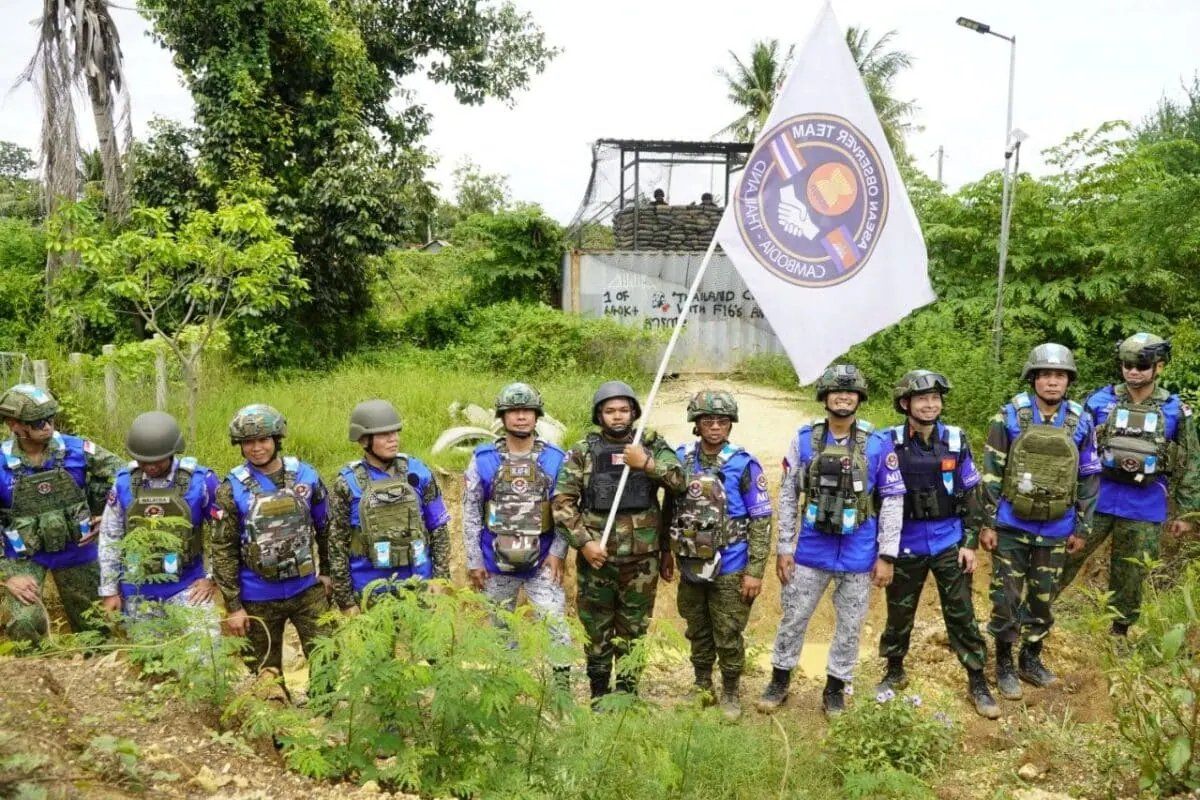
The Asean Observer Team in Cambodia recently conducted inspections at three separate locations in Banteay Meanchey province, documenting conditions that Cambodia argues demonstrate unlawful Thai occupation. At Boeung Trakuon in Kouk Romiet commune, the team verified 44 containers positioned across 14 different locations, with Cambodia reporting that nearly 8,000 residents from approximately 1,900 families remain prevented from returning home. Similar inspections at Chouk Chey and Prey Chan villages revealed an additional 72 containers spread across 10 locations. Collectively, these three areas contain 116 containers at 24 separate sites, with Cambodia claiming more than 13,000 people, including over 3,400 children, cannot access their homes due to Thai-controlled barriers.
The significance of independent observation cannot be overstated in territorial disputes where both parties maintain conflicting narratives about ownership and control. By securing Asean verification of physical conditions—rather than relying solely on Cambodian documentation—Pheaktra effectively transfers evidentiary weight from bilateral claims to multilateral observation. The Philippine-led Asean team's presence itself becomes part of the record, suggesting that conditions on the ground are sufficiently concerning to warrant sustained regional monitoring rather than dismissal as routine security measures.
Cambodia has also enlisted UN scrutiny through Tom Andrews, the Special Rapporteur on human rights in Cambodia, who visited the region during a July mission. Andrews subsequently reported that approximately 650,000 Cambodians were displaced during the conflict, with more than 20,000 remaining unable to return to homes they identify as being in Thai-controlled areas. His findings carry particular weight because his mandate focuses on humanitarian access and human rights rather than territorial claims, potentially insulating his observations from accusations of bias toward either side. Andrews explicitly called for the safe return of these populations to areas he visited, creating a human rights dimension to what Bangkok frames as a purely territorial or security issue.
However, Cambodia must navigate a crucial distinction that its minister acknowledged: independent observation does not automatically constitute a determination of sovereignty. The Asean Observer Team's role centers on verifying ceasefire conditions rather than adjudicating territorial ownership. Similarly, Andrews' findings address humanitarian concerns within his mandate rather than settling boundary disputes. These observations create valuable documentation of the humanitarian and physical situation but do not bypass the established legal mechanisms through which the boundary should be determined, including the 2003 Terms of Reference and the Joint Boundary Commission process.
Cambodia's legal position rests on specific historical foundations: the Franco-Siamese treaties and conventions, historical maps, boundary documents, and the 2000 Cambodia-Thailand border Memorandum of Understanding. Pheaktra articulated Cambodia's stance with pointed clarity, arguing that containers, barbed wire, trenches, and flags cannot substitute for legitimate legal title to territory. This framing challenges Thailand's apparent strategy of establishing de facto control through physical infrastructure, suggesting that Cambodia recognizes occupation alone, without legal backing, cannot determine boundaries in the modern international system. It is a significant assertion given the regional precedent of border disputes being resolved through combinations of military control and negotiated settlement.
Thailand has indicated it will not abandon security measures simply because Cambodia objects to their territorial implications. Prapas maintained that neither country can unilaterally declare sovereignty and that Thailand will continue protecting what it considers its territory and defending its personnel. This stance suggests Thailand believes its security justifications supersede Cambodia's territorial claims, at least pending formal boundary commission determinations. The fundamental disconnect remains: Thailand argues it is defending its sovereign territory, while Cambodia insists Thailand is using security justifications to occupy areas Cambodia claims as its own.
Cambodia has also connected the territorial dispute to humanitarian obligations under the December 27 ceasefire agreement, which explicitly provides for affected civilians to return safely to their homes without obstruction. Thousands of Cambodians prevented from returning behind container barriers represent, in Pheaktra's interpretation, evidence that the post-conflict resolution remains incomplete. By linking territorial control to humanitarian access, Cambodia frames the dispute not merely as a technical boundary question but as a breach of ceasefire commitments requiring immediate resolution. This humanitarian angle potentially appeals to regional and international bodies concerned with civilian welfare beyond abstract territorial questions.
The dispute now exists across multiple registers: territorial sovereignty, humanitarian access, security justifications, and international credibility. Cambodia's strategy of marshaling third-party witnesses addresses a real challenge in border disputes: the tendency for each side to dismiss the other's documentation as biased or incomplete. Independent observation creates an evidentiary foundation that neither Bangkok nor Phnom Penh can easily dismiss, though it simultaneously reveals the limits of observation as a tool for resolving fundamentally political disputes over territory. For Southeast Asia more broadly, this case illustrates both the utility and limitations of regional mechanisms in addressing long-standing territorial tensions.
The longer-term implications for Cambodia-Thailand relations depend on whether independent verification can pressure formal boundary commission proceedings or whether Thailand will continue asserting control while resisting external pressure. Cambodia's approach of building an international record may prove effective in changing regional and international perception of the dispute, but it cannot force Thailand to accept boundary determinations it believes contradict its legitimate security interests. The presence of containers, trenches, and barriers will persist as physical reminders of contested control, complicating any future resolution unless both parties agree on the legal mechanisms and historical evidence that should govern the final boundary determination.

