Cambodia is attempting to steer its economy toward advanced manufacturing and technology-driven sectors, moving decisively beyond its historical dependence on the garment and textile industries. The push gained momentum recently when Deputy Prime Minister Sun Chanthol, serving as first vice-chairman of the Council for the Development of Cambodia (CDC), led a high-level delegation to South Korea for a coordinated investment promotion campaign. The visit included multiple company visits and the 2026 Incheon-Cambodia Investment Roadshow held on June 16, underscoring the government's determination to reposition the nation as an attractive destination for capital-intensive, skill-intensive manufacturing that generates stronger economic returns than labour-intensive production.
During his roadshow address, Chanthol made clear that Cambodia's government intends to facilitate Korean investor participation across multiple sectors, emphasising the availability of incentive packages and investment protection mechanisms under the Kingdom's revised investment law. The messaging strategy carefully combined diplomatic reassurance with concrete examples of existing Korean presence in Cambodia, demonstrating that the country already hosts sophisticated manufacturing operations. By presenting investment opportunities to Korean firms already familiar with the Cambodian market, officials aimed to lower perceived barriers to expansion and deeper integration into the economy.
The automotive sector emerged as a centrepiece of Cambodia's pitch. Daejoo KC Group, a major South Korean conglomerate with interests spanning metallurgy, chemicals, logistics, construction, automotive components and energy, received particular attention during the delegation's visit. The company operates in Cambodia through two subsidiaries, including Camko Motor, which assembles Hyundai vehicles for domestic consumption and manufactures automotive wire harnesses for export—generating approximately 500 jobs. Its partner entity, Camko Infracore, handles vehicle distribution, maintenance services and spare parts supply. By showcasing an established Korean manufacturer already embedded in Cambodia's automotive ecosystem, Chanthol reinforced the argument that the Kingdom possesses the infrastructure, workforce and institutional knowledge to support expanded production.
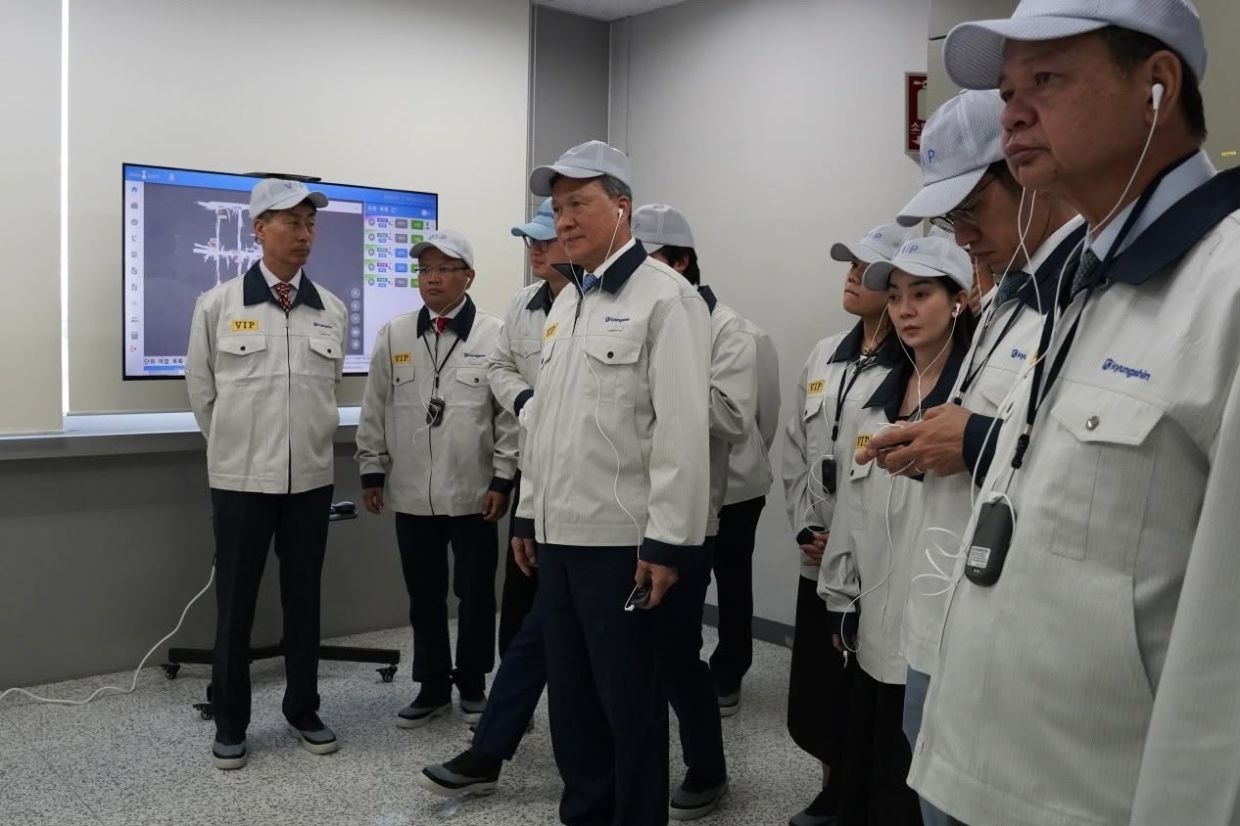
The visit to Kyungshin Co., Ltd. demonstrated Cambodia's strategic interest in capturing higher-value segments of the automotive supply chain, particularly as global manufacturing pivots toward electrification. Kyungshin, founded in 1974, specialises in automotive electronic components, wire harnesses, connectors and electrical systems for electric vehicles, alongside advanced EV technology development. The company has maintained operations in Cambodia since 2012 through a wire harness facility in Kandal province, supported by approximately US$20 million in capital investment and employing 1,467 workers. This long-term presence provided tangible evidence that Cambodia can sustain complex manufacturing requiring technical precision and quality control standards demanded by global automotive manufacturers.
Cambodia's pivot toward electric vehicle systems and automotive electronics carries particular significance for regional supply chain dynamics. As major automotive manufacturers worldwide accelerate the transition from internal combustion engines to electric powertrains, Southeast Asian nations compete intensely for investment in EV-related component production. By positioning itself as a viable alternative to Thailand, Vietnam and Indonesia for Korean automotive suppliers, Cambodia seeks to capture growth in a sector offering superior productivity, technology transfer and export potential compared to traditional garment manufacturing. The government's targeting of EV specialists suggests recognition that automotive electronics represent the most dynamic and profitable segment of vehicle production.
Beyond manufacturing, the delegation's visit to Incheon Baek Hospital revealed Cambodia's intention to attract foreign investment in healthcare infrastructure and digital medical systems. Chanthol described healthcare and international-standard hospitals as key government priorities, signalling interest in Korean expertise regarding advanced medical technology, digital healthcare management systems and professional training programmes. This dimension of the mission reflects broader aspirations to develop higher-value service sectors that complement manufacturing growth. Healthcare technology represents an area where capital investment, knowledge transfer and ongoing technical cooperation can occur simultaneously, creating sustained engagement between Korean and Cambodian institutions.
The structured composition of Cambodia's delegation underscored the government's commitment to aligning diplomatic, commercial and regulatory resources. Participation included the Cambodian ambassador to South Korea, CDC officials, representatives from the Ministry of Commerce, the Korean Chamber of Commerce in Cambodia, the Cambodian Oknha Association and the Cambodia Chamber of Commerce. This coordinated approach signalled that investment promotion constituted a priority across government agencies and the private sector simultaneously, reducing bureaucratic friction and demonstrating institutional readiness to support Korean investors. The breadth of participation also conveyed that Cambodia viewed the Korea relationship as strategically important across multiple policy domains.
Cambodia's economic diversification imperative derives from the limitations inherent in garment-dependent manufacturing models. For decades, the textile, apparel and footwear sectors generated substantial export revenues and employment, establishing Cambodia as a global supplier. However, these industries offer limited scope for productivity improvements, skill development and value chain integration compared to automotive components, electronics and healthcare technology. Wages in the garment sector remain constrained by competitive pressures from countries with lower labour costs, while automation threatens the employment base without creating skilled manufacturing jobs. Policymakers increasingly recognise that sustainability requires transitioning toward sectors where Cambodia can compete on factors beyond labour cost—such as supply chain proximity, technical capabilities and institutional stability.
The targeting of South Korean investors specifically reflects Cambodia's assessment that Korean firms possess both the capital resources and technical expertise needed for the envisioned economic transition. South Korea has accumulated extensive experience establishing integrated manufacturing networks throughout Southeast Asia, particularly in automotive and electronics sectors. Korean companies demonstrate willingness to invest in intermediate manufacturing—assembling or producing components for export rather than serving only domestic markets—an approach that generates foreign exchange and integrates local suppliers into global value chains. Additionally, Korean investors typically transfer operational knowledge to local workforces and suppliers, creating multiplicative skill development effects beyond the directly employed workforce.
The roadshow's emphasis on Cambodia's investment law reforms and macroeconomic stability represented an attempt to address historical investor concerns about regulatory certainty and political risk. By highlighting incentive packages, fiscal benefits and investment protection mechanisms, the government signalled that institutional frameworks have matured beyond the weaknesses that previously deterred capital-intensive investment. This messaging became particularly important given that automotive components and medical technology require multi-year investment horizons, substantial fixed capital commitments, and confidence in contractual enforcement. Cambodia's willingness to compete on institutional grounds rather than labour cost alone suggested confidence that governance improvements have achieved levels necessary to support advanced manufacturing.
For Malaysian and Southeast Asian regional dynamics, Cambodia's investment pivot carries implications for industrial relocation patterns and competitive positioning. Malaysia has historically dominated higher-value automotive component manufacturing in Southeast Asia, hosting regional operations for major global suppliers. Cambodia's emergence as a competitor for Korean automotive investment could eventually alter investment distribution within ASEAN, particularly if Cambodia successfully establishes clusters of related suppliers and institutions. However, Cambodia faces significant gaps in technical workforce development, supply chain sophistication and infrastructure capacity compared to Malaysia or Thailand. Success would require sustained commitment to vocational training, regulatory consistency and infrastructure investment over multiple years.
The broader strategic significance of Cambodia's Korea engagement reflects recognition that Southeast Asian economies cannot rely indefinitely on comparative advantages in labour-intensive manufacturing. China's technological advancement and wage increases have compressed the space for low-cost production, while automation continuously reduces labour requirements across manufacturing sectors. Nations that successfully transition toward technology-intensive, capital-intensive sectors secure superior long-term growth trajectories and superior income growth. Cambodia's deliberate cultivation of Korean investment represents a calculated attempt to accelerate this transition, leveraging South Korea's regional manufacturing presence and institutional relationships to establish Cambodia as an integrated node within East Asian supply networks. Whether the strategy yields sustained results will depend on Cambodia's ability to develop human capital, institutional capacity and infrastructure at pace with investor expectations.