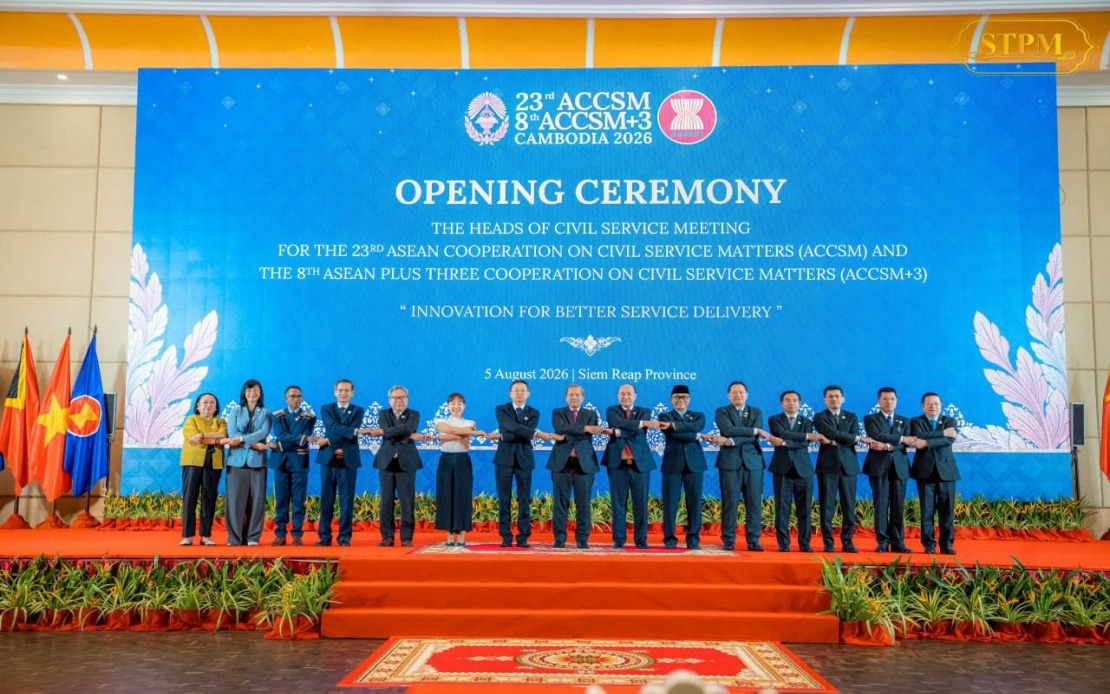
Cambodian Prime Minister Hun Manet has called upon ASEAN member states to leverage artificial intelligence and digital innovation as tools for transforming public services, ultimately improving citizens' quality of life whilst simultaneously reducing economic disparities across Southeast Asia. Speaking at the 23rd ASEAN Cooperation on Civil Service Matters in Siem Reap this week, Hun Manet framed technological modernisation not as an end in itself, but as a means to address genuine citizen needs and strengthen institutional foundations throughout the bloc.
The Cambodian leader's intervention arrives as governments throughout Southeast Asia increasingly embrace digital technologies and AI systems to streamline bureaucratic processes, enhance administrative efficiency, and modernise how they deliver services to constituents. Yet Hun Manet distinguished between superficial tech adoption and meaningful transformation, advocating for an approach that balances innovation with practical realities on the ground.
Central to his argument was the recognition that ASEAN encompasses nations at vastly different stages of economic and technological development. Rather than imposing uniform timelines or standards, Hun Manet stressed that each country must adopt emerging technologies at a sustainable pace appropriate to its existing capacity, infrastructure, and human resources. This nuanced position acknowledges that rapid, ill-considered AI implementation could widen rather than narrow gaps between wealthier and less-developed ASEAN economies.
Hun Manet emphasised that successful innovation must be built upon solid institutional foundations and adequately trained workforces. Without sufficient human capital and organisational readiness, the argument goes, new technologies risk becoming ineffective or even counterproductive. This perspective carries particular weight for Southeast Asian nations still building civil service capacities, where technological solutions must complement rather than replace institutional development.
The prime minister expanded his vision beyond individual country modernisation to argue for collective regional resilience. He contended that ASEAN faces interconnected challenges—climate-related disasters, uneven economic development, and persistent poverty—that transcend national borders and demand collaborative responses. Innovation frameworks that facilitate knowledge-sharing and mutual learning across member states, he suggested, represent a more effective approach than isolated national initiatives.
Hun Manet positioned the ASEAN Cooperation on Civil Service Matters as a critical platform for achieving these collaborative objectives. By harmonising policies, exchanging best practices, and building shared institutional capacity, ASEAN governments can address common challenges more effectively whilst respecting the diverse circumstances of individual nations. This framing acknowledges that regional challenges require regional solutions, reinforcing ASEAN's foundational principle of collective action.
For Malaysia and other middle-income ASEAN economies, Hun Manet's remarks carry particular relevance. These nations have invested significantly in digital infrastructure and civil service modernisation, positioning them as potential knowledge leaders within the bloc. Yet his emphasis on inclusive approaches suggests that leading countries should tailor capacity-building support to less-advanced neighbours' actual capabilities rather than imposing standards calibrated for wealthier economies.
The timing of these remarks reflects growing momentum within ASEAN for digital transformation, yet also mounting recognition that technology adoption requires careful planning and social considerations. Recent experiences across the region demonstrate that poorly executed digital initiatives can generate public frustration, reduce service accessibility for disadvantaged populations, and strain already-stretched civil service resources.
Hun Manet's formulation of innovation as fundamentally people-centred rather than technology-centred offers a philosophical counterweight to narratives emphasising AI as an autonomous solution to governance challenges. By insisting that technological implementation must serve explicitly identified citizen needs, he grounds digital transformation in tangible outcomes rather than abstract technological progress.
The remarks also underscore ASEAN's persistent concern with maintaining internal cohesion whilst navigating globalised technological change. By emphasising mutual learning and collaborative adaptation, Hun Manet positioned ASEAN as a community capable of domesticating global AI trends rather than passively accepting foreign technological frameworks.
Looking forward, Hun Manet's vision suggests that ASEAN's competitive advantage may lie not in rushing AI adoption, but in developing distinctive approaches that combine technological sophistication with people-centred governance. This positioning could differentiate ASEAN's development model from approaches emphasising rapid digitisation regardless of social consequences.
The 23rd ASEAN Cooperation on Civil Service Matters, held in Siem Reap from August 3-5, brought together civil service representatives from ASEAN plus China, Japan, and South Korea. This broader grouping enabled ASEAN nations to contextualise their innovation strategies within regional and international development frameworks, strengthening dialogue with major trading and investment partners.
Hun Manet's intervention will likely shape ASEAN's evolving digital governance agenda, encouraging member states to approach AI adoption as requiring institutional investment, human resource development, and coordinated regional learning rather than unilateral technology procurement.

