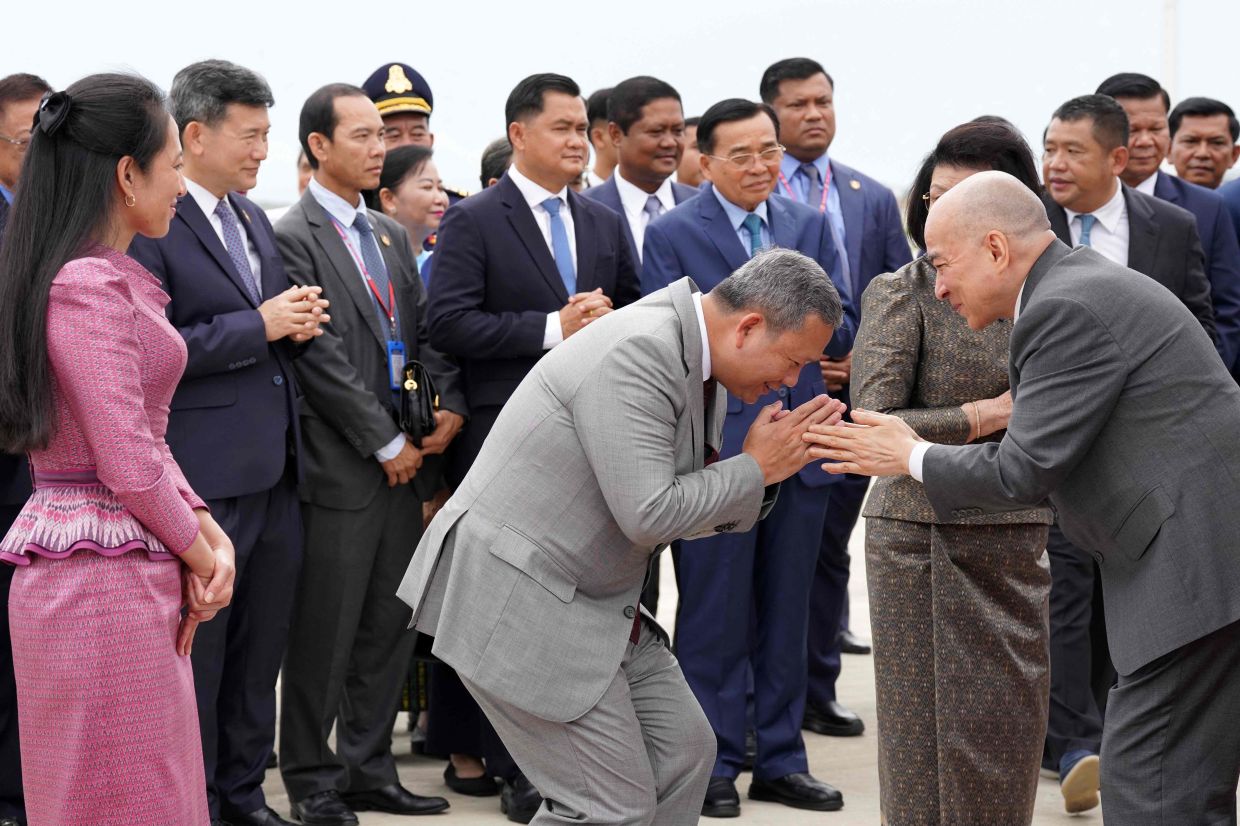
Cambodia's King Norodom Sihamoni has returned home to Phnom Penh after undergoing treatment for prostate cancer in China, marking a significant moment for the Southeast Asian nation's political establishment. The 73-year-old monarch touched down in the capital on Friday afternoon, where he was received by high-ranking government officials including former premier Hun Sen and his son Hun Manet, who currently serves as prime minister. State-run broadcaster TVK covered the arrival, with Hun Sen confirming on his Facebook page that the king had "arrived in the country safely."
Sihamoni's absence from Cambodia extended over several months following his initial departure to Beijing earlier in the year for health assessments. The palace publicly disclosed his prostate cancer diagnosis in April, and he subsequently remained in China to receive ongoing medical intervention. According to official statements from the Royal Palace in Phnom Penh, the king underwent "successful" surgery performed by Chinese medical specialists. This arrangement reflects the long-standing medical relationship between Cambodia's monarchy and Chinese healthcare institutions, a pattern that has characterised the nation's leadership for decades.
The treatment regimen lasted more than three months, during which Sihamoni received continuous care from Beijing-based physicians. A palace statement released on Tuesday, shortly before his departure, indicated that his condition had shown considerable improvement following the extended course of therapy. The timing of his return and the positive health assessments suggest that Cambodian officials felt confident enough in his recovery to facilitate his journey back to the kingdom, where significant ceremonial and constitutional duties await the reigning monarch.
Sihamoni's medical journey carries historical echoes within Cambodia's royal narrative. His father, King Norodom Sihanouk, similarly journeyed to Beijing for cancer treatment before abdicating the throne in 2004. Sihanouk's decision to step down paved the way for Sihamoni's ascension to the monarchy, a transition that marked a significant chapter in Cambodia's post-conflict political history. The elder king passed away in 2012, having spent his final years in Beijing following his abdication. This family precedent demonstrates both the trust placed in Chinese medical expertise and the pragmatic approach Cambodia's royal house has adopted regarding healthcare decisions.
The current monarch represents a departure from typical regional monarchical profiles. Sihamoni maintained a relatively unconventional path before assuming the throne, spending the majority of his adult years outside Cambodia pursuing artistic endeavours and cultural interests. His linguistic capabilities—fluency in Khmer, French, Czech, and English—reflect his international upbringing and cosmopolitan background. This aspect of his biography distinguishes him from many of his regional counterparts and speaks to the diverse influences that have shaped modern Cambodia's leadership.
The king's medical situation also underscores broader patterns of Southeast Asian nations turning to China for advanced medical treatment. As China has expanded its healthcare capabilities and diplomatic influence throughout the region, several ASEAN leaders and their families have increasingly sought treatment in Beijing hospitals. This trend carries both practical and geopolitical dimensions, as medical partnerships often reinforce diplomatic ties and economic relationships between nations. Cambodia's reliance on Chinese medical facilities for its monarch represents one of the most tangible expressions of this deepening health-sector interdependence.
The visible presence of Hun Manet at the airport welcoming ceremony carries additional significance given Cambodia's recent political transitions. The younger Hun has consolidated authority as prime minister following his predecessor's political manoeuvring, and the public display of deference toward the returning monarch serves to reinforce the constitutional framework upon which his government operates. Such ceremonial moments, while appearing routine, function as important reaffirmations of institutional relationships within Cambodia's power structure.
For Malaysia and other Southeast Asian observers, Sihamoni's successful treatment and recovery offer reassurance regarding Cambodia's political continuity. The monarchy serves as a crucial stabilizing institution within Cambodian governance, and any extended absence or health uncertainty among senior royals can create anxieties about succession and institutional stability. The king's return, coupled with positive health assessments, resolves these latent concerns and allows Cambodia's political and administrative apparatus to proceed without the complications that extended royal indisposition might otherwise create.
The incident also highlights the medical tourism dimension of contemporary Asia, where leading hospitals in major Chinese cities have become preferred destinations for treating high-profile patients from across the region. These facilities offer cutting-edge technology, experienced specialists, and often provide a level of privacy and institutional discretion that appeals to heads of state and their families. The quality of care available in Beijing appears to have warranted Sihamoni's confidence, as evidenced by his willingness to undertake an extended treatment course there rather than seeking alternatives elsewhere.

