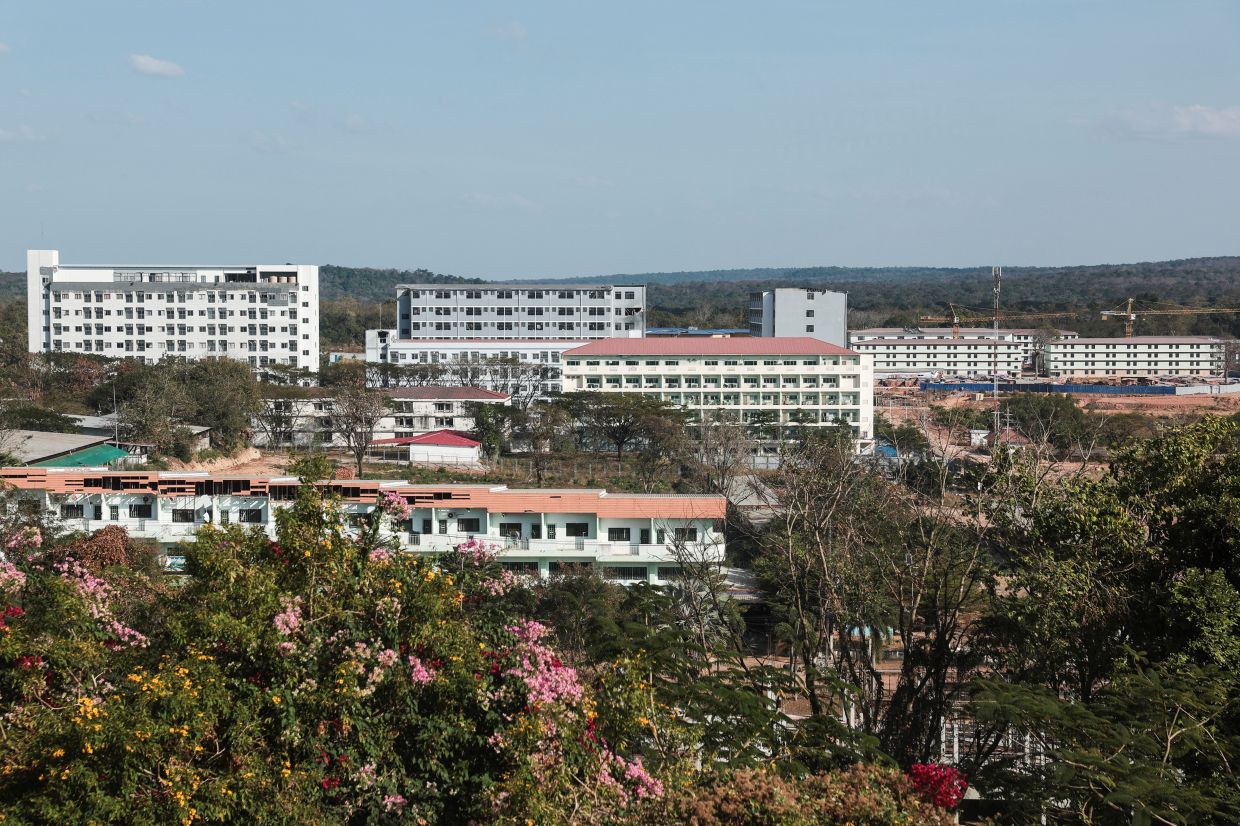
A sweeping investigation by Reuters has exposed the involvement of a major Cambodian business empire in providing facilities for widespread cyberfraud and human trafficking operations, raising uncomfortable questions about the intertwining of legitimate commerce and organised crime in Southeast Asia. The Lim Heng Group, which operates the Royal Hill casino straddling the Thai-Cambodian border near O'Smach, leased out multiple buildings within its compound to operators of what authorities describe as an industrial-scale scamming enterprise run primarily by Chinese criminal syndicates. A lease agreement dated March 2024 reveals the landlord charged US$200,000 monthly for three structures—a rate substantially above market value for the remote border location—despite the buildings being configured with fake police stations and bank offices designed to deceive victims globally.
The discovery marks the first detailed accounting of direct commercial relationships between a major Cambodian casino and the criminal infrastructure supporting transnational fraud networks. Reuters found no evidence that the Lim Heng Group itself participated directly in the scamming or human trafficking activities, yet the arrangement raises significant questions about corporate responsibility and regulatory oversight in Cambodia's casino sector. The property itself sits metres from the Thai frontier, with the fake institutional facades serving as backdrops for romance scams and police-impersonation fraud orchestrated against victims across multiple countries. The structural placement of these criminal operations within a legitimate hospitality complex, owned and operated by a politically connected businessman, illustrates the sophisticated integration of illicit activities within Cambodia's business landscape.
When Reuters sought clarification from both Royal Hill and the parent company, neither entity responded to phone calls, emails, or questions transmitted via registered post—despite confirmed delivery of the correspondence. This silence comes despite the operations at the site having become a matter of public record and international attention. Cambodian legal experts note that under existing law, property owners can face charges if evidence establishes they possessed knowledge of criminal use and permitted it to continue. The Cambodian Human Rights Action Coalition and attorney Piseth Duch, who specialises in business and human rights matters in Phnom Penh, have underscored this potential legal exposure. The regulatory framework thus places the onus on landlords to exercise due diligence regarding tenant activities, a standard that appears not to have been met.
Significantly, Lim Heng Group received formal notice of potential trafficking concerns at its property by September 2024, when it filed legal complaints against two Cambodian publishers whose journalists had reported on foreign nationals allegedly confined within the Royal Hill compound. Court summonses, both dated September 16, accused the outlets of incitement to discrimination but did not specify which elements of their reporting the company disputed. One publisher, Penn Nuon, confirmed the complaint's existence and acknowledged reporting on foreign detainees at the casino. Though he maintained the accuracy of his journalism, Nuon ultimately withdrew the article following legal advice in order to settle the dispute. The absence of transparency in the complaint mechanism—and the subsequent removal of public reporting—raises concerns about potential chilling effects on media freedom and accountability journalism in Cambodia.
The scope of criminal activity at the compound became visible to international security apparatus only through Thailand's military intervention. General Thatchai Pitaneelaboot of the Royal Thai Police, which is directing the investigation into the cyberfraud operations, confirmed that Chinese criminal organisations perpetrated scams at the Royal Hill site during briefings with visiting journalists. Thai security agency reports from 2024, reviewed by Reuters, established Lim Heng's ownership stake in the property and documented the scale of operations. The facility ultimately became a target during Thailand's brief December border conflict with Cambodia, with Bangkok claiming its forces were responding to Cambodian military occupation of casino buildings being used for drone and sniper operations. Thai forces subsequently occupied the site and invited international media to inspect evidence of the scamming infrastructure.
The Royal Hill case exemplifies a broader regional problem that has attracted international concern. Southeast Asia has become a primary manufacturing centre for transnational fraud, with primarily Chinese-led criminal syndicates operating from multiple border locations. These operations coerce trafficking victims—often migrants seeking economic opportunity—into perpetrating romance scams and impersonation fraud against targets worldwide, with Americans losing an estimated US$10 billion to such schemes in 2024 alone. Security analysts observe that casino ownership frequently provides criminal groups with convenient mechanisms for laundering illicit proceeds, as gambling facilities enable rapid capital movement and the integration of illicit funds into seemingly legitimate revenue streams. Jason Tower of the Global Initiative against Transnational Organized Crime emphasises this connection between gaming operations and financial crime facilitation.
Cambodia's particular vulnerability to this phenomenon reflects the concentration of casino ownership among politically connected businesspeople, according to Sophal Ear, a professor at Arizona State University who studies Cambodian governance. Lim Heng exemplifies this nexus between commercial power and political influence. Photographs document his presence at social gatherings alongside senior military commanders, he holds a royal title equivalent to ducal rank, and financial records show he donated US$20,000 to Cambodia's military within the past year. An Amnesty International investigation, drawing on gaming regulator records and witness accounts, identified at least a dozen scam centres operating under the direct control of Cambodian casino proprietors—figures Reuters has not independently verified but which suggest a systemic pattern rather than isolated incidents.
The Cambodian government's official response reveals a curious disconnect between public commitment and practical acknowledgment. Phnom Penh has pledged to eliminate scam centres and has taken significant enforcement steps, including extraditing casino owner and alleged trafficking kingpin Chen Zhi to China and enacting legislation specifically targeting scammers. Yet authorities have consistently mischaracterised Royal Hill, describing it variously as merely a hotel complex even as international broadcast media documented the fake police stations and banking facilities discovered within its grounds. Chhay Sinarith, a senior government minister responsible for combating online fraud, stated in response to Reuters inquiries that Cambodia remains committed to international cooperation on the matter and is investigating alleged operations in the Royal Hill vicinity. However, he suggested that Thai security forces should return custody of seized locations to facilitate Cambodian investigations—a statement that appears to deflect responsibility.
The physical evidence of the operation itself tells a stark story. Royal Hill presents itself as a faded neoclassical structure with gold-rimmed decorative spires positioned metres from the Thai border. Adjacent buildings, enclosed within a perimeter fence topped with razor wire, contained at least four structures utilised for criminal activity according to both Thai security officials and testimony from Pornpen Aimhun, a Thai woman who identified herself as a trafficked worker at the compound. Within these secured spaces, Reuters observed the lease agreement itself, located in an office that Thai military sources indicated had functioned as a command centre for scam operations. The rental contract stipulated a two-year lease duration with monthly payments of US$200,000—a figure wildly disproportionate to actual property values in a remote border town. A comparable mixed-use building in an upscale Phnom Penh neighbourhood advertised in May 2024 commanded merely US$25,000 monthly rent, suggesting the Royal Hill arrangement reflected not legitimate market dynamics but rather the premium associated with operational security and institutional tolerance.
The contract itself was signed by the tenant, identified only as a Chinese national, and by Seng Chanthy, listed as a Royal Hill employee at the time. Seng Chanthy declined requests for comment regarding the arrangement. Reuters withheld the tenant's name, citing inability to independently verify his identity or specific role in the scamming operations—a journalistic choice reflecting appropriate caution rather than definitive innocence. The structural arrangement outlined in the lease—multiple buildings, extended tenure, and extraordinarily high compensation—appears calculated to facilitate large-scale, sustained criminal operations rather than conventional hospitality services. For Malaysian observers, the case underscores the regional dimensions of transnational crime and the vulnerability of border communities to exploitation by organised syndicates leveraging casino infrastructure and political connections to operate with relative impunity. The implications extend beyond Cambodia to Singapore, Malaysia, and Thailand, all of which host or border similar operations.

