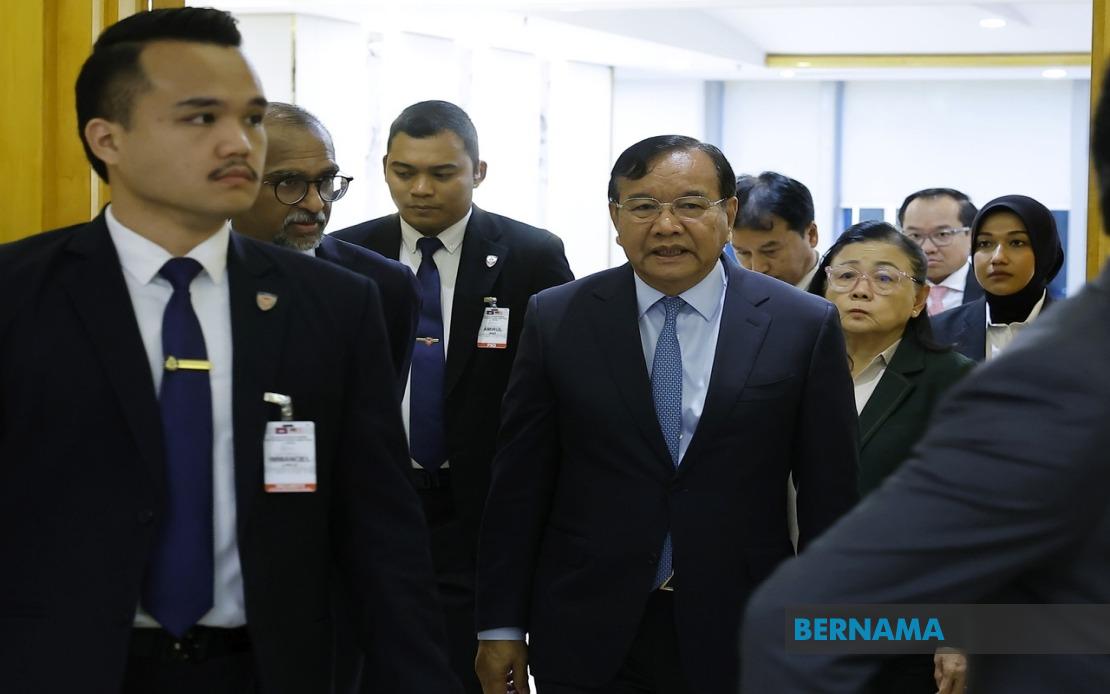
Cambodian Deputy Prime Minister and Foreign Minister Prak Sokhonn departed Malaysia on Sunday afternoon, bringing to a close a strategically significant two-day official visit that has reset important institutional mechanisms governing bilateral relations between the two Southeast Asian neighbours. Sokhonn and his delegation boarded a commercial flight from Kuala Lumpur International Airport Terminal 1 at 4.45 pm, bound for Phnom Penh, with Malaysian Government chief ceremony officer Datuk Rozainor Ramli attending the departure formalities.
The timing of Sokhonn's visit carries particular significance as both nations prepare for a milestone moment in their shared diplomatic history. By arriving on Monday, the Cambodian official began laying groundwork for celebrations marking the 70th anniversary of diplomatic relations between Malaysia and Cambodia scheduled for 2027, a timeline that underscores the enduring nature of ties forged across seven decades. This forward-looking dimension to the visit reflects a conscious effort by both governments to revitalise engagement at senior levels and demonstrate commitment to sustaining partnership into the coming years.
During his time in Malaysia, Sokhonn secured an audience with Prime Minister Datuk Seri Anwar Ibrahim at the Prime Minister's Office, where the two leaders engaged in substantive discussions about deepening strategic cooperation. Rather than limiting conversation to ceremonial courtesies, both sides identified concrete areas for expanded collaboration spanning the digital economy, artificial intelligence applications, the halal industry, food security initiatives, and human capital development. These sectors reflect the priorities facing both nations as they navigate rapid technological change and regional integration.
Perhaps the most substantial achievement of Sokhonn's visit was the co-chairing of the 3rd Malaysia-Cambodia Joint Commission for Bilateral Cooperation Meeting alongside Malaysian Foreign Minister Datuk Seri Mohamad Hasan. This reactivation of the institutional mechanism represents a watershed moment, as the commission had remained dormant for two decades, highlighting how bilateral mechanisms can atrophy without consistent high-level engagement. The resumption signals both capitals' determination to inject new vitality into their relationship through structured, regular dialogue at the ministerial level.
The economic dimensions of Malaysia-Cambodia relations reveal the substantial material foundation undergirding political ties. In 2025, bilateral trade between the two countries surged 27.4 per cent compared to the previous year, reaching RM5 billion, equivalent to approximately USD1.17 billion. This growth trajectory indicates strengthening commercial integration, with Malaysian exporters shipping goods valued at RM4.13 billion to Cambodia whilst importing RM880 million in Cambodian products. The asymmetry in trade flows reflects both countries' complementary economic structures and Malaysia's established position as a supplier of manufactured goods and services.
Malaysia's investment profile in Cambodia underscores the country's economic footprint across the border. As of 2024, Malaysian businesses had accumulated USD3.20 billion in cumulative direct investment across 162 registered projects throughout Cambodia, positioning Malaysia as the kingdom's third-largest foreign investor overall. This substantial capital presence creates mutually reinforcing economic interests, as Malaysian enterprises generate employment and technology transfer whilst Cambodia provides markets and manufacturing opportunities. The depth of Malaysian investment suggests confidence in Cambodia's business environment and growth prospects.
The resumption of the joint commission reflects broader regional trends toward institutional renewal within Southeast Asia. Following years of disruption and reduced diplomatic activity across multiple channels, major ASEAN members are prioritising the reactivation and expansion of formal cooperation frameworks. For Malaysia and Cambodia specifically, the renewal arrives at a moment when both nations face shared challenges around regional stability, economic competitiveness within ASEAN, and the management of external pressures from major powers. Regular, structured dialogue through the commission provides a venue for addressing emerging issues before they escalate into diplomatic friction.
The choice of sectors identified for expanded cooperation—particularly digital economy and artificial intelligence—reflects the strategic priorities of contemporary Southeast Asia. Both Malaysia and Cambodia seek to position themselves within global technology ecosystems rather than remaining passive consumers of foreign innovation. The emphasis on halal industry and food security, by contrast, acknowledges traditional strengths and vulnerabilities specific to the region, where Malaysia's halal certification expertise commands global recognition whilst food security remains a persistent concern across Southeast Asia. Human capital development addresses the fundamental reality that technological advancement cannot translate into sustainable growth without sufficient investment in education and skills.
For Malaysian readers, the implications of renewed Malaysia-Cambodia engagement extend beyond bilateral commerce and diplomacy. Cambodia's strategic location along major shipping routes and its role within regional supply chains mean that political stability and economic prosperity there directly affect Malaysian regional stability and trading patterns. The resumption of high-level dialogue mechanisms also signals that Malaysia remains committed to active engagement within its immediate neighbourhood, maintaining influence and presence as China and India expand their roles across Cambodia. Through robust bilateral cooperation, Malaysia reinforces its status as a central player in regional affairs rather than a peripheral actor.
The 2027 anniversary celebrations represent not merely a historical commemoration but an opportunity to institutionalise gains achieved during this renewed engagement period. By anchoring planning around that date, both governments create incentive structures for sustained cooperation over the coming two years, suggesting that Sokhonn's visit functions as the opening salvo in a broader initiative to deepen Malaysia-Cambodia ties across multiple dimensions. Whether the momentum established during this visit translates into concrete institutional innovations and expanded people-to-people exchange remains to be seen, but the resumption of the joint commission after twenty years represents a meaningful recommitment to bilateral partnership at the highest levels.

